


THE CONFERENCE ON CHRISTIANITY AND LITERATURE is an interdisciplinary society dedicated to exploring the relationships between Christianity and literature. Organized formally in 1956, CCL is dedicated to both scholarly excellence and collegial exchange and includes hundreds of members from a variety of academic institutions and religious traditions from the United States, Canada, and more than a dozen other countries.
NEWS

2023 BOOK OF THE YEAR AWARD
The Conference on Christianity & Literature is very pleased to announce that its 2023 Book-of-the-Year Award goes to The Eucharist, Poetics, & Secularization: From the Middle Ages to Milton, by Shaun Ross (Victoria College, U of Toronto).
We contend that this book performs two rare, exemplary tasks extremely well, tasks that the CCL Book-of-the-Year Award is designed to honor. It takes historical texts seriously, charitably, and graciously enough to refuse to reduce them to chapters in a triumphalist narrative that culminates in the present day of the reader. Relatedly, and even more importantly, it receives sophisticated religious texts as artefacts of sophisticated, hard-won religious belief worth hearing on those terms, not merely artefacts of sophistication from which the chaff of simplistic, outmoded belief must be sifted out.
Intervening in a crowded field of monographs on the Eucharist and early modern Protestant poetry, most of which situate Donne’s and Herbert’s poetry as liminal between a medieval Catholic poetics of real Divine presence and a modern poetics of real Poet presence, Ross complicates that field in two ways: by demonstrating that an inquiry into Eucharistic poetics in English began far earlier than Herbert, Donne, and the Reformation, and by exploring the various subtle modes and gradations of Eucharistic presence as theologians and poets alike described it, not a simple binary between real Presence and not-Presence. The diverse enquiries into Presence the book tracks – named in chapter titles as ‘Medieval Sacraments’, ‘Southwell’s Mass’, ‘Herbert’s Eucharist’, ‘Donne’s Communions’, and ‘Communion in Two Kinds: Milton’s Bread and Crashaw’s Wine’ – justify the book’s central claim that ‘the eucharistic poetics of late medieval and early modern England . . . can be thought of as an incarnational counter-impulse to the contemporary forces of disembodiment at work in Reformation-era Europe, forces which were important precursors to (but not efficient causes of) the “disengaged stance of rational analysis” that become both epistemologically and ethically normative in the Enlightenment’ (p. 22).
These enquiries, by the end of the book, pay off in both disciplines the Conference on Christianity & Literature represents. ‘Rather than imagining the sacrament as newly destabilized during the Reformation, we should instead treat the eucharist as the focal point of Christianity’s longstanding effort to synthesize its excarnational, “secularizing” impulses (towards the disciplining of the body, doctrinal clarity, interior devotion, etc.) with the incarnational investments simultaneously at the heart of the faith (the full humanity of Jesus, the resurrection of the body, the communion of saints understood as the body of Christ)’ (p. 254): Christianity. ‘The poets in this study turn to the eucharist as a way of understanding their own words as a mode of presence that gives itself as gift, both back to the poet and to its reader’ (p. 258): literature. But the book’s last sentences bring these disciplines together, as the title of our organization does, as the Eucharist brings Christ & His Body together: ‘If we take [these poets] at their words, rather than pathologizing their work as the product of an unconscious secularity, we will call into question the tendency to treat poetry as the rival of religion, and to see literary scholars as the new interpretive priesthood of a disenchanted age. We might thus free poetry from the burden of having to be a new secular liturgy, and see it instead as a mode of presence with something still to learn from the religious accounts of meaning that, so far, refuse to depart from the world’ (p. 258).
Interested members of the CCL who would like an account of these ideas intermediate between this email and a close reading of the entire book may resort to the substantive interview with the author found at Christian Humanist Profiles 251: The Eucharist, Poetics, and Secularization – The Christian Humanist.
Chad Schrock (chair), Patty Brown, Jonathan Sircy
2023 CCL Book-of-the-Year Award Committee
2022 CCL LIFETIME ACHIEVEMENT AWARD
The Conference on Christianity and Literature is pleased to announce that Jewel Spears Brooker is a recipient of the 2022 CCL Lifetime Achievement Award. The award citation reads as follows:
The Conference on Christianity and Literature honors Jewel Spears Brooker as the recipient of the 2022 Lifetime Achievement Award. As a former President of the Conference on Christianity and Literature and a world-renowned expert on Modernist literature, Dr. Brooker's career as teacher, scholar, and leader has demonstrated a deep commitment to literature that addresses the most profound questions of human existence and meaning. The author or editor of 11 books, Dr. Brooker is one of the pre-eminent T. S. Eliot scholars of the past half-century. Her most recent book is T. S. Eliot's Dialectical Imagination (2018), and she has co-edited (with Ronald Schuchard) two volumes of the critical edition of The Complete Prose of T. S. Eliot: Apprentice Years, 1905-1918 (2014) and Still and Still Moving, 1954-1965 (2019). She also wrote Mastery and Escape: T. S. Eliot and the Dialectic of Modernism (1994) and Reading The Waste Land: Modernism and the Limits of Interpretation (1990, co-author, Joseph Bentley). She has also edited T. S. Eliot: The Contemporary Reviews (2004), Approaches to Teaching Eliot's Poetry and Plays (1988), and Conversations with Denise Levertov (1998). Combining the close-reading sensibilities of a first-rate literary critic with philosophical, theoretical, and theological acumen, Dr. Brooker has led readers of Eliot on a “hermeneutical journey” in which we return to familiar texts again and know them for the first time.

2022 BOOK OF THE YEAR AWARD
The Conference on Christianity and Literature is pleased to announce that the 2022 CCL Book of the Year Award has been awarded to Monica West for her book Revival Season: A Novel (Simon & Schuster, 2021).
2021 BOOK OF THE YEAR AWARD
The 2021 CCL Book of the Year Award was awarded to Christina Bieber Lake for her book Beyond the Story: American Literary Fiction and the Limits of Materialism (University of Notre Dame Press, 2019).
2022 LIONEL BASNEY AWARD
The Conference on Christianity and Literature is delighted to award the Lionel Basney award for the best article in the 2022 volume of Christianity and Literature to Haein Park for her essay “Sentimentalism, Realism, and Secularity in Edith Wharton’s The House of Mirth.” Park’s article enters a longstanding critical debate about the novel’s ending and its evident departure from the novel’s realism, arguing convincingly that “a more constructive interpretation rests in examining how [the final scenes] reveal Wharton’s negotiation of transcendence within the genre of realism.” Drawing on Charles Taylor's work on secularism and specifically the “imminent frame,” Park demonstrates the “powerful phenomenological” urge toward transcendence experienced by Wharton's protagonist Lily Bart even in an American milieu dominated by economic exchange based on utilitarian calculation, a world of desiccated Christian practice. Wharton’s depiction of Bart’s participation in an alternative “gift economy” at the novel’s end, Park shows, has generally been dismissed as an uncharacteristic reversion to the sentimentalism that marked earlier American women’s writing rather than a sign of Wharton’s proper role as an American literary realist. Park carefully traces dissenting scholarship—as well as Wharton's own complex religious identity—before ultimately drawing on Jean Luc Marion, Jacques Derrida, and Kathryn Tanner to show how Wharton embeds the radical nature of the gift—or grace—in her narrative in such a way as to negotiate the possibility of transcendence within the genre of realism rather than outside it.
The adjudicating committee commented favorably on Park’s elegant prose, masterful engagement with the extant criticism, compelling close reading, and integration of philosophical and theological concepts that genuinely illuminate Wharton’s novel. The essay beautifully exemplifies how an approach to literature that takes Christianity seriously as a way of knowing can give a more adequate aesthetic and intellectual account of some major writers whose commentators have not tended to approach their work through the lens of religion. In this way, Park’s essay contributes significantly both to Wharton studies and to the broader discipline of Christianity and literature.
CCL at MLA 2024 | Philadelphia
191. James Baldwin: Then and Now
FRIDAY, 5 JANUARY 8:30 AM-9:45 AM, COMMONWEALTH A2 (LOEWS)
Presider:
Mark Andrew Eaton, Claremont Graduate U
Presenters:
1. Michael Lackey, University of Minnesota, Morris
“James Baldwin’s Critique of Christian Nationalism”
2. Bryan Santin, Concordia U
“The Self-Confrontation of Prayer: The Christian Right in James Baldwin’s Later Essays”
3. Mark Andrew Eaton, Claremont Graduate U
“James Baldwin and the Culture Wars”
CCL at MLA 2023 | San Francisco
402. Global Christianities and Global Literatures, Saturday, January 7, 2023, 8:30-9:45am, Moscone West 2002
Presider:
Mark Eaton, Azusa Pacific University
Presenters:
- Angelica Duran, Purdue University
"Milton’s Early Modern English Protestant Paradise Lost on the Modern Mexican Public Stage"
- Bennett DiDente Comerford, Harvard University
“A Global Literature of Vernacular Proportions: Language, Religion, & Resistance in Modern Bengali”
- Mary W. McCampbell, Lee University
"A Clash of Kingdoms: Secondary Trauma and Spiritual Formation in Purple Hibiscus and Transcendent Kingdom"
Respondent: Cynthia R. Wallace, St. Thomas More College, University of Saskatchewan
CCL at MLA 2022 | Washington, DC
Belief and Dante: Global perspectives on The Divine Comedy
2021 marks the 700th anniversary of Dante Alighieri’s death and the completion of The Divine Comedy. The Conference on Christianity and Literature invites paper proposals for the 2022 MLA conference that consider the contemporary relevance of Dante’s work, across geographies, traditions, genres, and languages. In particular, this panel invites papers that seek to explore, interrogate, or clarify the stakes and status of belief itself, whether in Dante or in contemporary responses to the poem.
CCL at MLA 2021 | Toronto
CCL at MLA 2020 | Seattle
CCL at MLA 2019 | Chicago
CCL at MLA 2018 | New York
CCL at MLA 2017 | Philadelphia
CCL at MLA 2016 | Austin
CCL at MLA 2015 | Vancouver
CCL at MLA 2014 | Chicago
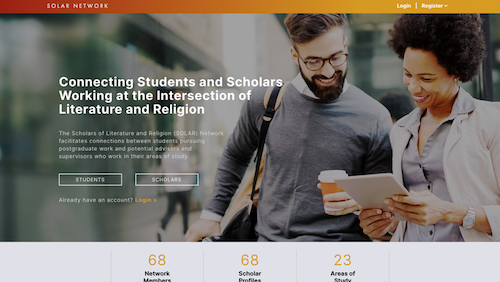
THE SCHOLARS OF LITERATURE AND RELIGION (SOLAR) NETWORK HAS LAUNCHED!
The Conference on Christianity & Literature is pleased to invite you to take advantage of this new tool from the Rivendell Center for Theology and the Arts (RCTA) at Yale University. This online directory is designed to serve both students and scholars working at the intersection of literature and religion. Find out more by clicking here.
UPCOMING REGIONAL CONFERENCES
For announcements about upcoming CCL Regional Conferences, please click here.
LIFETIME ACHIEVEMENT AWARD
Any member of CCL may submit the name of a person to be considered for the award. All nominations are to be made in writing and submitted to the President no later than November 1. Each nomination should be accompanied by a brief letter of recommendation along with either a copy of the nominee’s cv or an equivalent biographical sketch; the latter documents may be supplied in electronic form or as links to web sites containing the information. The CCL Board of Directors will consider the nominations and conclude the selection process at its annual meeting in early January. For a list of the long line of distinguished recipients of the CCL Lifetime Achievement Award, please click here.
CCL FELLOWSHIPS AND GRANTS
For information about CCL Fellowships and Grants, please click here.