CREATIVE AND CONSCIENTIOUS USE OF AI
Forging the future of AI in higher education, Pepperdine University is at the forefront of exploring AI’s potential to improve the world around us.
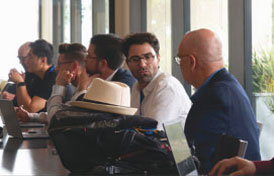
To support our faculty as they employ AI in their research and classroom settings, Pepperdine hosted a daylong discussion of the tool’s rapid development at its annual faculty conference this fall. Alongside keynote addresses and panel discussions from experts in the field, breakout sessions relating to each of Pepperdine’s diverse academic disciplines helped prepare University professors to take advantage of AI in their work by launching an important dialogue focused on technology, pedagogy, and faith.
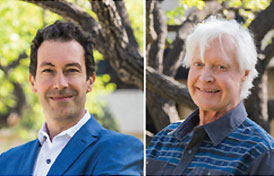
Fabien Scalzo, associate professor of computer science and director of the Artificial Intelligence in Imaging and Neuroscience Lab, has initiated research to apply the new technology across several disciplines. Contributing to the medical field, Scalzo has employed AI to quantify average recovery in those recuperating from strokes, along with the development of noninvasive monitoring of intracranial pressure. In the process, he has also developed innovative ways to involve undergraduates in research. As director of the Keck Institute for Data Science at Pepperdine’s Malibu campus, Scalzo empowers Pepperdine students to learn more about AI and play a direct role in the quest to discover new knowledge that could go on to save lives.
Gerard Fasel, associate professor of physics, has begun using AI software to expand photographic data collection of the aurora borealis. Engaged in research of the magnetic interactions between the sun and Earth, Fasel uses data from auroras—celestial displays occurring when energy from solar winds interacts with our terrestrial atmosphere—as visual indicators of energy exchanges.
Both Scalzo and Fasel have purposed funds from a $10 million grant from the W. M. Keck Foundation to curate AI software that discerns cloud formation from auroral light in photos, winnowing valuable data. The pair recently involved Seaver College undergraduates in the development process, guiding students on thoughtful adoptions of AI. This breakthrough in technology will expand the pool of data Fasel uses in his current research initiatives, including ongoing collaborations with NASA.
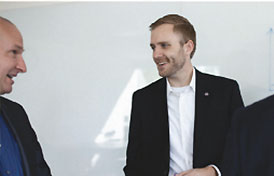
The University’s commitment to use AI ethically and conscientiously is shared by the faculty at the Pepperdine Graziadio Business School. Cole Short, associate professor of strategy and a leading advocate for the ethical usage of AI, was honored with the AI 2030 Award. Recognized for his transformative strides in the responsible development and deployment of AI technologies, Short’s work on the technology includes coauthoring a significant publication that positions AI not as a replacement for human capability but as a technology to support human creativity and thought.