Lucian Himes (’23) Inspires Stewardship of the Sea
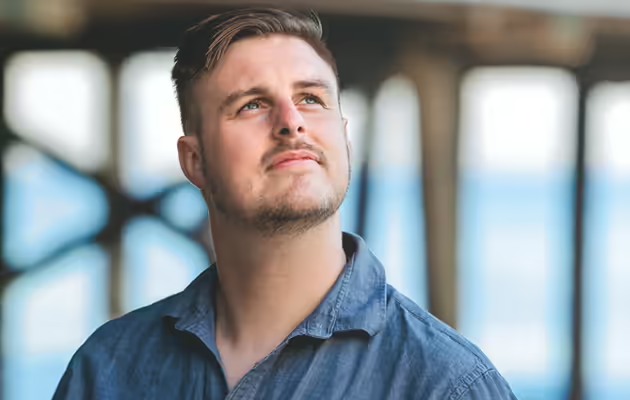
As an undergraduate biology student at Seaver College, Lucian Himes discovered that research isn’t something you wait around for. It’s something you dive into headfirst with courage and a sense of calling.
At Pepperdine Himes yearned to plunge into marine research. So he did what any curious scholar would do: he sent an email to Florybeth “Flo” La Valle, a biology professor in the Natural Sciences Division, stating his interest. She replied, “Be ready to get in the water on Friday.”
“That approach of not waiting around for something to happen, but just getting in there and figuring things out—that really stuck with me.”
"That approach of not waiting around for something to happen, but just getting in there and figuring things out—that really stuck with me," Himes says. "It’s something I admire about Dr. La Valle and something I try to embody in my own life."
Though Pepperdine doesn’t offer a formal marine biology program, Himes carved his own path through hands-on research, interdisciplinary inquiry, and meaningful faculty mentorship. Two years after graduating, he is still conducting research with Professor LaValle, who he considers a profound influence on his life.
"Dr. LaValle has been so much more than a professor to me,” he says. “She has provided me with wisdom in research and in science but also in my life outside of school. She has been one of the largest factors in where my life has ended up today and will continue to be a massive factor in my life going forward."
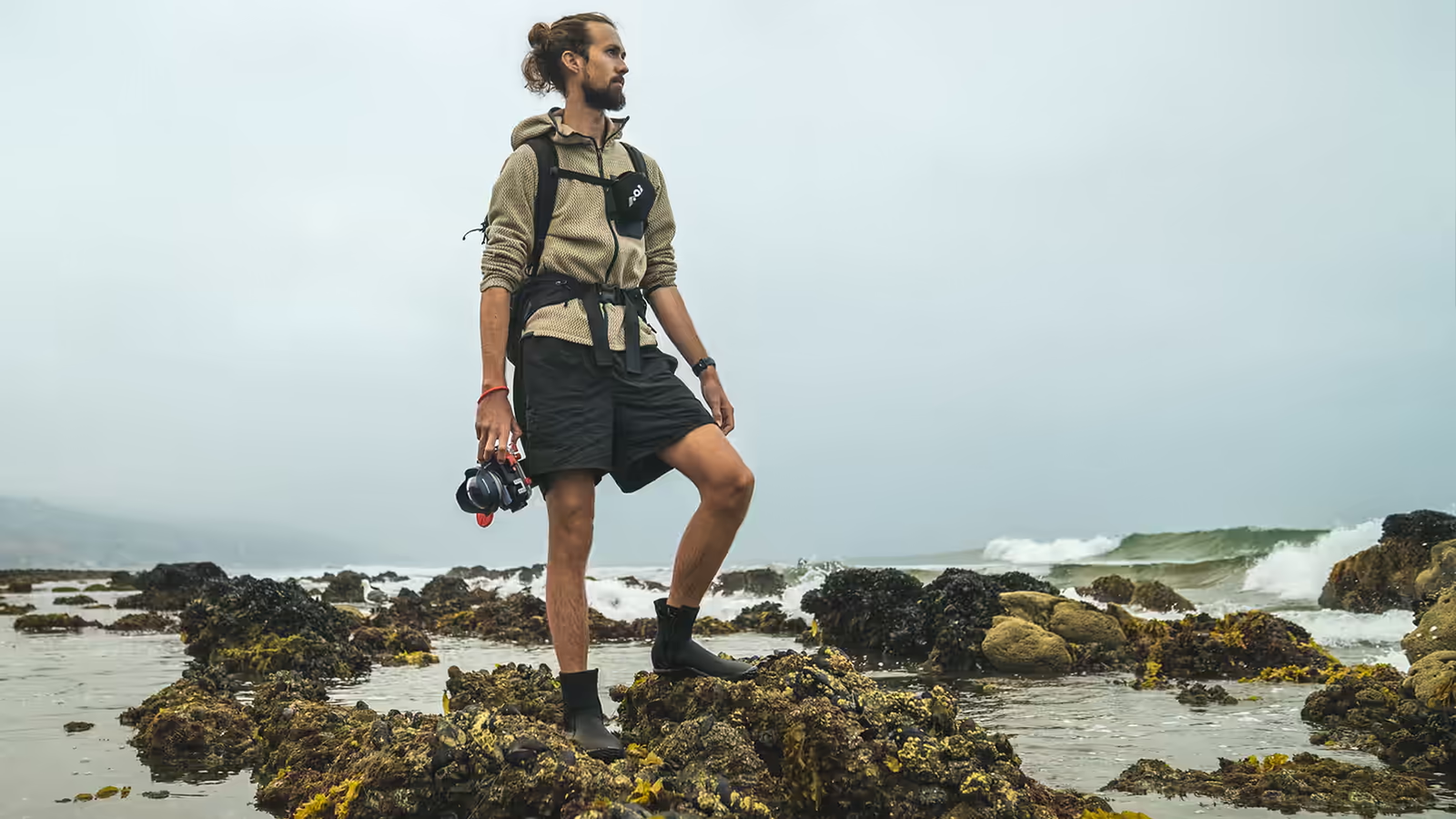
Himes’s academic path has taken him across the globe. As a Fulbright Scholar, he conducted tropical coastal ecology research in Papua New Guinea, one of the world’s most ecologically significant but understudied marine environments, following graduation. Himes spent 10 months living and working in remote coastal villages alongside village scientists and international marine biologists and used drone photography to map and monitor coral reefs as he studied coral reef ecosystems and the role of local communities in conservation alongside local non-governmental organization Mahonia Na Dari.
"One of the most impactful parts of my time in Papua New Guinea was working alongside local communities to understand what they truly needed and ensuring that the science we pursued was designed with real, tangible impact in mind," he says. "I love making discoveries that will be helpful for a larger audience—not just finding information for information’s sake. In Papua New Guinea I didn't just want to answer questions related to science. I wanted to find solutions that would actually be used by real people."
Himes believes science must not only generate knowledge, but also empower local voices, protect vulnerable ecosystems, and reflect deeper values of care and humility. Today his focus is on tropical coastal ecology, which is the understanding of how the ecosystems and everything in them interact. His goal is to try to understand and quantify his findings in order to promote a more harmonious relationship between humans and the environments around us, lead to more sustainable practices, and ensure humans protect and appreciate the beauty of the natural world. By deploying drones over coral reefs and coastal habitats, he captures high-resolution imagery that allows researchers to monitor environmental changes over time, such as coral bleaching, algal overgrowth, and erosion patterns. Drone technology provides a bird’s-eye view of ecological dynamics that can be difficult to observe from underwater alone, which offers valuable data for both research and conservation planning.
"Drones give us a rare opportunity to shift our perspective," he says. "You're no longer on level with something or looking down at an angle. You can really look from the top down, and you can see so much more from above."
Looking ahead, Himes hopes to pursue a PhD in marine biology with a focus on coral reef ecology and the future of human‑reef coexistence. He dreams of guiding policy, designing community‑driven monitoring programs, and nurturing the next generation of stewards.
"I want to help ensure that these ecosystems—these incredible natural resources—don’t just survive but continue to thrive and inspire people and be appreciated by people going forward," he says.
Ultimately, Himes hopes to inspire others to care more about the world around them.
"I don't want people to focus on me," Himes says. "I want people to notice everything else that's around them—the beauty of the ocean out there, the mountains back there, the natural world—and for them to understand it and care about it and invest in it and protect it. If I can look back on my life and say I inspired people to care more about their impact on the world around them, then I've had a successful life."
Explore More
The biology degree program at Seaver College is designed to provide biology majors with opportunities for experiential learning through hands-on research, small labs, and instruction by professors in both lectures and labs.