Pepperdine University Hosts Veritas Forum on the Christian Call for Hospitality
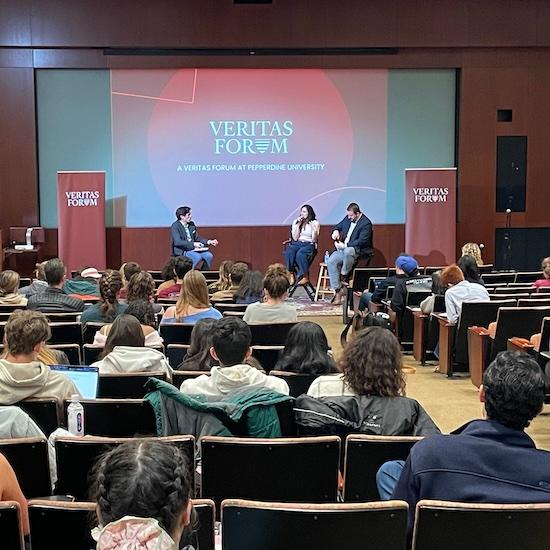
Pepperdine University recently hosted “Can I Really Love My Neighbor?”—a Veritas Forum event, which invited students, faculty, staff, and friends of the institution to consider the Christian call for hospitality and how it can be practiced in the current cultural moment.
“Over the course of several discussions with the Veritas student executive board, we came to the conclusion that we want to see people treating differences [be they ideological, spiritual, or otherwise], better,” said Yelyzaveta Shevetovska a Seaver College senior and president of the Veritas Club on campus. “We didn’t know exactly what we meant by ‘better,’ but that is why we needed this forum and our esteemed speakers to help us figure it out. Not by being "nice," but by confronting our feelings, getting out of our comfort zones, and talking to each other.”
To dissect the topic of hospitality, Pepperdine’s Veritas Club members relied upon Amanda Rizkallah, an associate professor of international studies at Seaver College, and Matthew Kaemingk, an author and professor of public theology at Theological University Utrecht. Together, these two distinguished speakers analyzed the nuances of the subject from a faith-driven, academic perspective.
The conversation—moderated by Jonathan Koch, an assistant professor of English at Seaver College—ranged from how to manage differences of opinion to the contexts in which challenging conversations should be had, all the way to lessons in political philosophy.
While evaluating these various subjects, Kaemingk introduced attendees to the concept of agonism, explaining that, in ancient Greece, an agon was a place where athletes would come together and spar with wooden swords. Though these contests were competitive, the participants would not kill each other; instead, the battle would help both parties develop respect for one another.
The public theology professor used his explanation of the agon as an illustration of how hospitable individuals should treat differences of opinions. Rather than drawing a steel sword and aiming to inflict harm, one should reach for a wooden weapon. They should engage in the conversation, wrestle over the ideas with their counterpart, and leave the ring with a new perspective.
“The command to love your enemies is interesting; because Jesus is naming that we have enemies,” says Kaemingk. “I don't hear Jesus throwing out a lot of conditions for those who he would show hospitality for. He seems to call us to a kind of hospitality that is costly, like it was costly for him.”
“I don't think in the life and example of Jesus, we have any loophole; I just don't think there's any condition under which we are allowed to duck out of being hospitable,” added Rizkallah. “It's an uncomfortable life, and we should expect to be mocked and viewed as naïve by the cult of the general culture.”
While offering her insights during the dialogue, Rizkallah called upon attendees to exercise hospitality by practicing curiosity and active listening. She claimed that using the phrase, “tell me more,” in the midst of challenging conversations can be a productive act of humility—one that allows the other person to feel heard.
Moreover, the international studies professor used the parable of the prodigal son to evaluate a biblical basis of hospitality. She highlighted that the father of the parable runs to greet his wayward son upon seeing him from a distance. In Rizkallah’s view, this act exemplifies the courage and intentional nature that characterizes Christian hospitality.
“I was astounded by the claims Christ and the scriptures make about hospitality, what we're called to, and how alien it is to the current political landscape,” said Noah Shifter, a Seaver College senior and vice president of the Veritas Club, regarding what he learned from the event. “I am impressed and compelled by the difference of Christian ethics. It seems like they barely belong in this modern world.”
The Veritas Forum at Pepperdine is largely student organized. The topic and speakers for the 2026 event were selected nine months earlier with the goal of evaluating Jesus’s commandment to love your neighbor as yourself. From there, undergraduates involved with Seaver College’s Veritas chapter drafted questions based on their own analysis of the topic.
“What impresses me most about this group of student leaders is that they did not lose sight of the bigger questions and goals of the forum while undertaking all the planning work,” said Koch Veritas’ faculty advisor on campus. “Throughout our preparatory meetings, Liza and Noah continued to think about the forum topic, adding nuance to the questions we were preparing to ask at the event and staging preliminary conversations for the members of the Veritas Club to prepare them for the discussion. In short, they remained committed to seeking the truth even as they dedicated themselves to the work of putting on the event.”
Learn more about Pepperdine University’s Veritas Forum.
SUBSCRIBE TO THE WAVELENGTH
Pepperdine Newsroom's official newsletter for campus updates and top news.
Subscribe