Pepperdine University Hosts the Christian Association of World Languages Annual Conference
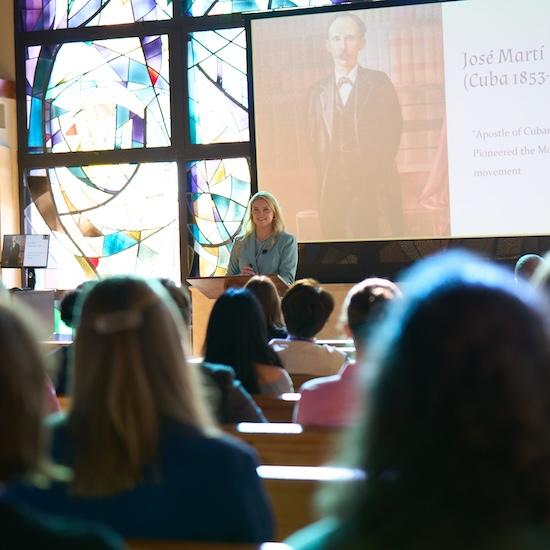
Pepperdine University recently hosted the Christian Association of World Languages (CAWL) annual conference—where 50 scholars from around the US gathered to learn more about language pedagogy from their contemporaries. Lila Carlsen, a professor of Hispanic studies at Seaver College and Pepperdine’s vice provost, served as the event’s keynote speaker.
“You are developing competent language learners to build bridges across cultures for the rest of their lives,” said Carlsen, addressing her peers at the outset of her talk. “Your impact will go on to affect the professional and personal journeys of countless students.”
Speaking on the conference’s 2026 theme of “Riding the Waves of Change,” Carlsen addressed the headwinds affecting higher education today, focusing especially on the emerging technology of artificial intelligence. She described AI’s influence on traditional pedagogy as a potential “50-year storm”—one that will force professors to alter their assignments, grading practices, and teaching tactics.
While acknowledging the educational challenges of this new technological era, Carlsen affirmed that humanistic abilities are still required to promote student learning. She highlighted that AI is incapable of emotion-driven behaviors like care, compassion, and love—sentiments that strong educators are able to offer students through the curriculum and the classroom.
Carlsen illustrated her point by discussing the impactful Spanish-language authors, poets, and thinkers that she studies alongside her students. She led attendees through readings from figures like Sor Juana Inés de la Cruz, José Martí, Pablo Neruda, and Gabriela Mistral, discussing, in the process, what each of them had to offer both educators and language learners.
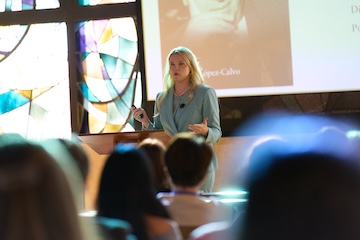 Carlsen speaking to a chapel filled with language scholars
With these literary examples, Carlsen emphasized that impactful ideas and revelations rarely come from isolated periods of study. Rather, a true, transformative education is collaborative, conversational, and relationally oriented.
“My value as an educator is not because I have large sections of the Quixote memorized; or that I can give a list of 20 examples of the picaresque in literature; or that I can role-play notable authors in my class,” said Carlsen. “AI can do all that, probably better than I can. My value as an educator comes from how I care for my students. I see them. I listen to them. I help them reach their goals.”
Carlsen concluded her remarks by challenging the educators present to consider what makes their learning spaces come alive. She asked that they consider this revolutionary technological moment not as an obstacle to overcome, but as an opportunity to creatively reevaluate best teaching practices.
“You are the gift of God to your students,” she said. “As a world language professor, you hold the key to the past, the present, and the future of the world.”
CAWL was founded in 1990 and has hosted an annual conference since 1991. Ame Cividanes, a professor of teaching of Hispanic studies at Seaver College, served as the CAWL conference chair and organized the 35th annual gathering at Pepperdine University’s Malibu campus. Scholars from Baylor University, Hope College, and Wheaton College were all in attendance alongside others from equally as notable academic institutions including Pepperdine's own International Studies and Language Division. The event was held on Friday, March 20, and Saturday, March 21.
“It was a profound blessing for Pepperdine to host the CAWL conference for the very first time,” said Cividanes. “We came together not just as colleagues, but as a community united in faith and fellowship, seeking God's guidance as we navigate the 'waves of change' in our field. I believe every scholar walked away inspired and refreshed, ready to take these new insights back to our classrooms. Ultimately, our students are the most important part of why we do this, and we are eager to implement what we've learned to better serve and love them through our teaching."
SUBSCRIBE TO THE WAVELENGTH
Pepperdine Newsroom's official newsletter for campus updates and top news.
Subscribe