Pepperdine University Hosts Inaugural Waves Innovation Summit
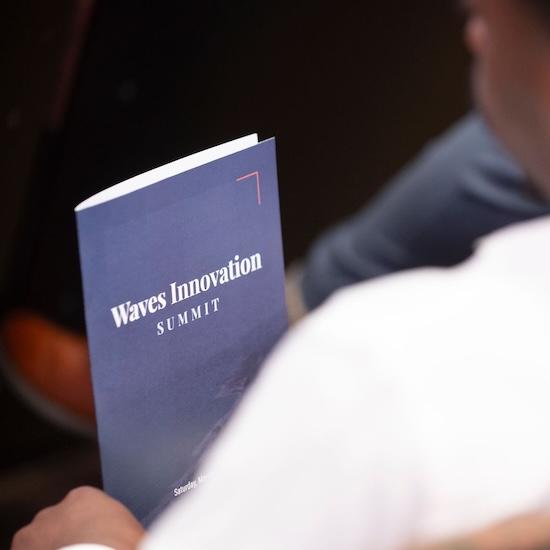
Pepperdine University recently hosted its inaugural Waves Innovation Summit—an event that brought together current students, alumni, friends of the University, and leading experts from the field of technology to analyze how AI is affecting the world of entrepreneurship.
The event was orchestrated and cofounded by Austin Bishop, a current Seaver College student, Ulysse Saltiel (’25), an alumnus and member of the Seaver College Board of Advisors, and Fabien Scalzo, an associate professor of computer science and director of the Keck Data Science Institute. This trio used their combined depth of institutional and technical knowledge to advance Pepperdine’s mission of developing forward-thinking, service-minded leaders.
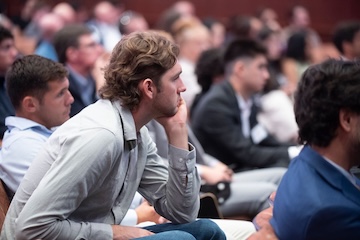 A broad audience of curious learners gathered for the Summit
“This summit was born out of a simple conviction: that Pepperdine's students, alumni, and faculty have an incredible capacity to change the world,” said Saltiel. “The world needs more mission-driven leaders—people grounded in purpose—who are sitting at the tables where the most important decisions are being made. People who lead with integrity in a complex world . . . That’s what today is about.”
Over the course of the summit’s proceedings, participants heard from a wide range of leaders in the AI and business sectors. Representatives from OpenAI, Nvidia, and Google were joined by practitioners from the world of finance, entertainment, and law for a series of informative discussions based at Pepperdine’s Malibu campus.
Using AI Profitably
Eric Egland, an AI subject matter expert at Cisco, served as the event’s keynote speaker. Egland, who used AI to develop a billion dollar return on investments in the national defense and insurance sectors, focused his address on how to derive value from AI systems. He specifically cited that 95 percent of AI implementations do not yield a profit for companies.
With this glaring statistic in mind, Egland emphasized to attendees the importance of both change management and domain expertise. He claimed that successful users of AI are those who possess an openness and willingness to alter their usage tactics based on data-driven findings. Yet, in order to craft these strategic decisions, one must possess keen insight into their given field.
“If you have a real problem, chances are you have a bunch of smaller issues that all roll up into it,” said Egland. “Which of those problems can you identify? Which of those problems can you address as well or better than anyone else? That’s what domain expertise is . . . That’s the key thing.”
The Many Facets of Evolving Tech
Following Egland, the summit provided participants with the chance to learn from a wide variety of industry experts. Through a series of fireside chats and panels, the inaugural event introduced and analyzed topics related to the next generation of AI companies, how to power coming technological innovations, the medical industry’s solutions-oriented use of AI, marketing in a new digital age, and the future of sports analytics.
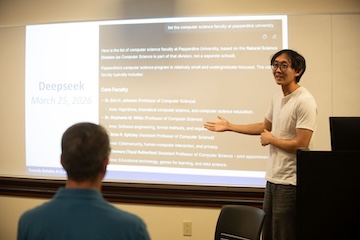 Sean Wu, Pepperdine's first Rhodes Scholar, presented at the event
To help lead these conversations, Pepperdine welcomed a number of its accomplished alumni back to campus. Masoud Hussain (MS ’24), a business development manager at Syntrologie; Anthony Kennada (‘08), the founder and CEO of Goldenhour; Steven Lesky (‘15), a senior financial analyst at Waymo; Jonathan Pearce (’02, MBA ’05, JD ’06), a law partner at SoCal IP Law Group LLP; Mike Umbro (‘05), founder and principal of FieldView Capital; Sean Wu (’25), the University’s first Rhodes scholar and a master’s degree candidate at the University of Oxford; and Cristie Zellmer (’02), marketing operations at OpenAI—all of these accomplished alumni returned to Malibu to help equip the next generation of Pepperdine students.
“Pepperdine is home,” said Umbro. “The professors I had here were so warm and caring. They embodied the campus’ sense of purpose, which is a very special thing. As a student, I took it for granted. Now, I’m trying to make up for that. I love being here, and I'm happy to offer my time and thoughts to students because there's no reason to fear this world knowing that we have this community.”
Umbro’s sentiments resonated with the many students in attendance. With a crowd full of undergraduate and graduate candidates preparing to navigate the professional marketplace, the Summit served as an intellectual training ground for how to be effective in today’s corporate environment.
“As a student, we feel like we’re the guinea pigs for this AI innovation,” said Jayden Hanson, a Seaver College senior who attended the summit. “It absolutely thrills me to be able to learn more about AI and the next generation of technology at Pepperdine. I think more institutions of higher education need to prioritize studying developing technology and bringing together AI specialists from a variety of fields.”
Practical Opportunities
Beyond the insightful discussions, the Innovation Summit also provided hands-on opportunities for attendees to build their entrepreneurial and AI coding skills.
For example, the producers of the ABC show SharkTank visited campus and invited students, alumni, and friends of Pepperdine to sign up for a 30-minute pitch meeting. Participants had a half hour to explain the businesses they were in the process of developing. Each of the attendees who took part in this event became eligible to appear on the national TV show and sell their product to Shark Tank’s all-star cast of business executives.
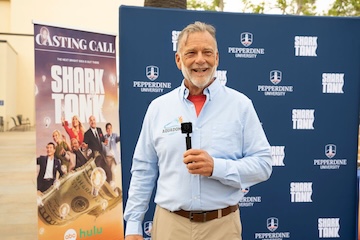 Summit participants pitched to the producers of SharkTank
"One of the main reasons I wanted to get my MBA at Pepperdine was to learn how to scale a business from finance to consulting,” said Nicole E. Limo (MBA ’25), an alumnus who pitched a new social media platform alongside one of her Pepperdine classmates. “It's truly a full circle moment to be back pitching our business to Shark Tank."
In addition to the SharkTank pitches, the summit hosted Pepperdine’s first-ever hackathon—an event reserved for Seaver College undergraduates to test their coding abilities against two separate prompts. Students who participated developed either a web platform designed to visualize and statistically analyze a Pepperdine volleyball practice, recording, in the process, key metrics like spikes and digs; or a system that detects sports-centric, AI-generated deepfakes.
The hackathon was created and judged by two Seaver College alumni—Brody Maddox (’25) and Jackson Walker (’24)—as well as Scalzo. Together, these three engineered the competition to act as an experiential learning opportunity for students—one that offered a total cash prize of $5,000.
“It was really great to get students involved in a difficult problem,” said Maddox and Walker. “We want to help them stretch their brains with something that's a little more real world than they might be used to.”
Building the Future
Pepperdine’s inaugural Waves Innovation Summit was produced through a collaborative effort involving students, faculty members, and administrative leaders at the University’s Graziadio Business School and Seaver College. The event, its speakers, and its participatory opportunities exemplified the institution’s commitment to developing the next generation of ethical problem solvers.
“We know that the most successful leaders of tomorrow will be the ones with the strongest moral compass,” said Deborah Crown, the dean of the Graziadio Business School. “Today's event made it clear that at Pepperdine, we are not just talking about the future, we're building it.”
SUBSCRIBE TO THE WAVELENGTH
Pepperdine Newsroom's official newsletter for campus updates and top news.
Subscribe