How Sean Wu ('25) Became Pepperdine University's First Rhodes Scholar
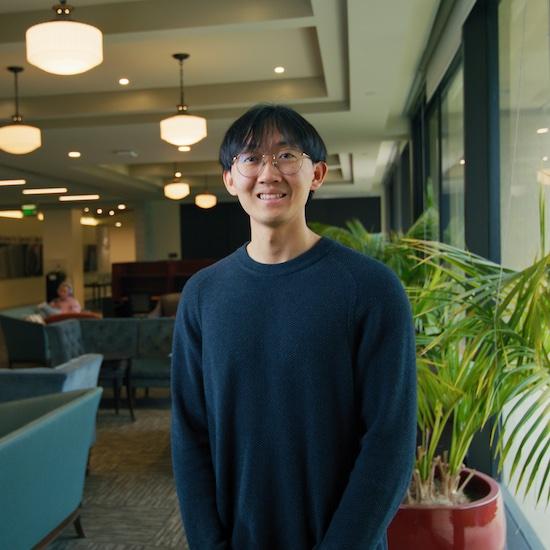
Sean Wu needed a reset.
In 2021 he graduated from Diamond Bar High School somewhere in the middle of his class. A self-proclaimed “okay” student, Wu knew he had potential, but he hadn’t yet found the key to unlock it. At Pepperdine University, he discovered a fresh start and a clear path forward: a bachelor's degree in computer science and mathematics with a minor in advanced data science. lt was precisely the new start he had been seeking.
Over the next four years, Wu’s world transformed.
As he rose through college, a revolutionary technology burst onto the scene: large language model AI systems that would open doors of opportunity to those willing to study their capabilities and harness their power. Wu was one of them. One after another—a spark of passion, a wise mentor, and problems were introduced, researched, solved for the betterment of humanity.
Now in 2025, four years after his new beginning, Wu has graduated from Seaver College as Pepperdine University’s first-ever Rhodes Scholar, in addition to his many other titles such as valedictorian, Goldwater Scholar, Computing Research Association (CRA) awardee, and National Science Foundation Graduate Research Fellowship (NSF GRFP) scholar. He has been admitted to the nation’s top-ranked computer science PhD program at Stanford University, but first he will head to Oxford University to begin his graduate studies.
While this total transformation may seem extraordinary to some, Wu sees it as a natural outcome of the research process—one grounded in dedication, hard work, collaboration, and curiosity that he first encountered during his first year at Pepperdine.
Step 1: Identify a Passion
“I came to Pepperdine pretty blind,” explains Wu. “I just wanted to get involved in research however I could.”
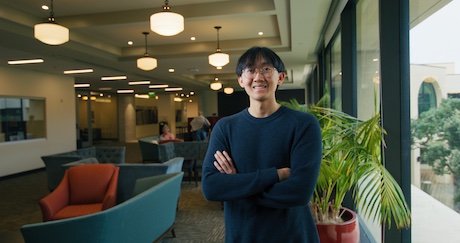 Sean Wu came to Pepperdine looking for a passion. During his first year, he found
one.
Sean Wu came to Pepperdine looking for a passion. During his first year, he found
one.
Wu enrolled at Seaver College with a music scholarship to play the tuba in the Pepperdine Orchestra—a unique opportunity that did not require him to study the fine arts. Unfettered by financial constraints and free to pick from the broad array of academic disciplines offered at the Malibu-based, liberal arts institution, his decision was influenced by the University’s abundant research offerings.
An R2 university with a strong reputation for engaging undergraduates in meaningful research, Pepperdine offered the young man from Chino Hills the chance to pursue his curiosity.
“On the first day of my intro-level computer science class, my professor explained how he had used artificial intelligence (AI) to predict strokes,” says Wu. “At the time, I didn’t even know what AI was beyond just a cool buzzword. But as I looked more into my professor's work, I saw that his research with AI in the medical field touched so many different diseases. It was like my professor turned into a superhero in the middle of class.”
Inspired by the impactful reach of AI research, Wu began to orient his studies around this new fascination. He applied to become a summer fellow at the Keck Institute for Data Science on campus and took part in any research project that involved AI. Whether it was helping biologists classify plant cells or training large learning models to better process detailed medical terminology, Wu was all in.
Through these experiences, he learned how to break up complex topics into a three-part research process. One: identify a very specific problem. Two: read the existing literature. Three: discover—through repeated testing—a solution. Repeat until the question has been answered.
Using this process, Wu began to share his findings in scholarly publications. His first journal article was published in 2022. The next year he published six more. And in 2024, he authored a staggering 10 articles in peer-reviewed publications. As an undergraduate, his work has been featured in prestigious journals such as The New England Journal of Medicine and has been cited 167 times to date.
“Pepperdine makes it very easy for students to transition into research,” says Wu. “It doesn’t feel like work to me. I look forward to these projects.”
Step 2: Discover a Mentor
Wu discovered a passion and learned how to take action on his ideas at the very start of his Pepperdine career. But in order to understand how far he could take the research process, he needed a mentor.
Fabien Scalzo, an associate professor of computer science at Seaver College and a prolific researcher, was named director of Pepperdine’s Keck Institute for Data Science in 2021, which he launched with a clear mission: to use the power of AI for the betterment of humanity—the same goal that also defines his own scholarship where he focuses on applying computer science to solve complex medical challenges.
Scalzo expounded on this objective in his classroom, and its message resonated with a first-year student looking to get involved in problem solving. A partnership emerged between the established scholar and Sean Wu, a burgeoning talent.
“It’s everything,” is how Wu describes the impact of his mentor. “He provided opportunities for me, as well as new problems to solve. Dr. Scalzo showed me that you can use AI research to save lives through medicine.”
The work of their first summer together, which was funded by the Keck summer fellows program, involved using AI to study glaucoma and cataracts. This initial project spun into three years of collaborating over a variety of projects. The pair formed a genuine professor/student bond and went on to publish 11 scientific papers together.
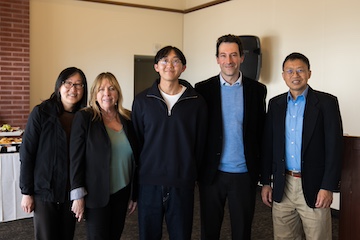 Wu discovered mentors like Dana Dudley and Fabien Scalzo at Seaver College.
“Working with Sean for the past four years has been a true blessing,” says Scalzo. “In the classroom, he always came well-prepared for every lecture. In research, Sean worked hard and learned quickly. He was also very receptive to feedback and, at the same time, explored new, promising ideas on his own. What I found impressive and inspiring was his ability to connect with others and his commitment to helping them both in the classroom and through research projects.”
With a mentor’s encouragement and guidance, Wu’s abilities expanded. He was no longer just passionate about the work, but was now able to venture out on his own and explore the world of research for himself.
“Now, I can find my own projects,” says Wu. “Most of the recent research is defined by my curiosity. But, in the beginning, it was super important that Dr. Scalzo and my other mentors opened something up for me.”
Step 3: Solve More Problems
Sean Wu’s next steps beyond Pepperdine focus on the singular goal of solving more problems to benefit others. Through his Rhodes Scholarship to Oxford, Wu plans to keep expanding his research agenda.
After becoming a Keck Summer Research Fellow and earning his initial publications, he applied for a Barry Goldwater Scholarship, a program that identifies and supports undergraduates pursuing careers in research. Only 8 percent of Goldwater applicants are chosen for the award. In 2023, Wu was among the select cohort.
He followed up this feat by being named an honorable mention selection to the CRA’s Outstanding Undergraduate Researcher Award list—an achievement that distinguished him as one the country’s exceptional computer science majors.
With these two major achievements, Wu knew he had a chance to earn a Rhodes Scholarship—one of the most competitive and prestigious awards an undergraduate can receive. With a CV full of diverse research publications and a series of national honors, the Seaver College student applied for the opportunity with one goal in mind: change the world for the better.
“I am beyond excited to receive the Rhodes Scholarship,” said Wu immediately after receiving word of his success. “It’s an achievement I never imagined in my life, and a privilege to join some of the world’s leading scholars in fighting the world's fights.”
Yet he didn’t stop there. Wu doubled down and applied for and received a prestigious NSF GRFP grant alongside his admission into the Computer Science PhD program at Stanford.
Despite all this success, Wu insists that his goal hasn’t changed. Of course, he’ll focus on growing his network as a Rhodes Scholar and beyond. Sure, he will earn more notable grants to help fund the work. But all that comes from following the process—engaging with the problems—discovering the solutions.
“I just want to learn how to be a good researcher,” says Wu. “My dream, right now, is just to be a good AI researcher.”
SUBSCRIBE TO THE WAVELENGTH
Pepperdine Newsroom's official newsletter for campus updates and top news.
Subscribe