A Vocation Discovered: Dwayne Simmons’ Journey to Becoming a Renowned Neuroscientist
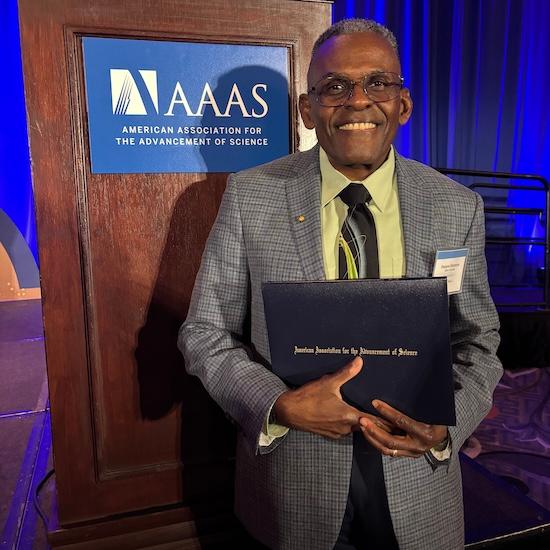
Ivy League institutions recruited him, but Dwayne Simmons (’80) was looking for something more.
As a prospective undergraduate student, academic prestige was not enough to lure the bright Ohio native to the East Coast. Instead, he sought an institution that balanced both rigorous scholarship and Christian values.
“I was looking for an environment in which I could explore my faith and also pursue the science I was interested in,” says Simmons. It was these qualities that led him to apply, commit to, and ultimately graduate from Pepperdine University's Seaver College.
Since earning his bachelor’s degree from the premier Christian liberal arts college, Simmons has forged a career as an esteemed neuroscience professor, researcher, and newly inducted fellow of the American Association for the Advancement of Science (AAAS). In looking back on his accomplished vocational journey, the neuroscientist considers his undergraduate education in Malibu to be the key that unlocked his potential.
“Attending Pepperdine was a real change for me,” he explains. “Aside from marrying my wife, it proved to be the best decision I've ever made.”
A Vocation Discovered
Simmons’ journey to becoming a renowned neuroscientist began in the Santa Monica Mountains.
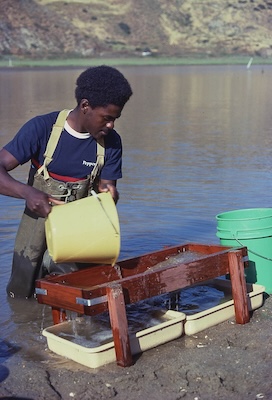
As a first-year student, he planned to study computer science; however, by the end of his first nine months on campus, Simmons was learning more about biology and engaged in research alongside Stephen Davis, Pepperdine’s distinguished professor emeritus of biology. Hiking up and down the campus’s rolling hills, collecting data on sand dollars and plants, and analyzing findings in the laboratory were activities that colored his summer, as he elected to stay in Malibu and chase his scientific interests year-round.
Even though Simmons did not have a keen interest in ecology, this initial chance to participate in a research venture was transformational. Given the freedom to do his work independently and devote his time to developing and executing experiments revealed an undying interest in pursuing new knowledge. It also provided Simmons with the space needed to nurture one of his enduring curiosities, the human brain.
“Midway through my undergraduate career, I realized that I was really excited and passionate about learning how the brain worked,” he explains. “So I dropped the computer science studies, read as much as I could on neurology, and felt like I had finally discovered a sense of purpose.”
This revelation, as well as his undying fascination with research, motivated Simmons to apply for a National Science Foundation Graduate Research Fellow Program Scholarship—aka a golden ticket to a doctoral studies program. He drafted his proposal, pleading for a chance to study math and neuroscience.
“Neuroscience, at that time, was a fledgling field of study,” Simmons recalled. “I'm quite sure everybody who read my application laughed. But still, I consider myself fortunate. The selection committee probably thought it was so funny that they actually gave it to me.”
In Malibu he discovered a new passion for research and a new subject to study (the brain). And, on top of that, the school prepared him to walk confidently into a doctoral degree.
“The preparation was really awesome,” says Simmons. “Pepperdine allowed me to be independent in the laboratory. And that meant that when I went to graduate school, I knew I wanted to get a PhD and be a researcher.”
Hearing the Call
With just a few PhD programs in the US devoted to the developing field of neuroscience, Simmons dedicated his admissions efforts to Harvard, Northwestern, University of Chicago, and Stanford. During that time, the neuroscience departments of these institutions were so small that they accepted only a handful of candidates.
In fact, Harvard accepted just two students during Simmons’ application cycle. He was not one of them. Prior to the fall, the head of the Division of Medical Science Program, called the young scientist and informed him his application had not been selected for the neuroscience department; however, it had been accepted in a new developmental biology program at the Ivy League Institution.
“I said, ‘okay, but can I still take neuroscience classes?,’” says Simmons recalling the conversation with the dean. “The dean responded, ‘That's the beauty of this program. You can take any classes you want.’”
At Harvard, Simmons spent his first two years engaged in a curriculum similar to that of medical school. Immersed in the world of medicine, he heard a professor lecture on the auditory system. A music lover, Simmons was curious how the ear and the brain worked together. And like that, the PhD candidate found a specific subject to study.
Today, Simmons’s research centers on understanding how brain neurons grow, develop, and forge connections with sensory cells in the inner ear throughout the aging process. This effort started at Harvard, but soon continued on the West Coast.
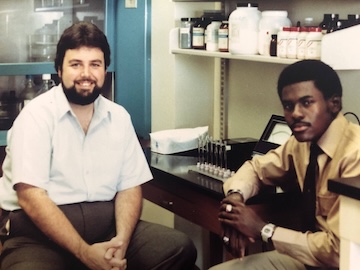
After earning his PhD, Simmons received a call from Stephen Davis, his Pepperdine mentor. Seaver College was attempting to build out their undergraduate research offerings. The campus community felt as though Simmons was the right man for the job.
“I really hadn't thought about undergraduate teaching,” says Simmons. “I loved the idea of training people in research, but I hadn't thought about doing it as a profession. In the end, it didn’t take much convincing. Pepperdine made me believe I should try it.”
Opening Doors for Others
On the Seaver College campus, Simmons was the driving force behind the institution’s Summer Undergraduate Research in Biology (SURB) program, which allows undergraduates from all over the country to come to Malibu and pursue their research interests.
He has since expanded his professorial and scholarly reach by taking appointments at the University of California, Los Angeles; Washington University in St. Louis; and Baylor University, where he currently directs the Baylor Transdisciplinary Research Undergraduate Experience (B-TRUE) program. At each of these stops, Simmons has paid his Pepperdine experience forward, opening doors of opportunity for young, curious, undergraduate researchers.
While fostering his academic career, Simmons has also invested in his family. He and his wife, D’Nisa Hoover Simmons (’95), have raised two children, Dillon and Danae. Dillon Simmons served in the United States Navy for three years; and Danae is a current Pepperdine student, who is following in her father’s footsteps and studying biology.
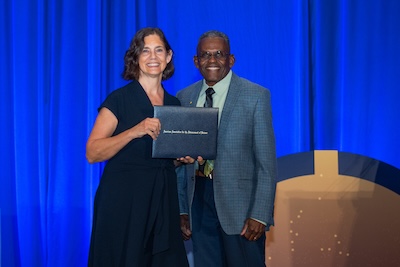
In the midst of cultivating this abundant personal and professional life, Simmons has remained steadfast to his passion for neuroscience. His scholarly investment in the field has expanded the way fellow researchers think about the connection between the ear and the brain, as evidenced by his selection as a AAAS Fellow. With this most recent accomplishment, Simmons distinguishes himself as one of the premier scientists, engineers, and innovators in the nation, joining the ranks of Thomas Edison. W. E. B. Dubois, and Maria Mitchell.
Though Simmons’s ascent from curious undergraduate to renowned scientist has taken place over decades of work; though it has carried him to some of the most esteemed institutions of higher education in the world, he credits all the success to his academic foundation—the academic foundation he received at Seaver College.
“Being selected as an AAAS fellow was a total surprise,” says Simmons. “Once it settled that it was real, I saw it as a validation. It's validation of undergraduate research and my Seaver professors such as Gary Tallman and Stephen Davis. They were the ones who really inspired me to pursue a career in research.”
However, Davis views Simmons' success from a different perspective, saying: “He's gone way beyond scholarship. Dwayne will be remembered as a champion of student learning, especially undergraduate student learning, and that is the ultimate achievement for any educator.”
SUBSCRIBE TO THE WAVELENGTH
Pepperdine Newsroom's official newsletter for campus updates and top news.
Subscribe