Ambassador Sam Brownback Joins Pepperdine as Senior Fellow to Advance International Religious Freedom
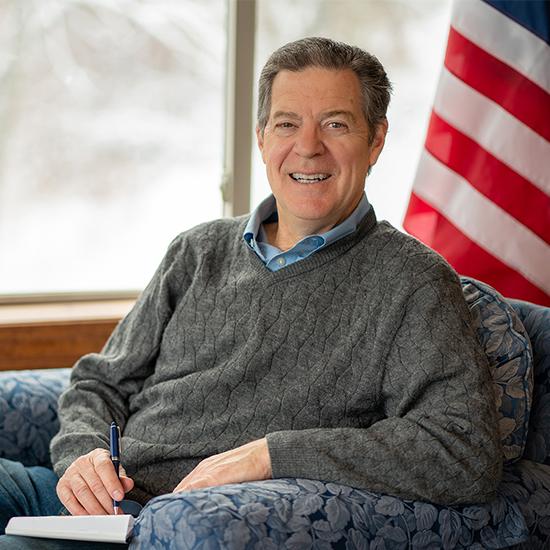
Sam Brownback, the 46th governor of Kansas, former US senator and Ambassador at Large for International Religious Freedom, and co-chair of the IRF Summit, has joined Pepperdine University as a senior fellow promoting international religious freedom.
Grounded in a conviction to uphold the dignity of all people, and therefore, the right to worship freely and practice the dictates of religion without fear, key initiatives of this partnership include global justice convenings in conjunction with the Sudreau Global Justice Institute and the Pepperdine School of Public Policy. These efforts also involve ongoing research work with Pepperdine students, Caden Benedict (’23), who is pursuing a joint master of public policy and JD, and Logan Lee, a master of public policy candidate.
“At Pepperdine, I’ve found that a lot of people care about the formation of their own soul, and their own relationships with Christ are strong, which gives them this capacity to be able to do the work they've been called to do," says Brownback.
Defending Religious Freedom Worldwide
Across the world, violations of religious freedom continue to affect communities of many faiths.
According to the US Department of State, Nigerian Christians and their church leaders are being killed. The Human Rights Research Center states that the Uyghur Muslim population in China has suffered persecution and torture. And in Tibet, public Buddhist prayers have been legally prohibited.
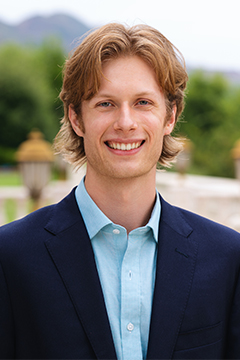 Caden Benedict
“A human right doesn’t hold together unless it’s for everybody,” Brownback explains. “The leaders of these nations look at religious freedom as an existential threat, and we look at it as a cornerstone of freedom.”
Brownback has penned numerous op-eds in relation to the protection of this human right. Throughout the drafting process, Benedict and Lee offered their editorial support and research skills to pieces that shed light on issues such as Syria’s diminishing Christian population.
In addition, Lee coauthored an article detailing the nation of Burma’s militia attacks on their Christian population, published in The Hill at the end of 2025. That October, Benedict also coauthored a feature in The Hill on religious persecution in the Sahel region of Africa, particularly Nigeria, with Brownback and Clint Lyons, cofounder and executive director at iReach Global. The following month in November, the US Department of State designated Nigeria as a country of particular concern regarding the protection of its religious communities.
A region just south of the Sahara desert that extends horizontally across north-central Africa, the Sahel faces some of the fastest-growing terrorist attacks, with the death of thousands of Christians and the displacement of millions of civilians of all faiths, says Benedict. He explains that awareness of any threat to religious liberty serves as the first step toward action, underscoring the relevance of their publication. “It is a region that had previously gone quietly unnoticed,” he adds.
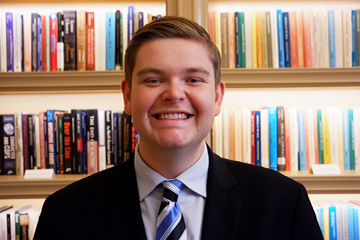 Logan Lee
Reflecting on Brownback’s work with Pepperdine, Benedict says: “Ambassador Brownback is advancing religious freedom internationally as well as locally, and because Pepperdine has a very strong reputation for religious liberty defense work through the Caruso School’s Sudreau Global Justice Institute and Religious Liberty Clinic, I think it's a great partnership.”
A Rooted Commitment
From the farmlands of Kansas, Brownback likened religious liberty within a nation to the cultivation of good soil—where fruitful ideas can take root and flourish thereafter. In this spirit, Brownback serves as chair of the National Committee for Religious Freedom, which focuses on protection of all religious communities and faith-based institutions in the US.
While serving as a US senator from 1996 to 2011, Brownback was the principal architect of the International Religious Freedom Act of 1998. The policy institutionalized the promotion of religious freedom as a core priority of US foreign relations and continues to have far-reaching influence today.
Prior to his public service, Brownback practiced law and taught agricultural law at Kansas State University, as well as serving as the state’s Secretary of Agriculture towards the beginning of his career. He earned a bachelor of science from Kansas State University and a JD from the University of Kansas.
“It’s easy to think of religious liberty in policy as abstract—and something that is taken for granted, but in reality, I think it's the difference between people living out their calling rather than living in fear," Lee concludes. “To affirm that every person has a soul and a conscience and the right to worship freely—that is the root of religious liberty.”
SUBSCRIBE TO THE WAVELENGTH
Pepperdine Newsroom's official newsletter for campus updates and top news.
Subscribe