Artist Sebastian Thomas Reimagines Medieval Stories Through a Colorful Graphic-Novel Lens
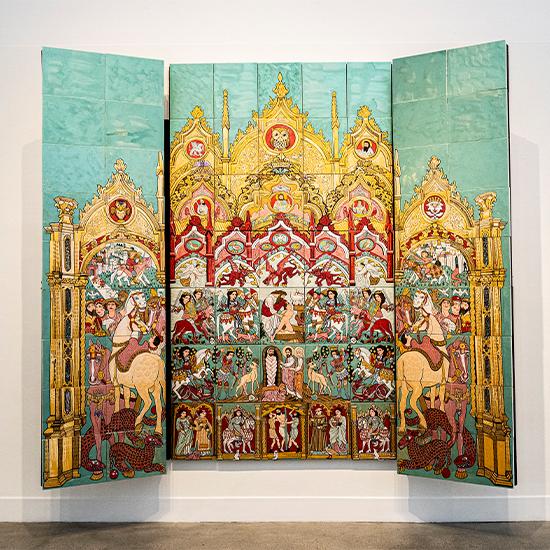
The latest exhibition at the Frederick R. Weisman Museum at Pepperdine University features the work of American painter Sebastian Thomas, who reimagines medieval iconography through a contemporary lens, blending traditional techniques with modern narratives to serve as commentary on present-day hierarchies as well as the digital culture. In this conversation with Mark Roosa, dean of University Libraries and interim director of the Weisman Museum, Thomas discusses his background, formative influences, and the works featured in this exhibition.
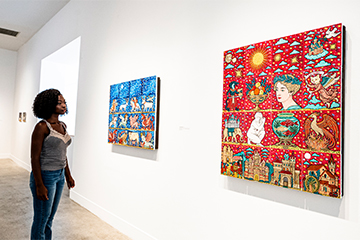 A student admiring the exhibition
Roosa: Growing up in the great Midwest, and gravitating to Chicago where do you now work and reside, what were some key formative experiences—perhaps associated with these locations—that called you to become an artist?
Thomas: I am originally from Arkansas, and one of the most formative places from my childhood was Terra Studios, an art park in Northwest Arkansas. I would spend days drawing the handmade sculptures of garden creatures tucked throughout its forest. Looking back now, I learned how to look closely and find wonder while enjoying my solitude. I think my sense of imagination and mythic characters also began there. Those kinds of experiences made becoming an artist feel like an inevitable calling.
Q: The Chicago art scene during the latter part of the 20th century was profound in its global influence. Who were some of the Chicago artists who influenced your creative focus and why?
Thomas: I’ve been fortunate to work closely with artists Michelle Grabner and the late Frank Piatek, both of whom helped sharpen my creative focus and instilled in me a deep sense of rigor. The Chicago Imagists have also been an important regional influence. I admire their embrace of strangeness and humor. One work I return to often by Chicago Imagist Barbara Rossi is Rhapsodent II—My Dentist’s Dream. She was inspired by images of dental molds and would transform them into something playful and unsettling. I admire how directly she embraces the uncanny without overexplaining it. That sense of mystery has been deeply influential in my own work, and I feel honored to be considered part of that broader lineage of Chicago artists.
Q: Artist and scholar Lisa Wainwright, who writes about your work, cites your style as modern International Gothic, where “devotional pictures of dense multi-figural groupings laden with extravagant costumes and awash in brilliant color” predominate. Are there particular historical works of art or literary references that have inspired you to work in this genre?
Thomas: Medieval manuscripts and stained glass have been enduring sources of inspiration for me. I’m drawn to the way these traditions use rich symbolism to communicate ideas that resonate across centuries. The Gates of Isaac reimagines the biblical story of the Sacrifice of Isaac, which is a popular theme in painting’s history. I was interested in painting the precise moment of greatest tension: Abraham’s dagger is fully drawn, but the angel has not yet intervened so it is unclear if Isaac will survive. One of the things I love most about painting is its ability to hold a single moment in climactic suspension. Because the image remains still, the story never fully resolves without our hindsight. Painting lingers in a state where its meaning and outcome remain open to contemplation.
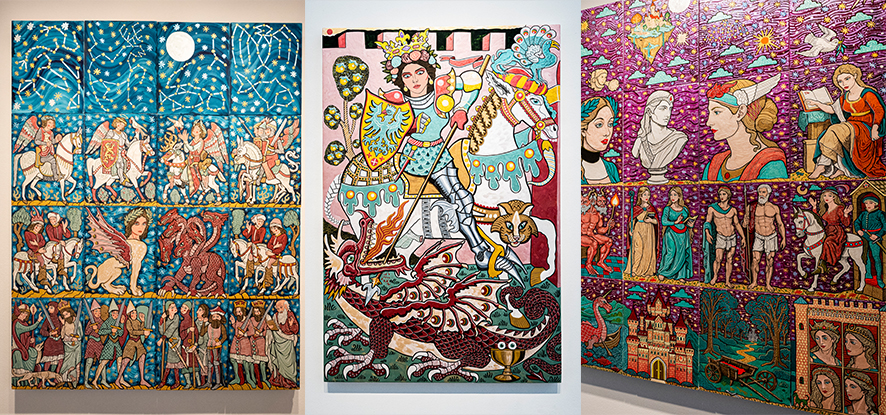 The Apollonian Polyptych (left), The Triumph of Saint Lucy (center), and Gloaming I (right) by Sebatian Thomas
Q: A through line I see connecting your works is the battle between good and evil. In a review of your work, art writer John Preus notes that, “Medieval paintings commonly represent various virtues through clear depictions of saints and villains to tell an allegorical story that likely would have been familiar to its audience.” What are some of the stories embedded in your works that you hope resonate with today’s viewers?
Thomas: I think these stories endure because they continue to evolve. John Preus is right that medieval audiences would have immediately recognized many of these allegorical narratives. My interest is asking where the newness exists within that familiarity. What aspects of these stories have been forgotten? What meanings have shifted? What do they still have to say? For example, The Consolation draws from the moment before Christ’s flagellation during the Stations of the Cross, but it does so without making Christ’s identity explicit. I’m interested in whether that scene can be experienced anew and whether viewers can enter it through empathy and uncertainty rather than recognition alone. Instead of offering a fixed moral lesson, I hope my paintings create space for these timeless narratives to remain open and alive in their stillness.
Q: Women are depicted in various powerful ways throughout your works. Could you shed some light on this particular emphasis?
Thomas: For me, depicting women in positions of power isn’t the sole defining statement of the work so much as a natural part of the world my paintings inhabit. I want these figures to exist without their authority needing to be justified, but simply occupying their place. Lucy and the Dragon reimagines the familiar iconography of Saint George slaying the dragon, but she seems mounted on a horse more fitted for Don Quixote than a triumphant knight. I love reshaping and having a say on these icons of my past, and I want to continue preserving their sense of courage and regality that has always made them compelling to me.
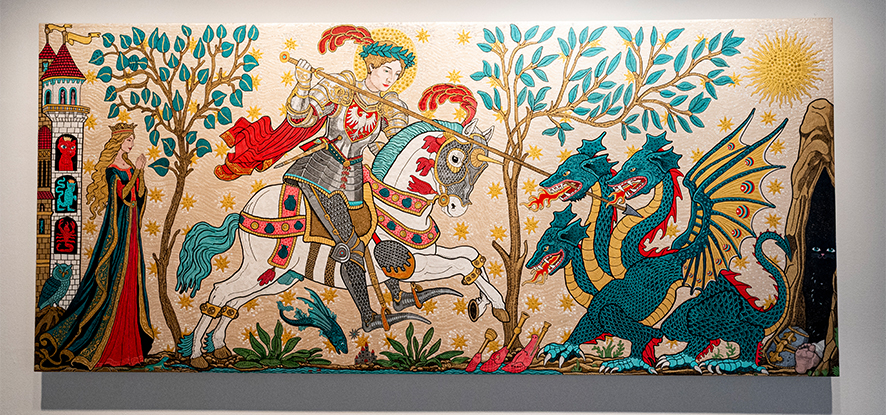 George and the Dragon by Sebastian Thomas
Q: Is there a time period or set of circumstances surrounding the creation of these stunning works you might wish to share with museum visitors?
Thomas: Although these paintings may appear to belong to the past, they are very much works of the 21st century. I’m not interested in perfectly recreating history but using its visual language to think through contemporary questions. Every painting is made with the urgency of the present. For me, tradition is most meaningful when it remains alive and that means that it must evolve and speak to the world we inhabit today.
Q: What new projects are in progress? Will we expect to see these works in the near future?
Thomas: I’m developing a new body of work that explores mythology and the triptych while scaling back the size of the works. While I still believe that large-scale work can have a sense of intimacy, lately I have been seeing my work become more and more surgical in mark making and approaching a smaller, more intense imprint from the hand. Albrecht Dürer stands at the start of this phenomenon.
Photo Credit:
All images courtesy of Ron Hall, University photographer
SUBSCRIBE TO THE WAVELENGTH
Pepperdine Newsroom's official newsletter for campus updates and top news.
Subscribe