Astrophysicist Deborah Haarsma Connects Science with Christian Faith at Pepperdine Libraries' Frank Pack Lecture
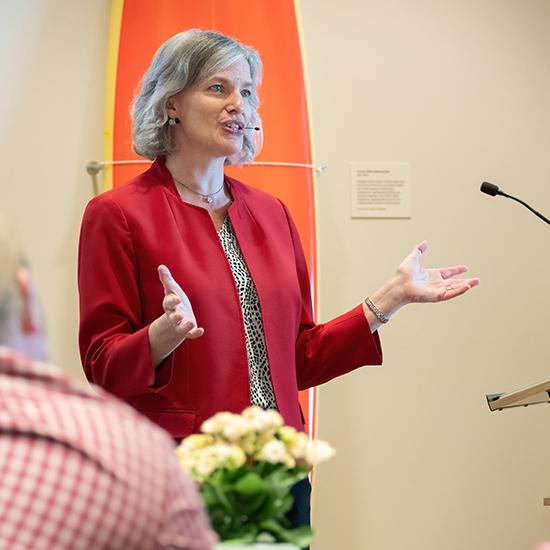
Psalms 19:1–2 paints a glorious picture of how the cosmos testify to God’s handiwork. Both in awe of the Creator and the created world, King David wrote: “The heavens declare the glory of God; the skies proclaim the work of His hands. Day after day they pour forth speech; night after night they reveal knowledge.”
In recognition of these verses, Deborah Haarsma, astrophysicist, author, and the former president of BioLogos, an advocacy organization devoted to sharing the interplay between science and Christianity, has devoted her career to the study of the world beyond our own. On March 11, the Pepperdine community was given the special privilege of hearing Haarsma’s insights on Christian faith and science at the 21st annual Frank Pack Distinguished Christian Scholar Lecture hosted by Pepperdine Libraries' Rushford Center.
To open her lecture, “Ancient Faith meets Modern Science: Following Christ in Today’s Debates," Haarsma noted that wonder is a shared human response to the beauty of the universe. While displaying one of her favorite photos of the Abell 370galaxy cluster taken by NASA’s Hubble Space Telescope, she mused, “These are some of the most massive objects in the universe, and when studying them I am always filled with a sense of wonder.”
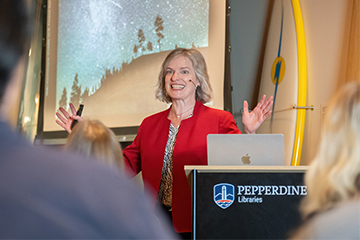 Haarsma speaking about her interest in galaxy clusters
For the renowned astrophysicist, pondering the intricacies of the universe always pointed to greater questions about its creator. Each telescope that discovers an unfound star, each mathematical equation modeling inner workings of the universe, and each satellite reaching a distant galaxy “are working in harmony,” she posited, “with the Christian perspective by revealing the glory of God.”
“Christian theology gives an amazing foundation for how and why we do science,” Haarsma continued. “It’s remarkable to realize that this intelligent and powerful Creator is also the lover of my soul. However, often people who share my positive view of science don’t know the creator who is behind it.”
Haarsma then touched on a perceived divide between scientific communities and those of Christian faith—though the two are certainly not mutually exclusive. In response, she offered tools of peace building. She outlined several approaches for how Christians can engage with science-minded skeptics of faith, and conversely, how to engage with those who are skeptical of science.
This division, Haarsma noted, exists primarily due to a communication gap between scientists and the general public. Topics of contention often revolve around “age of Earth” theories and evolution. While referencing a number of surveys taken across the United States, she also mentioned a lowering of Americans’ trust in the scientific community from 2018–22, during the global pandemic. To remedy a declined public attitude toward science, she called for better scientific communications—messages that are not laden with heavy jargon and are intentional about communicating to their audiences.
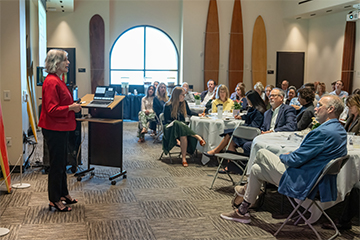 Attendees listened with intent as Haarsma delivered her lecture
She explained that building a sense of commonality is a key way to diffuse tense conversations. For a Christian audience, scientists of the same faith can play a key role in showing that Christianity is not at odds with science, but rather compatible with a shared aim of seeking truth.
“Here’s the opportunity for Christians who are working at [scientific] institutions to be that bridge of trust to communities that are skeptical,” said Haarsma. “Show that Christianity doesn’t reject what they value most.”
Turning to breaking technologies, Haarsma addressed the rapid rise of artificial intelligence. Many are looking to the Christian worldview for guidance, she has observed, due to its deep values of the significance of the human person. For instance, she noted that Christian engineers for decades have been saying that technology should have design goals beside just profit and efficiency or the satisfaction of human hubris. They should promote justice and creativity.
“Technology should help us to become more human, not less,” she added. “The Christian worldview gives us ways of knowing what our purpose is as we decide how to use these technologies.”
To close Haarsma expressed appreciation for the opportunity to speak at the Frank Pack Distinguished Christian Scholar Lecture. Named after Frank Pack, former Distinguished Professor of Biblical Studies at Pepperdine and Churches of Christ preacher, the lecture holds an annual tradition of inviting an accomplished Christian scholar to speak on their area of expertise. Lucy Perrin, who serves as the Rushford Center director and lead archivist, additionally offered opening remarks along with Provost Jay Brewster.
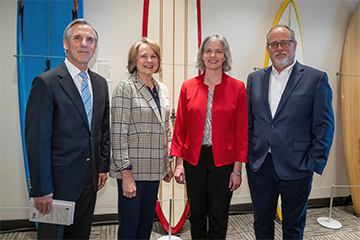 From L to R: Dean Roosa of Libraries, Perrin, Haarsma, Provost Brewster
The lecture, held in Payson Library’s Surfboard Room, resonated deeply with the Pepperdine community in attendance. Each attendee received a complimentary print copy of Haarsma’s book, Origins: Christian Perspectives on Creation, Evolution, and Intelligent Design, which she coauthored with her husband, Loren Haarsma, a professor of physics at Calvin University, who accompanied his wife to Malibu.
Many faculty members from Seaver College's Natural Science Division found their own professional convictions apparent in Haarsma’s words. Physics professor John Mann noted that his Christian faith provides centrality during the process of scientific inquiry.
“My Christian faith shapes how I approach science by grounding my confidence that the universe is ordered and consistent,” Mann explained following the event. “Because God is faithful, I expect the laws of nature to hold across time and space, and studying them becomes a way of exploring and appreciating God's creation.”
Todd Creekmore, an organizational psychologist who serves as assistant director of employee engagement at Pepperdine’s Human Resources department, agreed that the lecture served as a relevant reminder that Christian faith and science go hand in hand. He appreciated that the University convenes such discussions.
“Dr. Haarsma’s lecture gave me a deeper appreciation for how scientific discovery and Christian faith can complement and even strengthen one another in meaningful ways,” Creekmore said. “It’s encouraging to see Pepperdine creating space for these conversations, where the pursuit of truth is both intellectual and spiritual.”
To view Haarsma’s complete lecture, please visit Pepperdine Libraries’ Youtube page.
SUBSCRIBE TO THE WAVELENGTH
Pepperdine Newsroom's official newsletter for campus updates and top news.
Subscribe