Classic Learning Test Founder Jeremy Tate Discusses the Future of Education and the Great Books Tradition at President’s Speaker Series
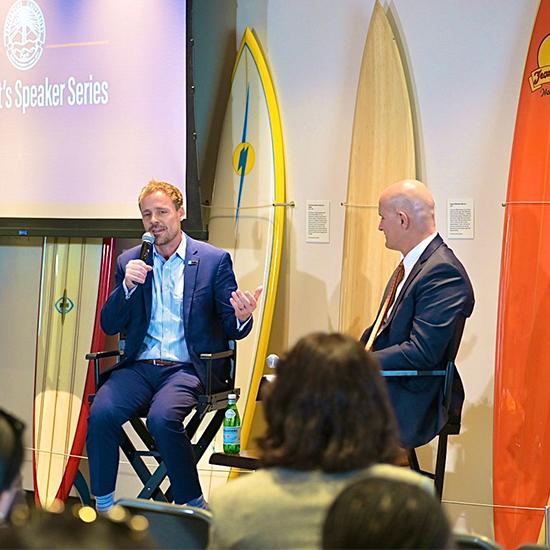
Jeremy Wayne Tate, founder and CEO of the Classic Learning Test (CLT), joined Pepperdine president Jim Gash (JD ’93) for a compelling conversation on restoring an education devoted to students’ moral and intellectual formation in the latest edition of the President's Speaker Series. Held Thursday, February 26, 2026, in Payson Library’s Surfboard Room, Tate also discussed reasoning behind the creation of CLT, the revival of Christian classical learning across the country, and the role of the Great Books tradition in revitalizing an education that, first and foremost, cultivates character.
“Education is never neutral,” said Gash in his opening remarks. “What we choose to teach, how we choose to teach it, and even how we measure what has been taught—these all reflect a vision of what we believe a human being is, and what we believe a human being is for . . . And we believe that students flourish when they are transformed by serious engagement with the great ideas and great works that have shaped civilizations.”
 Tate and Gash had a lively and thoughtful discussion
While introducing Tate as a luminary in educational reform who founded the CLT in 2015 as an alternative to the SAT and ACT, Gash explained that Tate’s Christian, values-centered approach to education is of utmost relevance to Pepperdine’s guiding tenets. “At Pepperdine,” Gash said, “we believe that intellectual excellence and moral formation are inseparable.” He added that Christian faith enriches learning, giving “us our North Star for truth” and “our understanding of human purpose.”
The CLT, Gash then explained, has influenced curricular decisions in schools and propelled conversations about literacy. The test invites students to respond to passages from a pool of roughly 150 foundational thinkers such as Plato, Aristotle, Dostoevsky, Dorothy Sayers, and C. S. Lewis, thereby offering a scholastic pathway that rewards deep intellectual inquiry and does not shy away from Christian thought.
During his time teaching in the public school system, Tate began questioning how standardized testing shapes what schools, and their students, prioritize. He observed the gravity standardized tests carried in defining curriculum, as many teachers were pressured to limit their lesson plans to teach their students just what would help them pass college entrance exams. Education itself had been reduced, and was being treated as a means to an end.
“I wanted to solve the problem I saw happening in education,” said Tate. “While a test is probably never going to change a single student's life, a school changes a student's life. And a test has a big influence on a school remaining faithful to its mission. If we care about the future of our country, we have to care about how we educate the next generation.”
 Tate drew parallels between education and Christian sanctification
Tate’s solution was not to eliminate testing, but to create an assessment that reinforces deep reading and serious engagement with classic texts. The CLT founder explained that “the classics” are the books and stories that have the ability to express “what it means to be human,” thus transcending time and demonstrating the ability to shape character through storytelling.
According to Tate, the CLT saw an explosion of popularity in 2024, rising from 25,000 test takers to 250,000 nationwide, including the nation’s prestigious service academies. Pepperdine University accepts CLT scores and more than 300 universities have joined. Numbers only continue to increase as Tate observes that his exam offered a needed alternative to an educational climate that provided information without any emphasis on individual formation.
At the heart of his mission, Tate explained that the process of virtue education closely parallels Christian sanctification of growing in wisdom, which involves bearing closer resemblance to God and His love. Relating this to his personal experiences with the Great Books, he shared that the reading of Dostoevsky’s Crime and Punishment as a young man brought forth an understanding of the destruction that comes from sin, which, in turn, spurred a pursuit of virtue.
Amid the vapidity of most social media and popular culture, he added that students are searching for meaning. “We are seeing a generation that wants something deeper,” he explained. “They want truth. They want substance.”
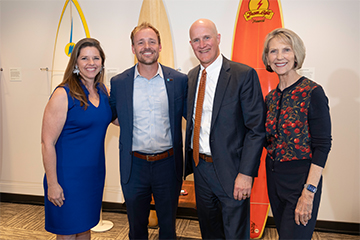 From L to R: Professor Hooten Wilson, Tate, Gash, and chancellor Jackson
In response to Gash’s question about artificial intelligence and the future of technology’s impact on learning, Tate expressed that he remains optimistic: “AI can summarize information,” he said, “but it can’t replace formation. It can’t replace a teacher who inspires, who models virtue.”
President Jim Gash has joined the CLT Board of Academic Advisors, Tate then shared. This board also includes Jessica Hooten Wilson, Fletcher Jones Chair of Great Books and professor of great books and humanities at Pepperdine. “President Gash is the single most dynamic, energetic, and mission-obsessed university president I have ever met,” Tate wrote in a post on X following the event.
A packed audience of Pepperdine faculty, students, and alumni, as well as administrators of Christian elementary schools, high schools, and universities, filled the University’s Surfboard Room as more than 4,000 watched via livestream on X and YouTube.
Kiernan Fiore, dean of curriculum at Holy Innocents School, a Catholic classical liberal arts TK–12 school in Long Beach, California, shared that she traveled with three of her students—Rafael Gonzales, Catherine Cruz, and Thérèse Hope Dyogi—to attend the president’s event.
“I appreciate that Pepperdine is a convener of such pertinent discussions,” said Fiore, “because the value of education is passing on the fullness of humanity.”
 Tate spent time conversing with attendees post-event
Within a few hours of the event, Tate and Pepperdine University uploaded clips of the discussion on their respective X accounts, and soon, these short videos began to garner nationwide attention from passionate leaders in educational reform. Comments of support were authored by Oscar Ortiz Duarte, the CEO and superintendent of Heritage Classical Academy in Houston; The Culturist, a widely popular publication about the classics; the Ascend: The Great Books Podcast; and its host Deacon Harrison Garlick.
Duarte wrote in agreement, “When education stops forming souls, it starts producing technicians without direction.”
An attendee of the president’s event and an aspiring writer, Holy Innocents junior, Dyogi, shares that she has been positively impacted by a virtue-based high school education. She sees the creative process of storytelling as a form of Christian apologetics, where—mirroring the Great Books—her narratives bring readers an understanding of the basis for faith, which is something she hopes to continue to pursue in college.
She said, “An education centered on the Great Books has helped me to see my purpose of bringing people to Christ and to help form them, and to be formed myself, into whole individuals.”
For a full broadcast of Tate’s conversation and previous events in the series, please visit PeppLearn. Learn more about CLT as an undergraduate testing option at Pepperdine University on the Seaver College admissions page.
SUBSCRIBE TO THE WAVELENGTH
Pepperdine Newsroom's official newsletter for campus updates and top news.
Subscribe