Davenport Institute at Pepperdine University Hosts AI Skills Training for Local Government Leaders
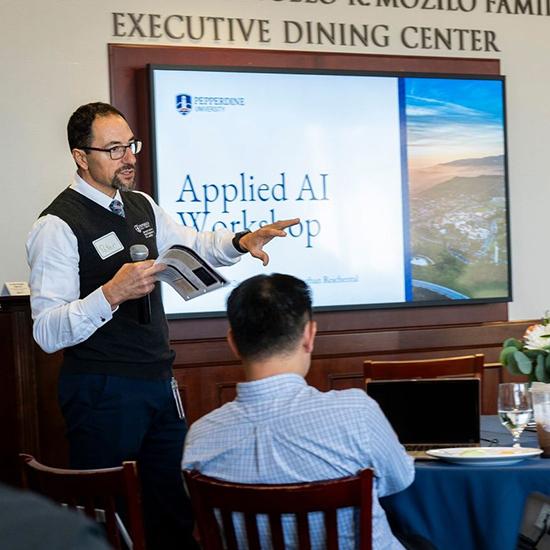
Pepperdine University’s Davenport Institute for Public Engagement and Civic Leadership hosted an immersive, two-day Applied AI in Local Government: Practical Skills for Public Sector Leaders workshop on July 28–29 at Pepperdine’s Drescher Graduate Campus in Malibu.
Through this workshop, local government professionals were trained to responsibly integrate AI into everyday public-sector operations. Through intensive lab sessions and guest panels, participants built confidence with leading AI platforms such as Claude, Google Gemini, and ChatGPT—and each left having learned the tools that can be used across all platforms that can be implemented with the platform their agency chooses to use.
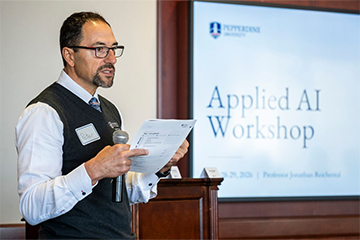 Peter Pirnejad offering opening remarks
Peter Pirnejad, ICMA-CM, executive director of the Davenport Institute, hosted the workshop alongside two industry experts: Jonathan Reichental, founder of Human Future, a global business and technology advisory, investment, and education firm; and Chris Shepard, communications officer for the City of Folsom and founder of Herding Labs, an independent studio creating consumer iOS apps that put AI to practical use.
“AI is expanding what is possible in public service, from deeper research and better decision-making to greater efficiency and responsiveness, but it also raises new questions around trust, transparency, ethics, and security,” Pirnejad said. “Now more than ever, we need to equip local government leaders to use AI responsibly and effectively so they can meet rising service demands while protecting the public trust.”
Over the course of two days, attendees were guided through real local government examples, including how AI can help organize council materials, draft first versions of staff reports and presentations, support data analysis, improve public-facing communications, and create more efficient workflows for city staff.
To close the program, the workshop’s hosts discussed industry insights on the future of AI and shared best practices for responsibly adopting emerging technologies, so these public sector leaders are best prepared to serve their constituents well. In addition to methods they could repeat on Monday morning, attendees left with a network of peers navigating the same transition, and the judgment to know what still requires a human being’s presence.
Josh Boudreaux, human resources director for the city of Lynwood, expressed that the two-day workshop provided valuable insight into cutting-edge AI practices, while introducing him to new alternatives on software usage. As the leader responsible for meeting personnel needs of the city’s departments, Boudreaux said he especially valued the dedicated time to build customized AI tools which align with the unique requirements and regulatory framework of California local government. Furthermore, he expressed that the workshop served as valuable intel for an upcoming public address he will deliver about the intersection of AI and employment relations.
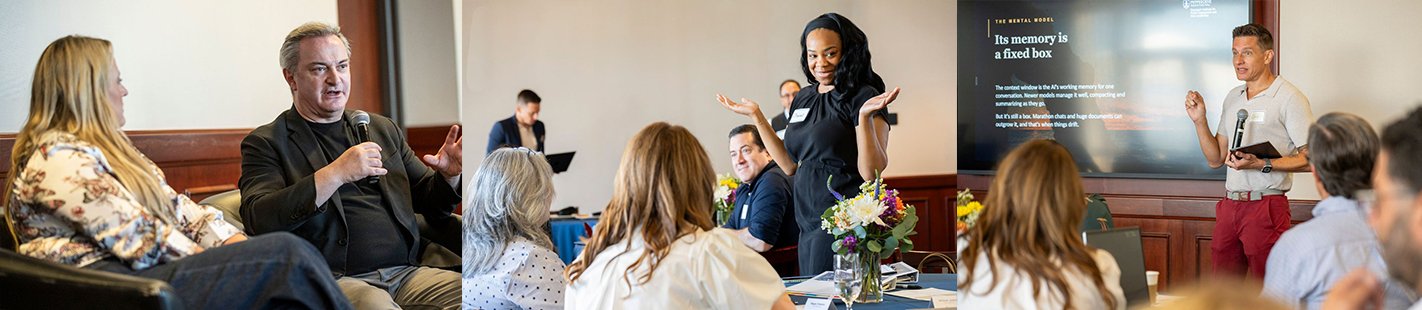 The Applied AI in Local Government Workshop trained professionals on how to apply
these tools in useful ways
The Applied AI in Local Government Workshop trained professionals on how to apply
these tools in useful ways
“Though I am familiar with AI platforms, I wanted to ensure that my understanding of the compliance piece was sound. I also wanted to gauge what level our colleagues across the nation are at regarding AI usage,” Boudreaux said. “The program really provided this information. One of my key takeaways was that we can pressure test each one of our curated AI systems with others, such as Claude versus ChatGPT.”
Boudreaux’s colleague in the city of Lynwood, Shanell Shipe, assistant to the city manager, agreed with his overall sentiments. She further shared appreciation that the workshop equipped her with knowledge and practical tools that she could immediately put to work.
“I came to this workshop to learn how I could use AI to have a more productive day, and take what I learn back to my team,” Shipe said. “I’ve been saying this over and over again, but the custom ChatGPT specialist is going to really support the creation of thorough staff reports to present to our council so that they can make sound decisions for our city. I look forward to taking that straight back to the office.”
Scott Trujillo, assistent city manager of the city of Calabasas added that the program was abundantly successful in "eqipping today's leaders to confidently lead in tomorrow's AI-driven world."
The Davenport Institute for Public Engagement and Civic Leadership, housed within the Pepperdine University School of Public Policy, is dedicated to advancing effective public engagement and civic education. Since its founding in 2005, the institute has worked with local governments, nonprofit organizations, and community leaders to strengthen democratic governance through meaningful public participation.
Under Pirnejad’s direction the Institute continues to expand its international leadership in artificial intelligence, democratic governance, and public trust through new global research supported by the International City/County Management Association (ICMA). The ICMA fellowship will advance the institute’s leadership on how emerging technologies, including generative artificial intelligence, can improve public service delivery while preserving the principles of democratic accountability, ethical leadership, and institutional trust.
The Davenport Institute has two more training opportunities this year; its signature Virtual Professional Certificate in Public Engagement for Local Government on Thursdays from October 15 to November 19, and its next Applied AI in Local Government: Practical Skills for Public Sector Leaders on December 2 and 3 at the Malibu campus.
SUBSCRIBE TO THE WAVELENGTH
Pepperdine Newsroom's official newsletter for campus updates and top news.
Subscribe