National Leaders Discuss Iran War and International Priorities with Public Policy Students

The spotlight was on Iran at the Pepperdine School of Policy as students grappled with one of the greatest threats to American national and economic security this semester.
Kiron Skinner, Taube Chair of International Relations and Politics and founding director of the Pepperdine Institute for Diplomacy, Security, and Innovation, challenged her students in her course, Past Is Prologue, which examines US foreign policy in the modern era through the lens of applied history.
Skinner hosted two leaders from opposite sides of the political aisle: senator Rand Paul (R-KY) and former national security advisor to President Biden, Jake Sullivan.
Both leaders addressed the escalating conflict in Iran and shared their personal philosophies on public leadership with the next generation of policymakers.
Constitutional War Powers and the Cost of Conflict
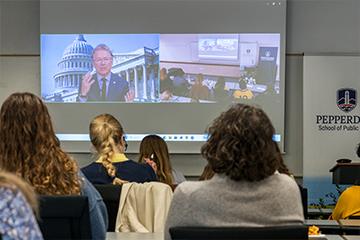 Senator Rand Paul engaging with students virtually
Senator Paul, a vocal advocate for restraints on US intervention, centered the discussion on the constitutional implications of recent military actions, specifically the US military action in Iran that began February 28, 2026, with Operation Epic Fury.
Senator Paul engaged more than 25 graduate students in a deep dive into the separation of powers, arguing that the executive branch has overstepped its bounds by exerting military force without a formal declaration from Congress.
“The initiation of war was something that they [the founding fathers] put in [to the Constitution], and I think really intended that the people would vote on this issue,” said the senator.
Invoking the Constitution’s authors’ desire to avoid the "forever wars" that plagued Europe for centuries, Paul challenged the logic of preemptive strikes against nuclear threats. He noted that warnings of an imminent threat of Iran armed with nuclear weapons have been a fixture of political rhetoric for decades.
“If you look at statements from both Israel and the United States, people who have been proponents of a preemptive war with Iran, they’ve been saying that Iran is one week away from nuclear weapons for literally 25 years.”
For Paul, the decision to go to war is not a strategic abstraction but a moral weight. “The bottom line is it’s an important vote. I think it's the most important vote that I can take. I don’t see it as a geopolitical puzzle,” he continued, “I see it as if I’m sending you or sending one of my kids to fight the battle.”
The senator also highlighted the domestic impact of foreign policy, pointing to the $38 trillion national debt as a primary threat to security. “I actually judge the threat to our national security of the debt being greater than the threat of Iran invading New York or sending ships or people to our country up through Mexico to invade our country.”
Acknowledging the political challenges of his stance, he stated, “These will be difficult votes and difficult for people who then interpret them as somehow not supportive of our young men and women fighting.”
Emerging Global Priorities
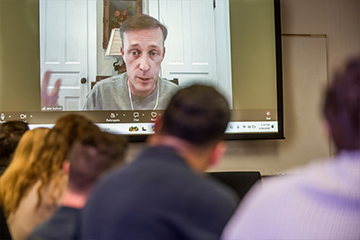 Jake Sullivan answering student questions
Weeks following Senator Paul’s visit, the class heard from Jake Sullivan, who discussed the Biden administration’s efforts to stop Iran from acquiring nuclear weapons. While covering similar ground, Sullivan identified a nuclear-armed Iran as a threat to US interests in the Middle East.
“Stopping Iran from getting a nuclear weapon has been a bipartisan commitment in multiple administrations,” said Sullivan. “My view is the best way to do that is through diplomacy, and that, to me, has to be the real focus for the United States.”
Sullivan briefed students on the evolving nature of the threat, specifically Iran’s use of geography and asymmetric technology—such as the high-volume production of drones—to disrupt global shipping. He then urged students to look beyond the immediate crisis.
“What I have strong conviction about over the longer term is that much of the history of the 21st century is going to be written in the Indo-Pacific region,” he argued. Sullivan expressed concern that while the US is focused on the Middle East, China continues to make strategic advances. He outlined five "races" with China regarding artificial intelligence (AI), ranging from economic integration to the militarization of AI and the control of nuclear weapons.
Sullivan found common ground with his predecessors, applauding the Trump administration’s focus on strengthening relationships in the Western Hemisphere.
“Because I think to compete effectively with China, even to think about the Indo-Pacific, ultimately that geography is connected to the western shores of the Pacific as well,” Sullivan stated.
Where Higher Education Meets National Security
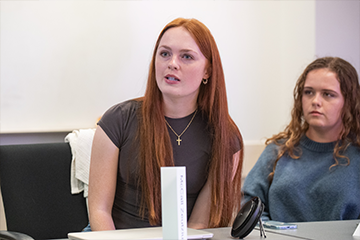 SPP students
The visits were more than just lectures; they were an exchange of ideas that shaped foreign policy decisions and military operations around the world.
One second-year graduate student asked Sullivan how to navigate simultaneous crises across multiple regions. Sullivan’s advice underscored the interdisciplinary nature of modern policy: “As you think about a career in national security, –being, not nearly fluent, but at least conversant in economics and technology will be vital to effectively navigating any future crisis or setting a longer-term strategy.”
As the session concluded, the conversation returned to the value of viewpoint diversity—a cornerstone of the School of Public Policy’s approach to its academic programs, including the Master of Public Policy program.
“I think there has been a shift over the last year or two where more attention is being paid to think about viewpoint diversity and how to disagree agreeably and make sure that people are exposed to a wide range of voices,” Sullivan noted.
While current events within the last year have reignited a national conversation on the true roots of civil discourse among higher education, viewpoint diversity has been championed by the Pepperdine School of Public Policy since 1997. Classes like Past is Prologue represent the interactive model of learning through guest speakers, writing policy memos, documentaries, and cutting-edge readings to guide discussions where students can engage with ideas that challenge their own to solve enduring problems for domestic society and international relations.
Sullivan left the students with a final charge to distinguish between their opinions and their convictions. He urged the future leaders to “hold fast to their convictions but be prepared to change their opinions if they get different information or hear different arguments or different perspectives.”
Learn more about Pepperdine School of Public Policy.
SUBSCRIBE TO THE WAVELENGTH
Pepperdine Newsroom's official newsletter for campus updates and top news.
Subscribe