New Laboratory Facilities at Château d'Hauteville, Switzerland, Expand Pepperdine's Study Abroad Curriculum and Research Opportunities
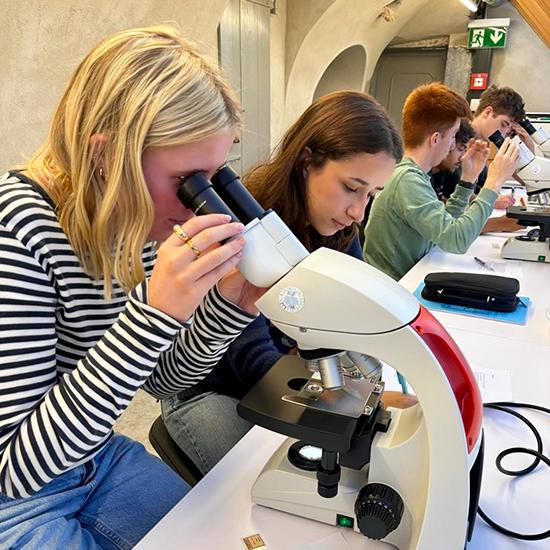
The first semester with a fully functional laboratory space at Pepperdine University’s Château d'Hauteville campus in Switzerland has come to a close, and the spring term is now underway. This new facility represents a transformational milestone for Pepperdine’s global education mission, allowing the château’s faculty in residence to significantly expand curricular offerings within the Natural Science Division.
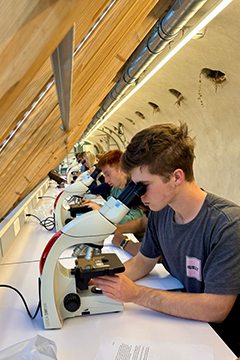 Students using microscopes for research
“Seaver College has a national reputation for student engagement in research and for our extraordinary opportunities in study abroad programs,” says Jay Brewster, the University’s provost and chief academic officer. “Creating our first dedicated international laboratory space at the Château d’Hauteville enables core laboratory science classes and international research partnerships. I am pleased with the impact of this facility upon our students.”
State-of-the-art technology includes advanced microscopes, professional-grade chemical storage systems, thermocyclers, and analytical balances designed for hands-on laboratory experiences. Highly specialized courses such as botany, ecology, and research methods are being taught this academic year. Microbiology lab and immunohistology courses will be available to Seaver College undergraduates in Switzerland next academic year. The lab also has the capability to host future classes in organic chemistry, biochemistry, and cell biology. Critical to the University's high research activity, the lab additionally supports research endeavors among faculty.
“Provost Brewster, dean Lee Kats, and I were able to tour the lab facility recently with a group of faculty,” says Lila McDowell Carlsen, Vice Provost and professor of hispanic studies. “We were impressed with the combination of technical capabilities incorporated creatively into the laboratory space with such unique historical features. Students and faculty at Pepperdine now have a lab that is truly like no other in the world, with the added benefits of the inspiring setting of our Hauteville property and views of Lake Geneva.”
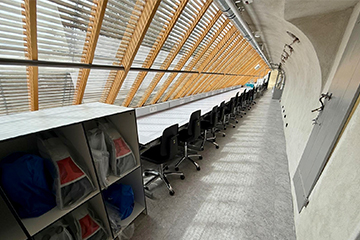 Laboratory facility before installation of equipment
Helen Holmlund, faculty in residence and assistant professor of biology and Donna Nofziger, professor of biology, assisted the lab’s design. They were joined by Ezra Plank, director of the Switzerland Program and professor of religion and Ben Veenendaal, Vice President of Planning Operations and Construction.
The space was formerly a greenhouse, a remnant of the estate’s two and a-half century legacy beginning with the Grand Hauteville family. Holmlund and Nofziger knew they needed to preserve its historical integrity, and to do so was a hands-on operation. Sitting across the floor with scratch paper and pencils in hand, the duo carefully measured the entire area, ensuring the fully functional laboratory would be installed with minimal upheaval to core architecture.
While designing lab furniture and ordering necessary equipment, Holmlund, Plank, and Nofziger consulted with Seaver Natural Science faculty members in Malibu to ensure that the lab would be constructed to serve the widest range of classes.
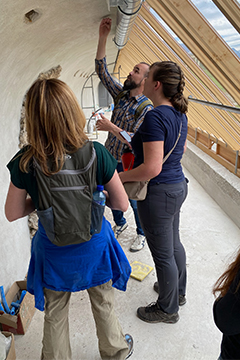 Holmlund, Nofziger, and Plank discussing design
“From the very start, Helen and I got to sit there and dream and think of the possibilities of turning this amazing historical space into a fully functional laboratory,” Nofziger shares. “I’ve been working at Pepperdine for nearly 30 years, and it is profound to think about how this space is the culmination of many people’s work, from its planning to the ground up. This initiative will continue to impact students and provide opportunities for hands-on scientific investigation for years to come.”
Holmlund, whose research examines how various ecosystems shape plant physiology, explains that the château labs enabled her to open a course called European Ecosystems, available fall of 2025. Echoing Holmund’s California Ecosystems course taught in Malibu, students collected native Swiss plants, along with invasive species, from the estate grounds and nearby forests, analyzing their findings in the lab.
“I am very grateful for Pepperdine's investment in this space because it really is a student-focused laboratory that can be used for many years to come,” says Holmlund. “Now my students can explore key ecosystems of Europe, including a travel journal assignment where they can document their abroad experiences while making ecological research observations.”
Expanded course opportunities have proven to benefit those interested in pre-health studies and biology majors, who can now take a full set of major-specific courses. In the past, classes such as Biology of Cells regularly experienced waitlists; however, the opening of the château laboratory facilities increased capacity and made additional seats available.
"Science students in highly structured degree pathways no longer have to choose between staying on track academically and studying internationally—we’ve made it possible to do both at the highest level,” says Plank. “We are grateful to Provost Brewster and his office who have been major supporters of this project from the beginning—both in encouragement and funding—and it would not have been possible without their support.”
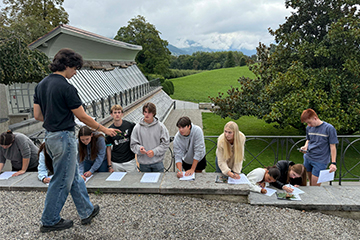 Seaver students completing hands-on research projects
Beyond technical skill development, the lab creates lasting mentorship opportunities. In the château’s residential setting, science students work side by side with faculty researchers such as Holmlund and Nofziger. Yet, this faculty-student collaboration extends beyond lab work. Discussions over shared meals about spiritual formation, for example, reinforce Pepperdine’s commitment to whole-person education.
Administration's long-term vision for the château includes an expanded portfolio of courses in environmental science, ecology, plant biology, and sustainability. Such subjects will be uniquely enriched by the campus’ historical agricultural features, vineyard landscapes, and protected forest ecosystems.
“This learning environment broadens future scientists into global citizens,” Plank adds. “Through our curriculum, students gain a deep understanding of the relationship between science, creation care, and human flourishing. We are ensuring that the next generation of scientists will be curious, compassionate, and globally aware—equipped to do not only good work in the world, but good work for the world.”
SUBSCRIBE TO THE WAVELENGTH
Pepperdine Newsroom's official newsletter for campus updates and top news.
Subscribe