Oncology Symposium at Pepperdine Highlights Innovations in Cancer Research and Patient Care
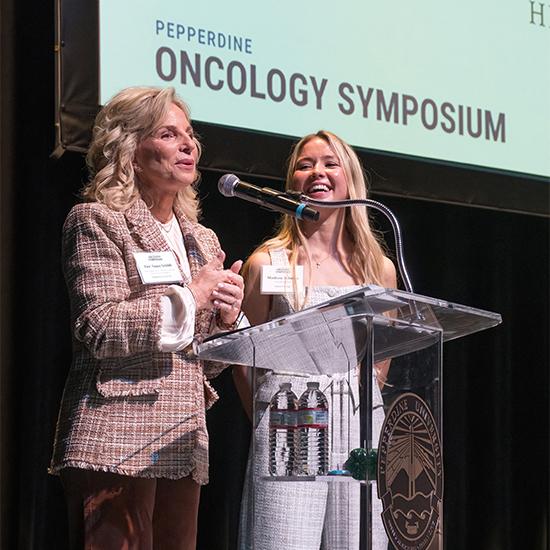
The inaugural Oncology Symposium was the vision of Seaver College student Madison Johnson. Inspired by her firsthand involvement in groundbreaking cancer research, Johnson organized an event featuring the latest breakthroughs in cancer care. The symposium brought together physicians, researchers, and patients to speak on their expertise and discoveries as well as share their personal journeys in the field. Additionally, students—including Johnson—were invited to speak and present their own research findings.
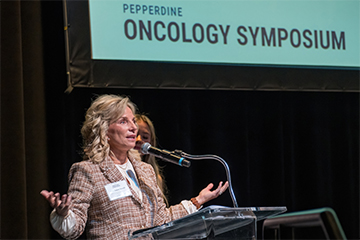 Dee Anna Smith
Held in Smothers Theatre on Wednesday, February 25, 2026, the event opened with Johnson alongside Board of Regents chair Dee Anna Smith (’86). Smith began the program by introducing the day’s agenda and sharing her deep commitment to both Pepperdine and cancer research, describing the event as a meaningful union of those two enduring passions.
In addition to her leadership role at Pepperdine, Smith is a proud alumna and longtime advocate in the field of oncology. “I am the CEO of Sarah Cannon Research Institute, where we conduct oncology clinical trials, and our mission is to advance therapies for patients," she shared. "When I think about Pepperdine’s mission and when I think about healthcare, I am inspired at a completely different level. This symposium is the convergence of the two for me… my driver is my faith, my heart is my friends and family, but my passion is cancer patients and Pepperdine University. Having this in one place…is pretty amazing." Smith added, “Everything that we do, academically, clinically, or otherwise, is to serve patients. It’s our mission at Pepperdine, and it’s our mission in healthcare.”
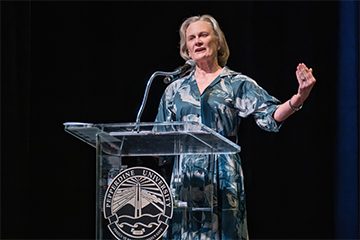 Julie R. Gralow
Following Smith and Johnson's remarks, the event opened with keynote speaker Julie R. Gralow, executive vice president and chief medical officer of the American Society of Clinical Oncology. A renowned oncologist, Gralow shared her journey from lab work to clinical trials, emphasizing patient-centered care and the need for global oncological treatment and study. She highlighted her leadership in developing breast cancer treatments, including a 6,000-patient trial, as well as her work in Ukraine and Uganda. Gralow also addressed the challenges of delivering cancer care in communities with limited access to healthcare—such as constrained funding, small patient numbers, and the need for innovative thinking and cross-sector partnerships. She closed by underscoring the importance of meeting patients where they are and offering hope without false promises, sharing personal stories of patient care, survivorship, and advocacy.
"My interviews with patients and my [work around the world] are what I'm most proud of, and what have brought me the most satisfaction in my career,” Gralow shared, reflecting on her passion for her patients, advocacy, and the fulfillment of meaningful work. “Partner, advocate, collaborate, do what nurtures your soul, and you will be happy.”
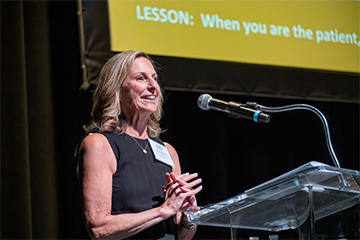 Teri Pollastro
Gralow invited her former patient and friend Teri Pollastro to share her story as a metastatic breast cancer patient. Throughout her presentation, Pollastro illustrated how Gralow's passion for oncology is inseparable from her commitment to her patients. Pollastro describes their relationship as transformational and through her care and encouragement, credits Gralow’s influence with guiding her from a frightened young mother to an influential patient advocate and collaborator in cancer research and care.
“Twenty-three years ago, a doctor called me from Europe to deliver the worst news of my life, and in doing so, she showed me what true patient care looks like," said Pollastro. "She always listened. She gave me hope without false promises. She helped me find my voice.”
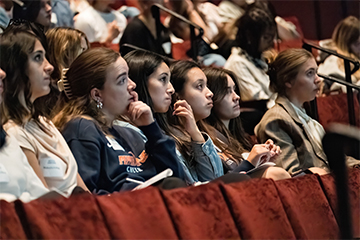 Students at the Pepperdine Oncology Symposium
Following Pollastro's presentation, Johnson moderated a panel discussion highlighting leaders in drug development and featuring experts shaping the next generation of cancer therapies. The panel included Sara A. Hurvitz, a professor of medicine, medical oncologist, and clinical research leader at the University of Washington School of Medicine where she serves as division head of Hematology/Oncology; Andrew McKenzie, vice president of Sarah Cannon Research Institute's Personalized Medicine program; Lindsey Murphy ('10), a pediatric oncologist at City of Hope Children’s Cancer Center; and Shahryar Ashouri, a clinical professor of medicine at the David Geffen School of Medicine at the University of California, Los Angeles. The panel discussed topics ranging from clinical trials and drug development in oncology to the rapid advancements in personalized cancer treatment, emphasizing the importance of genetic testing for prognosis and therapy intensity. They laid out the evolution of oncology, noting the distinction between different cancer types and the progress in treating metastatic breast cancer. Additionally, panelists answered audience questions—describing the significant roles nurses play in oncology care and in clinical trials and discussing how technological advancements are changing the field of oncology, as well as sharing advice to students interested in pursuing a career in cancer research.
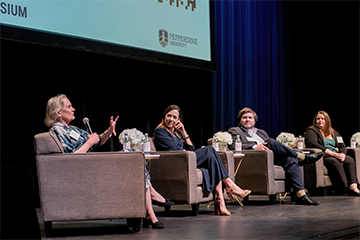 Oncology panel featuring leaders in cancer research
"When doors are closed or slammed in your face—and they will be—look for the next door in the next room, or even a window. Failure is okay and often will lead you to a better opportunity," expressed Hurvitz, advising students interested in this field to know its challenges, but to not be dissuaded by them . McKenzie added, “Every experiment works. You just don’t always know what it’s telling you . . .just because it didn’t tell you what you hoped for, or you didn’t get the result that you thought you wanted, there’s something to learn from that experiment . . . whether that’s in a laboratory or in life.”
Following the event, Murphy shared what it meant to return to her alma mater and represent such an impactful field.
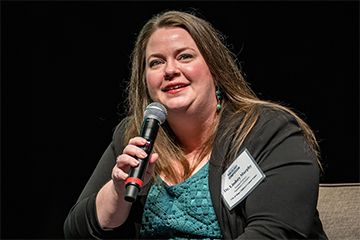 Lindsey Murphy
"I can't put it into words—witnessing the strides Pepperdine is making to invest in not only healthcare providers, but in the advancement of health and patient care, is truly indescribable. As a former student, being invited back to represent my field as an expert at this event is an honor and significant milestone for the profession as a whole. I am so proud of where Pepperdine is headed and the future of the University is really exciting."
The event concluded with student presentations on cancer research from Seaver College students Elizabeth Stansberry, Sophia Palumbo, Joan Argwings-Kodhek and Luke Pontoriero, Chloe Nacorra-Scruggs, Jessalyn Chen and Catherine Nguyen, and event organizer Madison Johnson, who delivered the final presentation. Their various projects covered the effects of radiation on the spinal cord, how socioeconomic factors may influence the healing and recurrence of breast abscesses, and how differences in immune system genes may relate to the bacteria found in breast tissue and their potential role in breast cancer. Other studies used CRISPR tools to turn genes on in breast cancer cells to better understand tumor growth and identify possible treatment targets, while additional research showed how epigenetic drugs can activate normally silent parts of DNA in cancer cells in mice, leading to new tumor-specific markers that could inform future therapies.
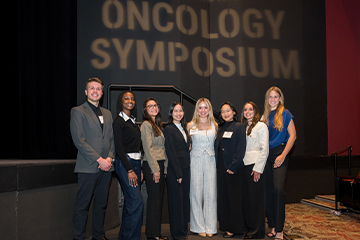 Student presenters
President Jim Gash (JD '93) provided closing remarks, expressing gratitude to students, faculty, clinicians, and leaders who participated in the day's event. He spoke of Pepperdine’s distinctive integration of research, compassionate care, and Christian faith, and celebrated Johnson’s vision and hard work, framing the symposium as the beginning of a sustained culture of healthcare innovation.
“Today has been a powerful reminder of what can happen when rigorous science, generous collaboration, and a deep concern for human flourishing come together,” said Gash.
Learn more about the inaugural event and its featured speakers on the Pepperdine Oncology Symposium 2026 website.
SUBSCRIBE TO THE WAVELENGTH
Pepperdine Newsroom's official newsletter for campus updates and top news.
Subscribe