Pepperdine Marks 25 Years of Women's and Gender Studies with Archival Project and Alumni Stories
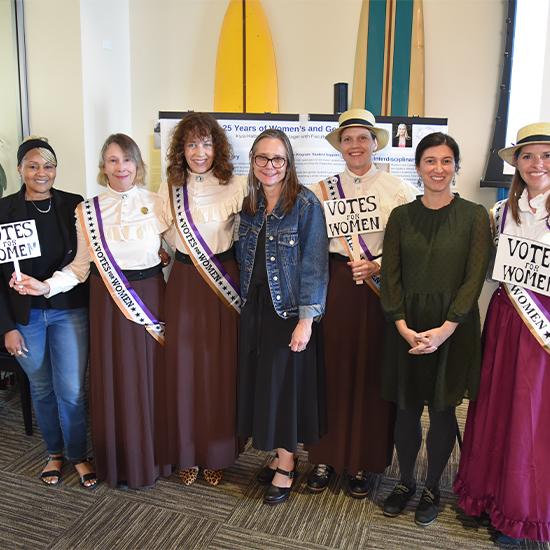
Pepperdine community members recently gathered to celebrate the 25th anniversary of the Women’s and Gender Studies (WGS) program, honoring a quarter-century of feminist teaching, interdisciplinary learning, and student transformation. Cohosted by the WGS program and Pepperdine Libraries, the event combined history, student and alumni testimony, and the unveiling of a new archival initiative that aims to preserve the program’s legacy for future generations.
A Minor with Major Reach
WGS coordinator and associate professor of English Katie Frye opened the event by exploring how WGS fits within Pepperdine’s broader academic landscape. The program is interdisciplinary by design, drawing courses from five divisions: Communication, Fine Arts, Humanities and Teacher Education, Religion and Philosophy, and Social Science. With 14 affiliated faculty members and 10 catalog-listed courses, Frye explained that students can complete the WGS minor by taking 19 to 20 units. In recent years, the program has seen its largest graduating classes, with students coming from majors as varied as biology, English, film, integrated marketing communication, psychology, religion, and sociology.
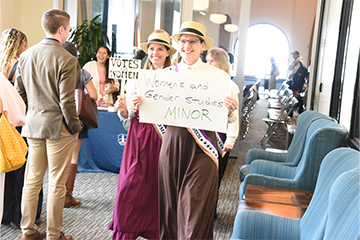 Fake protest at WGS anniversary event
Frye noted that students consistently cite the opportunity to take classes outside their primary departments as one of the program’s most valuable features, gaining tools to analyze how race, class, ethnicity, ability, religion, and nationality intersect with gender identity.
Recovering History
A central focus of the celebration was the story of how the program began. Frye described trying to answer a basic question: Who was the original coordinator of Women’s Studies? Early answers were inconsistent. Through interviews and further research, the archive team confirmed that the founding coordinator was alumna and English professor Erika Olbricht (’91), who helped to establish the program as a minor in 2001.
That discovery became the starting point for a larger project: “excavating” the history of WGS at Pepperdine. Over the past year and a half, Frye has worked closely with library staff Bailey Berry, librarian for digital conversion, publishing, and curation, and Christopher Miehl, archivist for Special Collections and University Archives, as well as former WGS student Kyra Hatton (‘25) and current student Saskia Jager. Together they combed through seemingly countless records, collected surviving documents, and conducted interviews with those who helped shape the program. The emerging archive includes original SAC proposals, syllabi, student letters, and a handful of promotional materials . Among the most striking items are early letters from students advocating for feminist coursework, including a 1999 letter from Amy Turk (’01), who is now chief executive officer of the Downtown Women’s Center which supports women experiencing homelessness.
“Preserving the program’s material culture and its digital footprint so that this piece of women’s history at Pepperdine is not erased . . . to that end, I am deeply grateful and proud of the work that we’ve all done,” shared Frye. “This program—and now the archive—has been and continues to be a collective of scrappy and resilient women."
A Community-Based Archive
University archivist Miehl explained that the WGS project required a community-based archival approach. Unlike more traditional collections that begin with boxes of neatly labeled files, WGS has generated relatively limited formal paperwork. Instead, the project centers on people and their own words. A community archive, Miehl noted, places community members at the top of the process, inviting them to tell their stories directly. This approach is especially important for programs like WGS that have historically been under-documented or overlooked in official records.
Miehl framed the effort as part of a broader attempt to push back against “archival silence”—the absence of certain communities and narratives from institutional history. His role, he said, was largely to “provide the stage,” while faculty, students, and alumni filled that stage with content.
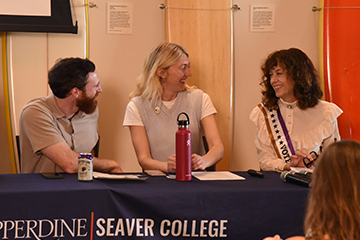 Panelists Christopher Miehl, Bailey Berry, and Katie Frye
Librarian Berry emphasized that archival gaps are a familiar problem for historians. While WGS had some surviving documents, they left fundamental questions unanswered. Berry and the team interviewed 15 individuals—founding faculty, alumni, and current students. They asked interviewees why they became involved in WGS, how it shaped their lives and careers, and how they saw it aligning with Pepperdine’s mission. Those conversations generated a rich record of both program history and personal transformation, much of which was featured in a video highlight reel shown at the event.
Transformative Learning in and Beyond the Classroom
Student and alumni voices throughout the celebration underscored that WGS is not just about course requirements; it’s about learning to see the world differently.
Sofia Reyes (’25), an alumna who double-majored in English and film, credited Dr. Karie Riddle’s Women and Politics course with significantly furthering her academic focus on gender and challenging her intellectually. She recalled how the course surrounded her with peers whose differing viewpoints broadened her understanding. Reyes further shared that the class “really pushed me academically while nurturing my studies in a way that made me feel confident in other courses going forward, and the critical-thinking skills I learned there still inform my work ethic postgrad.”
Speakers also noted that employers may not always recognize the WGS minor by name, but they do value the critical thinking, ethical reasoning, and commitment to social justice that the program cultivates.
Faith and Feminism in Conversation
The event also highlighted how faith and feminist inquiry intersect in the classroom. In the course Women and Politics, Riddle highlights Sojourner Truth—an American abolitionist and activist for African American civil rights and women's rights— as a figure who faced both race-based and gender-based exclusion yet remained rooted in her faith and her commitment to universal rights. In Dr. Nicole Gilhuis’ Food History course, students begin with a “theology of food” with Gilhuis exploring how food connects culture, faith, and place, before turning to everyday items such as bread, chocolate, and fish as “bridges to a deeper reality."
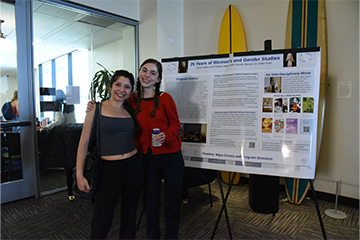 Students posing in front of program history board
Frye noted that "while the colleagues in the program have disciplinary differences that translate to a variety of topics, what shapes and guides our collective pedagogy is each professor's commitment to the Christian mission of our university."
The 25th anniversary celebration framed WGS not as a completed chapter but as an evolving story—one now being preserved in the archives and carried forward by the next generation of Pepperdine students. Frye credits students as the driving force behind the program’s existence and sees the archive as a meaningful step in safeguarding its legacy for years to come.
"Thank you to our students. Without asking for and enrolling in the classes, without your curiosity, your faith and optimism, your tenacity and your commitment, none of this would have been possible,” said Frye.
For more information and to view archival content, visit the WGS Collection on the Pepperdine Libraries website.
SUBSCRIBE TO THE WAVELENGTH
Pepperdine Newsroom's official newsletter for campus updates and top news.
Subscribe