Pepperdine Sudreau Global Justice Institute Helps Make History with Malawi Prison Project

Pepperdine Sudreau Global Justice Institute recently completed a historic three-day Prison Project in Malawi, marking the first time a full version of this program has been held outside of Uganda. The initiative coincided with a major milestone for Malawi’s justice system, as participants witnessed the country’s first-ever formal plea agreement. For more than a decade, the institute's Prison Project has sought to address prolonged pretrial detention and expand access to legal representation for individuals in custody. Through this program, Pepperdine law students collaborate with legal professionals to review criminal cases and help reduce court backlogs that often leave individuals waiting years to have their guilt or innocence determined by a judge. The effort is part of the institute’s broader mission to strengthen justice systems and advance equitable access to justice.
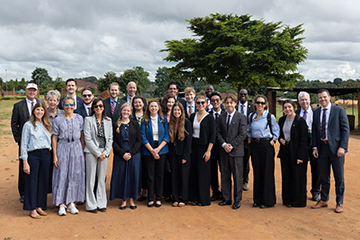 Sudreau team
The historic event also drew regional attention, with judicial leaders from other African countries attending to observe the process and its potential impact. The Pepperdine representatives included eight students from Caruso School of Law and one student from Regent University, alongside a team of attorneys supporting the initiative.
A Historic Milestone for Justice in Malawi
During their three-day stint, the team resolved a total of seven cases, all involving capital charges. However, the true significance lay in the introduction and implementation of plea bargaining.
Seth Bamburg (‘14, JD '17), executive director of the Sudreau Global Justice Institute, commented on the gravity of the achievement: "To see a powerful tool implemented into a justice system in real time was an almost indescribable moment. The judge who accepted the first plea bargain was a judge who had advocated for this tool for 24 years, so it was an incredible honor to partner with the leaders of Malawi’s justice system to see this dream realized." He added, "I’m confident that the momentum and historic collaboration from this week will build a very strong foundation for Malawi to fully integrate plea bargaining into their day-to-day criminal justice process."
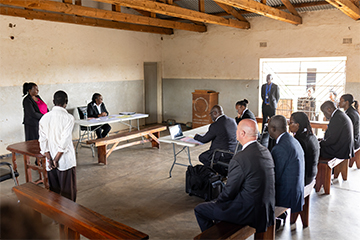 Malawi court room
The event was led by Malawian judicial leadership, including the Honorable Chief Justice Rizine Robert Mzikamanda. In his keynote address, Mzikamanda described the occasion as a “momentous and historic day for the criminal justice system,” emphasizing that Malawi’s commitment to expanding access to justice marks a truly groundbreaking step forward.
“Plea bargaining in a structured manner is an important vehicle for improving access to justice and for achieving justice for all,” Mzikamanda said. He also expressed gratitude for the partnership that made the initiative possible, noting that the effort “would not have happened without the . . . support of Pepperdine University… We cannot thank you enough.”
Mzikamanda further underscored the urgency driving the program, pointing to the systemic challenges facing Malawi’s justice system: “Prison congestion is stubborn… backlog and delay… continue to increase even as we grapple with inadequate resources.”
Those challenges were evident on the ground. The prison, originally built to house approximately 1,000 inmates, currently holds nearly 3,000—highlighting the critical need for interventions that expand access to timely justice.
Impact on Students and Inmates
For Pepperdine Caruso School of Law students, the project offered a profound opportunity to put their legal education into practice while serving those most in need.
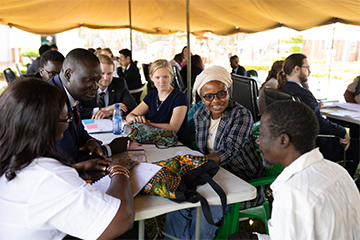 Pepperdine law students collaborate with legal professionals to meet with detainees
Caruso Law student Emma Joy McArthy reflected on both the weight and purpose of the work: “We worked with people who were pleading guilty to really horrific things. That was difficult at times, but it was also a reminder that everyone has inherent worth and value that goes beyond the worst thing they’ve ever done.” She noted the realities many individuals face within the system, adding, “People can wait months or years in prison without anyone speaking to them about their case.”
That experience reinforced her sense of calling. “The people I feel most drawn to serve with my law degree are the people who don’t have a voice, the people waiting in prison who haven’t spoken to a lawyer,” McArthy said. “My guiding verse through law school has been Proverbs 31:8–9: ‘Speak up for those who cannot speak for themselves.’”
For fellow Caruso Law student Max Stone, the experience was both personally and professionally transformative. “The idea of governments holding people in prison without due process is something that really troubles me,” he said. “The Prison Project stood out to me as an opportunity where one decision—choosing to participate—could actually help change someone’s life.”
Additionally, Caruso Law student Josh Finlayson emphasized the collaborative nature and broader impact of the initiative, citing it as a significant event to witness and partake in. “This trip reinforced for me that justice requires more than the commitment of individual defense attorneys. It depends on the collective buy-in of judges, prosecutors, prison officials, and defense counsel all working in tandem,” he said. “It was inspiring to see each of these key stakeholders eager to implement and continuously improve Malawi’s plea bargaining system during this trip.”
Reflecting on the significance of the experience, Finlayson added, “Representing Pepperdine as a law student during Sudreau’s first Prison Project outside of Uganda felt like standing on the shoulders of those who had spent years building the foundation for this work. The program’s success in Malawi makes me excited for Sudreau to expand their plea bargaining initiative to more countries across Africa, bringing greater access to justice to many more people.”
Learn more about the Sudreau Global Justice Institute's initiatives on the Caruso School of Law website.
SUBSCRIBE TO THE WAVELENGTH
Pepperdine Newsroom's official newsletter for campus updates and top news.
Subscribe