Pepperdine University Hosts Thomas H. Olbricht Christian Scholars' Conference
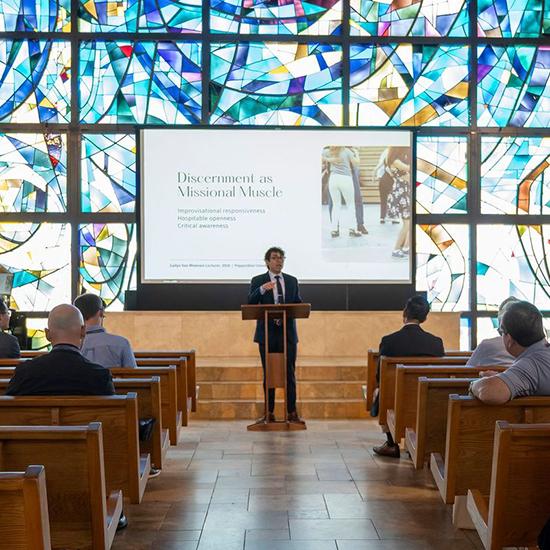
Despite the fluctuating changes occurring in colleges and universities now, or perhaps because of them, many desire for Christian higher education to be resolute in providing students with the opportunity to excel intellectually and develop spiritually.
To this end, Pepperdine University recently hosted the annual Thomas H. Olbricht Christian Scholars’ Conference. Convening academics, theologians, and public intellectuals from across the nation on its Malibu campus for three days from June 3 to 5, 2026, a number of plenary speakers addressed this year’s pertinent theme, “Christian Scholarship as Tangible Good.”
 L to R: Angel Adams Parham, David French, Jessica Hooten Wilson
“May this conference draw our attention to the good happening across our colleges and universities, and may it also underscore opportunities for change that will enhance our effectiveness as we serve a world that is facing proliferating challenges,” said Jay Brewster, provost of Pepperdine, in his opening remarks. “An important question to begin that conversation is—How are colleges and universities serving our society? . . . Are faith-based institutions unique in their approach to these challenges?”
The conference opened with Nicholas G. Carr, celebrated commentator and author of Superbloom: How Technologies of Connection Tear Us Apart, who joined theologian and author Curtis Chang to discuss the path forward toward human connection, especially for college-aged students, in the midst of a society where in-person relationships seem to be increasingly challenging to manage. Their conversation was recorded for the Good Faith podcast and can be listened to here.
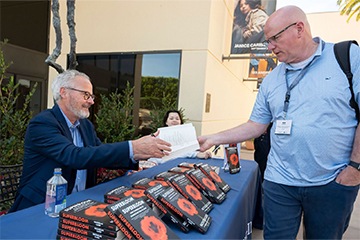 Nicholas G. Carr held a booksigning for Superbloom after his talk
The array of keynote sessions included a discussion on the enduring value of the liberal arts, involving David French, popular opinion columnist for The New York Times and visiting professor at Lipscomb University; and Angel Adams Parham, associate professor of sociology at the University of Virginia; and Jessica Hooten Wilson, Pepperdine’s professor of Great Books and Fletcher Jones Endowed Chair of Great Books.
“The attack on liberal arts education comes often from misunderstanding. Liberal arts education is not for the elite; it is not a luxury. Creative and rigorous thinking should not be sidelined as optional to your college experience,” Hooten Wilson insisted.
Additional convenings included the Robert E. and Bonnie Cohn Hooper Plenary on Christian Scholarship hosted by Byron Johnson, Distinguished Visiting Professor of Religious Studies and the Common Good. As a leading researcher on the impactful role of faith on human flourishing, Johnson drew upon his work to discuss how his findings support the need for faith-based institutions.
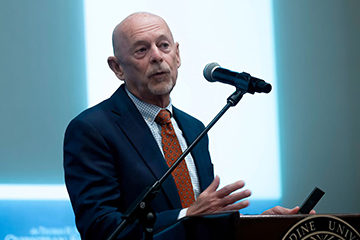 Byron Johnson
Reflecting on annals of data from his Global Flourishing Study partnered with Baylor University and Harvard University, to the audience he shared that devoted Christian faith, as well as education, stand as key “pathways to flourishing.” And this finding remains consistent across the global stage.
“These are what we call pathways to flourishing, where we've written a number of papers on these topics, family, work, education, and religious community,” said Johnson. “If you want to know how to flourish, these are the communities that can accelerate human flourishing. And so, here we are, not only an educational institution, but one that's Christian. Active Christians have higher flourishing scores globally.”
Annually the Thomas H. Olbricht Christian Scholars’ Conference rotates among various university hosts including Pepperdine University, Lipscomb University, and Abilene Christian University. Created under the leadership of Thomas H. Olbricht, renowned biblical scholar, author, and former chair of the Religion and Philosophy Division at Pepperdine, the conference has continued to be a locus of discussion of interdisciplinary faith-based scholarship.
Throughout the three-day event attendees were also invited to join a number of activities from RISE and Shine Yoga, presented by the Pepperdine RISE Institute, as well as tours of the Getty Villa, a Malibu staple. Members were also welcome to a viewing of liturgical manuscripts in Christian heritage and Saint John’s Bibles, presented by Pepperdine Libraries.
 Univeristy Presidents discussed the value of Christian higher ed
The final morning hosted the President’s Panel, moderated by Johnson. Four university presidents from across the country—Candice McQueen of Lipscomb University, Tim Westbrook of York University, Michael Williams of Harding University, and Jim Gash of Pepperdine University—gathered in Elkins Auditorium to discuss the value of Christian higher education—an approach to schooling that stands firm in forming students intellectually and spiritually, while actively supporting the development of their sense of purpose and well-being.
The university presidents also discussed a vision for Christian higher education’s most meaningful future, promoting an academic environment that propels students to become flourishing, lifelong learners. Amid climbing levels of aimlessness, disfranchisement, and loneliness within the younger generation, many attendees contended Christian higher education’s mission to guide purpose and moral clarity within a stable community is needed more than ever before.
“Christian schools need to lead their way into a future that has lost its North Star,” said Gash. “That's what young people need, that's what we all need, is to understand that there's purpose. The answer to how we live is found in scripture, and it's found in community, and it's found in faith-based institutions. We at Pepperdine are going to be preparing students to understand that and to be leaders.”
SUBSCRIBE TO THE WAVELENGTH
Pepperdine Newsroom's official newsletter for campus updates and top news.
Subscribe