Professor Edward J. Larson Relates Why 1776 Matters with New Book

Opening the spring semester’s lineup of the W. David Baird Distinguished Lecture Series, Edward J. Larson, Hugh and Hazel Darling Chair in Law and University Professor of History, presented his latest book Declaring Independence: Why 1776 Matters. Held on Wednesday, January 28, in the Payson Library Surfboard Room, Larson’s lecture, “The Meaning of 1776” traced key findings of his archival research that exemplified the significance of this pivotal year.
In light of the nation’s upcoming 250th birthday on July 4, Larson explained that 1776 marked the full-force actualization of the patriot aim. “What changed in 1776 was Americans’ embrace of independence as the foundation for their freedom and as the Revolutionary War’s goal. The full history of 1776 sheds light on what mattered to Americans then and the legacy it left thereafter,” he said.
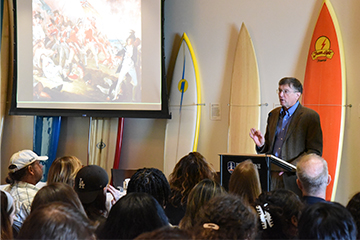 Larson addressing the audience
A scholar of the law and history, Larson emphasized the radical nature of the Founders’ rejection of the centuries-old European traditions of monarchy and divine right. Instead, with 1776 publications such as Thomas Paine’s Common Sense, the Declaration of Independence, and a flurry of drafted state constitutions, law was established as the new king. And this law made “by the people, for the people,” Larson explained, had the paramount aim of offering the greatest sum of human happiness while elected representatives partook in free, fair, and frequent elections.
“In Britain at the time, legal status and political office came from birth,” he added. “But by replacing reigning monarchs and ruling lords with elected leaders, American independence gave impetus to the principle of equality under law.”
Larson contended that the revolution of 1776 extended far beyond the battlefields. Quoting John Adams’ 1815 letter to Thomas Jefferson, he added, “‘The War? That was no part of the Revolution. It was only an effect and consequence of it. The Revolution was in the minds of the people.’”
The spirit of 1776, Larson explained, was present throughout the early American populus. Both public documents and private letters reflected this ethos, such as soldiers quoting the Declaration of Independence as they wrote to their loved ones from the throes of war.
Modern Americans likewise draw inspiration from the ideals of 1776. For example, Larson observed that former US presidents John F. Kennedy and Franklin D. Roosevelt both referenced the Declaration of Independence, the latter doing so on the eve of World War Two to embolden citizens with American fundamentals.
“To these leaders and those inspired by them, 1776 mattered,” Larson remarked as he took questions from lecture attendees. “For American independence in all forms, it still does. These individual rights of life, liberty, and the pursuit of happiness embraced during 1776 became the beating heart of the American dream.”
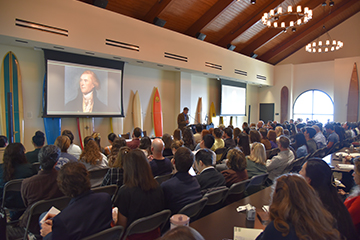 Attendees engaged with Larson's lecture
“The Meaning of 1776” welcomed a packed audience of Pepperdine students, faculty, staff, and friends of the University. Among these attendees included Lee Kats, dean of Seaver College, and Donna Nofziger, professor of biology, who had offered the lecture’s opening remarks.
There was a strong alumni presence at Larson’s lecture as well. Seaver College alumna Elizabeth Starkey (’25), hailing from Temecula, California, explained that she was first introduced to Larson’s work at 13 years old. The following year she published her debut novel, The Revolutionary Alternative, inspired by events of the Revolutionary War, at the remarkable age of 14. At Seaver Starkey majored in history, studying under Larson while enrolled in his Legal History and History of Science and Technology courses.
Starkey then shared her appreciation for the depth of Larson’s expertise, as he has authored or coauthored 16 books and more than 300 published articles within the domains of American history, legal analysis, and history of science, including the Pulitzer–Prize winning book, Summer for the Gods, which examines the 1925 Scopes “Monkey” Trial in Tennessee.
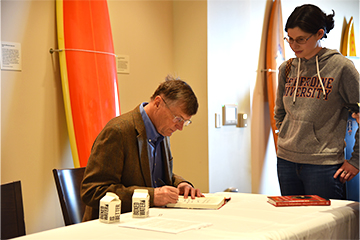 Larson signing Starkey's copy of Declaring Independence
“I started reading Larson’s books in my early teens and was pleasantly surprised when I realized that my professor was the very author I grew up reading—he was a notable figure in my academic career,” Starkey said. “I enjoyed gaining a deeper insight into his thought process while researching and writing Declaring Independence—it was inspirational and eye-opening as a young historian to understand the technique and rationale of an acclaimed professional.”
In addition to his lecture, Larson expressed the honor of participating in the W. David Baird Distinguished Lecture Series, as Baird himself, during his tenure as dean of Seaver College, recruited Larson to Pepperdine.
The W. David Baird Distinguished Lecture Series draws important scholars and public figures from many disciplines for stimulating discussions, in honor of David Baird’s rich scholastic legacy. Upcoming W. David Baird Distinguished Lectures include “Minding Justice: Mental Health and Criminal Law” by Kate Bonnici, assistant professor of English, on February 11, 2026 and “Always November: Lessons in Love, Loss, and Resilience” by author Arik Housley (’96) on February 19, 2026.
SUBSCRIBE TO THE WAVELENGTH
Pepperdine Newsroom's official newsletter for campus updates and top news.
Subscribe