Professor Emeritus of Biology Stephen D. Davis Presents Vast Pressed Seaweed Collection
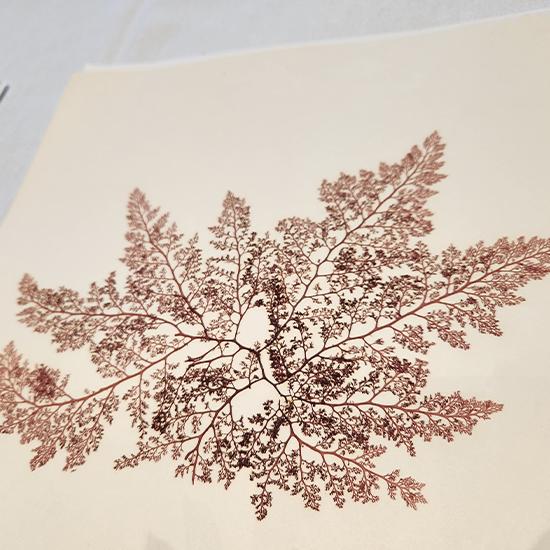
Unbeknownst to many, seaweed serves as a history book for the ocean, as these botanicals absorb and document the health of seawater within their tissue.
To preserve these annals of oceanic history, Stephen D. Davis, Professor Emeritus of Biology, donated a vast collection of 198 pressed, dried algae specimens to Pepperdine Libraries’ Special Collections and Archives. Having compiled this impressive collection over his 46-year career as a leading expert in Southern Californian ecology, Davis partnered with Pepperdine Libraries and first lady Joline Gash (’92) to host a special viewing of his collection and subsequent activity where attendees pressed and preserved their own seaweed specimens.
When a library’s special collections come to mind, one often thinks of books with clothbound covers and delicate pages of literature. But during the viewing, Lucy Perrin, director and archivist for Pepperdine Libraries' Rushford Center for Research and Churches of Christ Heritage Collection, remarked that Davis’s collection of seaweed and marine algae elevates the repository to be a library of the natural world.
“Steve, I wonder if you foresaw the extent of the impact this collection could have on the library and the college,” marveled Perrin. “One important reason to preserve these specimens is to make them available for future student research projects. So we thank you for having the vision to give these specimens to Pepperdine.”
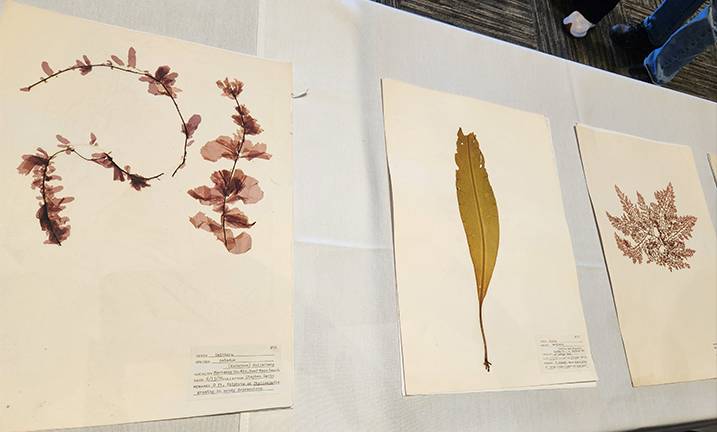 A number of Davis's pressed algae specimens
Perrin then explained that the specimens support Seaver College natural science research by providing a means for faculty to compare current nutrient pollution levels with that imbued within the preserved seaweed from the 1970s and 1980s. Though the marine botanicals are dried and pressed onto mounting paper, Seaver researchers are permitted to lift small clippings of the seaweed for further investigation. By sharing notice of the collection’s contents in a recent journal publication, Perrin invited researchers outside of Pepperdine to also seek access to it.
“Professor Davis’s remarkable collection transforms decades of field research into a lasting resource for discovery. We very much look forward to making these materials available for teaching, research, and learning,” said Mark Roosa, dean of Libraries.
Davis then took the podium to share many of the research excursions that led to the acquisition of the algae and seaweed specimens. While many were gathered locally along the Californian coast, Davis noted that a majority were sourced specifically from northern California where Stanford’s Hopkins Marine Station is located. There, in the 1970s, Davis encountered Isabella Aiona Abbott, lauded educator and phycologist, who he credited as a source of scholarly inspiration. Abbott pioneered the study of Pacific marine algae, discovering and naming more than 200 species. Befittingly, she earned the moniker “First Lady of Limu,” meaning “seaweed” in Hawaiian.
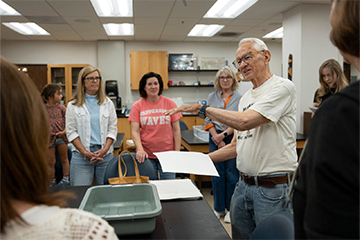 Davis explaining how to press and preserve sea algae
Having worked with Abbott throughout his career in Californian ecology, Davis shared a copy of Abbot’s watershed book Marine Algae of California for attendees to explore as he spoke.
According to Davis, the foundation of effective education, whether it be of students or adult attendees at a lecture, lies in fostering active engagement with the lesson at hand, rather than relegating students to the role of passive observers. Davis practiced this pedagogical approach, and he is well-known for taking his students on location to ocean sites and hillsides alike to gather botanical specimens for his in-class research.
“When students are out in the field making observations and talking with their professors, that’s when they light up,” the biology professor remarked.
The event proved to be particularly special for attendees such as Gash, who was a student of Davis’s while a biology undergraduate at Seaver College. She maintained that Davis has remained a trusted mentor throughout her own teaching career, as she taught high school science courses, including marine biology, beginning in 1993.
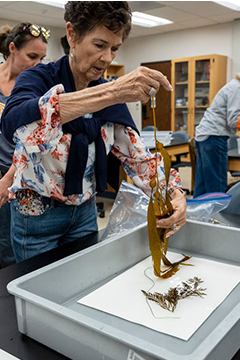 Attendees created their own pressed samples
“Besides being such an excellent scholar and teacher, Steve taught me so much about life, family, faith, and my career as an educator,” said Gash. “I still remember being a student, researching in his microbiology labs. Then, when I became a teacher, I knew I could always call him, and we could discuss ideas. So, I really appreciate that we all get to spend this special day with him.”
After Davis’s lecture, attendees—comprising the spouses of Pepperdine Regents and spouses of administrators—took a visit to Seaver’s natural science laboratory. There each participant pressed their own seaweed specimen, which Davis had gathered fresh that morning, onto mounting paper.
After a period of one to two weeks, the seaweed will fully dry and its gelatinous substances (alginates and agar) will act as an organic glue, adhering it to the paper. Each attendee will have their project mailed to them, so they can keep a lasting token of the afternoon.
Along with Gash, Deanne Lewis ('84), wife of regent John T. Lewis ('83), had Davis as a professor while in a marine environment course as a first-year student at Seaver College. The experience of viewing the vast collection of seaweed gathered by her former professor—to the opportunity to create her own preserved specimen—proved to be a treasured moment of nostalgia.
“It was so interesting to listen to Steve Davis speak about the biology of different types of seaweed, kelps, and algae. Also, I really enjoyed hearing about all the different scientists he has worked with throughout his career,” said Lewis. “I felt like I was in class again!”
SUBSCRIBE TO THE WAVELENGTH
Pepperdine Newsroom's official newsletter for campus updates and top news.
Subscribe