Professor Kiron Skinner Addresses Current State of US Foreign Policy at Commonwealth Club Event
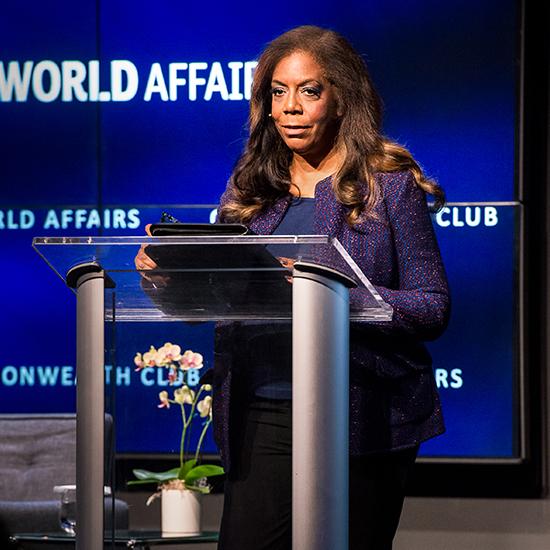
Offering an assessment of the current state of US foreign policy, Kiron Skinner, Taube Family Chair of International Relations and Politics at Pepperdine University's School of Public Policy, delivered a timely address titled “Understanding the Complexities of Our New Global Landscape,” at the Commonwealth Club World Affairs of California in San Francisco on Wednesday, September 10, 2025.
Hosted by the Commonwealth Club in partnership with Pepperdine University, Skinner’s presentation was a feature of the public affairs forum’s American Values Series underwritten by the Taube Philanthropies, founded by Tad Taube, visionary philanthropist. Skinner’s address was the final event Taube sponsored before his passing on September 13, 2025. Taube’s legacy endures at Pepperdine through the Taube Family Chair of International Relations and Politics at the School of Public Policy, held by Skinner, who established the University's Institute for Diplomacy, Security, and Innovation.
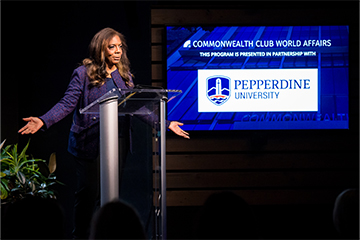 Kiron Skinner speaking
Pepperdine president Jim Gash (JD ’93) and chancellor Sara Young Jackson (’74) attended
the event. Dianne Taube, chairman and CEO of the Taube Philanthropies, and Gloria
Duffy, president and CEO of the Commonwealth Club World Affairs of California, also
attended the event. Russell A. Berman, Walter A. Haas Professor in the Humanities
at Stanford University, served as mediator during the event’s discussion in which
Skinner responded to questions posed by Berman and audience members.
Recognizing the anniversary of the terror attacks on September 11, 2001, Skinner remarked
how the event reshaped the structural realities of American foreign policy for generations
to come. In the years that followed, the Global War on Terror emerged as the forefront
national concern, which as a result, deferred the United States’ focus from designing
a comprehensive strategic framework that addressed simultaneously shifting global
alliances and power dynamics. This currently takes the form of evaluating transatlantic
relations between the US and the European Union, particularly in the context of the
Middle East, among other issues.
Skinner provided an analysis of the current state of global policy and its pressing
challenges by referencing watershed moments that occurred throughout 20th-century
US history, emphasizing that a commitment to freedom and free speech must remain pillars
of the American spirit if the nation is to continue with fortitude and principled
policy impacts.
“Our country was built on people who spoke too loudly, worked too hard, and didn’t
do the ‘right’ thing,” Skinner said. “That’s the suffragettes. That’s the Civil Rights
Movement. All of our big moments were when people stepped into the public square and
got really busy. They believed in the foundation and the principles that made this
nation great. We need to do that again.”
The throughline of Skinner’s address was the importance of continuing an intellectual discourse of “big ideas,” a principle rooted America’s foundational texts, further supported by leaders such as President Ronald Reagan, that empower bold and imaginative thinking that protects religious freedom while evaluating an incumbent class of political figures who often disregard the reality of current affairs.
Skinner further asserted that the American university is the ecosystem that contributes to creating these great ideas. “Post 1945 we remade the American university, and it became the engine of our amazing economy,” said Skinner. “Big ideas are what make America great when you take our history into consideration. If we stay in the status quo, not only will we not be a great power, we may cease to exist. It is the only way to secure freedom.”
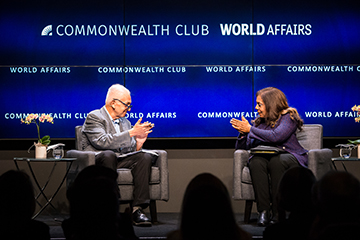 Kiron Skinner and Russell A. Berman in discussion
Skinner announced that she recently established Pepperdine’s Institute for Diplomacy,
Security, and Innovation. As its founder Skinner stated that the purpose for establishing
this institute was to bridge the gap between intellectual and policy ideas and decision-making
in a rapidly evolving global order. The institute focuses on supporting a new American
Grand Strategy through convenings such as seminars, conferences, and summits. The
institute will also publish research-based and opinion essays in its Journal of Diplomacy, Security, and Innovation.
“Pepperdine’s ambition with this institution is to unite leaders to create a standout
think tank that allows deeper contemplation of domestic and international affairs,
adding a necessary component to the academy that isn’t merely a beltway to Washington,”
said Skinner.
Skinner expressed gratitude for Pepperdine and Taube Philanthropies who have provided
platforms to share her point of view as a scholar and policy maker who participates
in open dialogue. She acknowledged the continual support from Moses Libitzky; Gloria
Duffy, whom Skinner has shared a lasting friendship; and Condoleezza Rice, former
Secretary of State.
Skinner brings a wealth of experience to this leadership role, having served as director
of the Office of Policy Planning at the Department of State and senior advisor to
the Secretary of State from September 2018 to August 2019. Her past government service
includes membership on the US Department of Defense's Defense Policy Board, as an
advisor on the Iraq and Afghanistan wars and on the Defense Business Board, among
other roles.
“What’s been important for me with Pepperdine is that there is an openness about faith
and freedom and its role in our democracy,” Skinner explained as she closed her address.
“If you believe in America, you believe in ideas, in our thought process, and you
believe in universities.”
During the event’s discussion period mediated by Berman, Skinner remarked, “In the
university, where you are still engaging with students, you are still training and
committed to the principles—when they are working well—that the university stands
for. Students aren’t tied to theories yet, so they will ask basic questions that take
you back to the beginnings of science.”
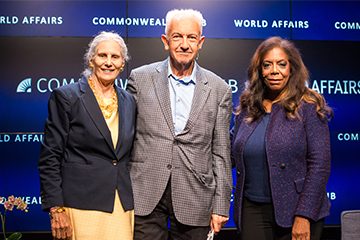 Gloria Duffy (left), Russell A. Berman (center), Kiron Skinner (right)
Berman echoed Skinner’s sentiments, as he remarked that while, “9/11 affected the
soul of the nation and our historical consciousness,” it is important for universities
and other institutions to uphold “the constellation of realism and idealism that goes
through American history,” in the midst of a shifting global order.
Skinner addressed the perceived gaps between academic international relational theories
and their real-world implications. Skinner also expressed concern about the current
atmosphere of fear among students to ask heterodox questions, remarking that they
should never be afraid to do so, as this jeopardizes the formation of astute foreign
policy thinkers.
In closing, Skinner called for educators and policymakers alike to set the conditions
for people to be free as they conceive strategies for the American position among
emerging foreign policy shifts, along with current transatlantic and global relations.
She said, “This nation has so much goodness in its bloodstream that if we unleash
it again with ideas grounded in freedom and faith, and not the religion of politics
and the incumbency, I think we will have a different world.”
SUBSCRIBE TO THE WAVELENGTH
Pepperdine Newsroom's official newsletter for campus updates and top news.
Subscribe