The "Straus Approach" and Sudreau Global Justice Institute Collaboration Leads to Successful ADR Trainings Across Africa
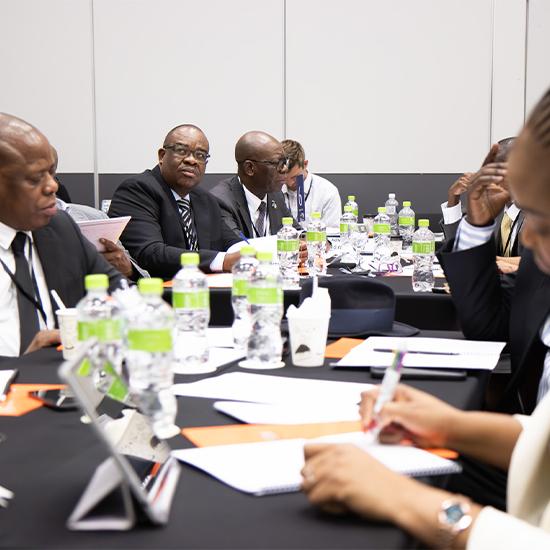
This spring, the Sudreau Global Justice Institute reached 245 judicial stakeholders across five African countries through a series of commercial mediation trainings designed to strengthen national justice systems.
Pepperdine Straus Institute for Dispute Resolution graduates John (MDR ‘09, JD ‘09) and Corrie Napier (‘04, MDR ‘20) led the commercial mediation trainings. The husband-and-wife team, founders of Pax Napier, a consulting and mediation firm, frequently partner with the Sudreau Global Justice Institute to train judges, lawyers, and other judicial stakeholders in practical mediation techniques that support more effective and efficient justice delivery. In March, the Napiers and Judge John Erlick taught Foundational Commercial Mediation in Botswana and Ethiopia, as well as Advanced Commercial Mediation in Zambia. An experienced mediation and arbitration professional, Erlick brings 40 years of experience as a civil litigator and trial judge to his work as a trainer. In May, the Napiers continued their efforts by leading Foundational Commercial Mediation trainings for judicial stakeholders in The Gambia and Sierra Leone.
 John and Corrie Napier
In addition to the commercial meditation trainings, Kyle Smith and McKamie Chandler of the Sudreau Global Justice Institute, alongside Judge John Erlick, led plea-bargaining trainings in Botswana, The Gambia, and Ethiopia, which focused on criminal case resolution. This momentum builds on the institute’s extensive ADR outreach in 2025, which included 13 training sessions that equipped 561 judicial stakeholders, including 15 chief justices.
From a Cultural Practice to a Formal System
For the Napiers, witnessing the impact of civil ADR training across diverse countries and legal contexts has been deeply meaningful. They emphasized that while mediation has long existed as a cultural practice in many of these regions, equipping legal professionals with structured tools to formally integrate it into judicial systems marks a significant step toward expanding access to justice.
“The feedback we have received from every country has both encouraged us to remember that peacemaking and mediation are always needed," shared the Napiers. "There are always opportunities to grow, both for the participants in each country as well as trainers and learners.” The Napiers pointed to several examples of the trainings' impact. In a recent session, a judge shared that she was inspired to become a mediator once she retires from the bench. In another, an attorney described how the training deepened their appreciation for the transformative power of mediation and its potential to positively influence both cases and the broader legal system.
The Straus Approach
Reflecting on the mission and success of the recent trainings, the Napiers shared that their preparation at the Pepperdine Straus Institute for Dispute Resolution was essential. "Not only was our education through Straus the basis for the theory and philosophy we developed in the trainings, but the approach that Straus employs of turning mediation and ADR theory in practice with practical role plays and simulations is the primary way these trainings have had such a large impact," they shared. "Every time we conduct the training, we receive feedback about how much more effectively they learn with the Straus approach."
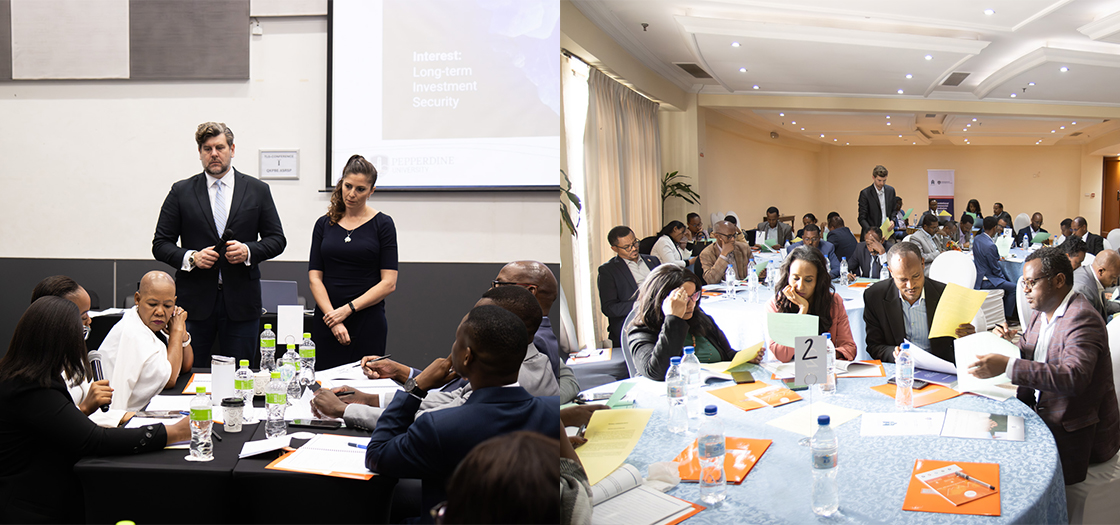 The Napiers leading trainings in Botswana and Ethiopia
When considering what stood out most during the experience, the Napiers pointed to the eagerness and humility of judicial leaders across each country, along with their shared commitment to strengthening their nations’ legal systems.
“In every country we’ve had the privilege of engaging, we find the judiciary and other legal professionals are eager to learn and practice, as well as find tangible and achievable ways for their countries to advance mediation as a dispute resolution mechanism in their formal legal system.”
One example that stood out to the Napiers involved a distinguished judge who had been mediating for 10 years but still attended the training to see if there was something new to learn. Reflecting on that experience, they shared, “The humility exhibited by such a prominent judge released the whole room to feel the freedom to engage the training in a genuine and focused manner.”
Zambia: A Leader on the Continent
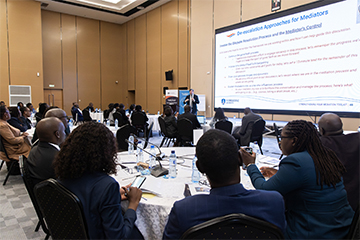 Training participants in Zambia
During the opening ceremony for the Advanced Commercial Mediation Training in Zambia, speakers highlighted the country’s growing leadership in advancing Alternative Dispute Resolution. The Honorable Lady Justice Abha Nayar Patel reflected on the significant progress Zambia has made since the Foundational Commercial Mediation training the year prior. She shared that mediation referrals increased dramatically in 2025, with 1,540 cases referred to mediation across the country, compared to the average of approximately 400 cases during the previous year. Lady Justice Patel emphasized that these results demonstrate the growing impact of ADR in reducing court congestion and resolving disputes more efficiently. She credited the support of national leadership, the commitment of the judiciary, and the ongoing partnership with Pepperdine University for helping advance access to justice initiatives throughout the country.
Pepperdine senior vice president for Global Impact, Danny DeWalt, shared that the Honorable Chief Justice of Zambia was unanimously voted the next chair of the Africa Chief Justices’ ADR Forum in October 2025. DeWalt praised the judiciary’s commitment to expanding ADR both within Zambia and across the continent, describing Zambia as a leader in advancing alternative dispute resolution.
For more information, visit both the Sudreau Global Justice Institute and Straus Institute for Dispute Resolution official websites
SUBSCRIBE TO THE WAVELENGTH
Pepperdine Newsroom's official newsletter for campus updates and top news.
Subscribe