UK Headmistress Katharine Birbalsingh Discusses "Strictly Education" at Pepperdine President’s Speaker Series
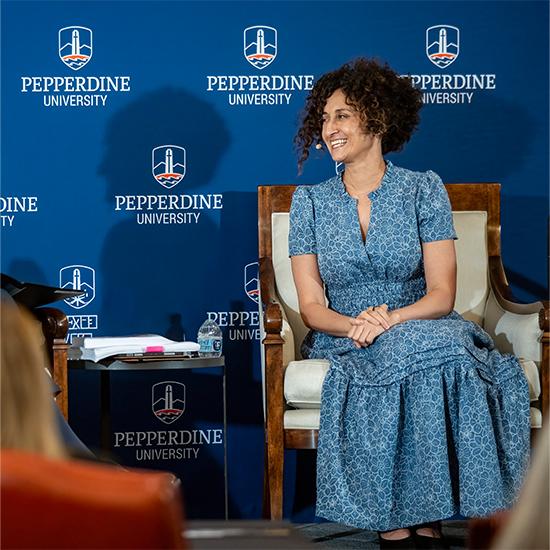
Katharine Birbalsingh, headmistress and cofounder of the London-based Michaela Community School, joined Pepperdine president Jim Gash (JD ’93) for the second installment of this academic year’s President Speaker Series on October 23 to discuss the fundamental purpose of education. Deemed “Britain's strictest headmistress,” Birbalsingh relayed the backstory behind this moniker, as well as how high moral and academic standards help children to achieve their greatest potential.
“At Pepperdine we still believe that intellectual excellence and moral formation belong together—and are indeed inseparable,” said Gash. “Today, we turn to questions that matter to every educator and student in this room and, indeed, at this University: What is true education? What is its end goal? What do we owe the young people entrusted to our care?”
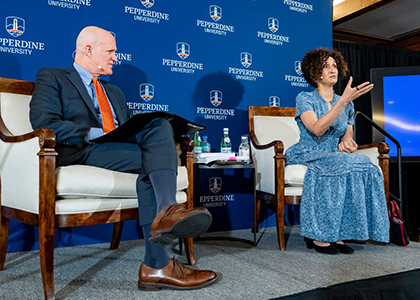 Birbalsingh and Gash discuss cultivating personal excellence in students
Gash opened the event by sharing that he first met Birbalsingh at the Alliance for Responsible Citizenship (ARC) Summit in London, where he was compelled by her vision for primary and secondary education, one that pairs rigorous academics with moral formation and self-discipline. Serving primarily inner-city children, Michaela was built in 2014 from scratch by Birbalsingh, with a founding premise that any child, no matter the background, is capable of excellence.
Birbalsingh shared that a misconception about love and discipline is widely held, clarifying that the two are not mutually exclusive. “Strict means that you love your students enough to keep your standards high.”
This “strictness,” Birbalsingh explains, often brushes up against what some consider the norms of the contemporary classroom. However, for Birbalsingh, holding children to low standards “is to undermine the resilience that they need to take personal responsibility, to take feedback, and to be, as I'm always saying to them, a better version of yourself today than you were yesterday.”
“Kids want to be held accountable,” she continued. “Our job as parents and as teachers is to hold the line. But we're always too interested in looking ‘good’ in the child’s eyes. But we must do what's right, and often what's right doesn't necessarily make us feel good inside.”
Following their first meeting at ARC, Gash shared that he and his wife, Joline Gash (’92), traveled to London to visit Michaela. Recounting a visit to the school’s cafeteria, Gash shared that he was anticipating the usual lunchtime chaos, but was moved to find the schoolchildren joyfully engaged in thoughtful conversation.
“Appreciations” was the lunchtime tradition the Gashes had walked into, where children around the table engage in a time of gratitude, learning to communicate gratitude for both great successes and life’s simple moments, such as one child’s comment that he wanted “to thank my mom for waking me up this morning.”
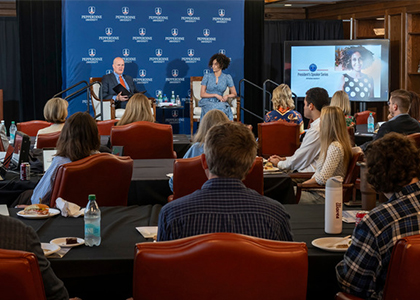 Birbalsingh and Gash speaking to a filled audience
“You've got ordinary, inner-city children who are so keen to learn. Their hands are flying up in the air. They know so much. They're so polite, and they're so kind and so well behaved,” Birbalsingh said. “Basically, we’re doing what people say is impossible.”
Birbalsingh insisted that the responsibility of inculcating proper, basic manners—such as listening quietly and engaging in informed conversation—and the practice of gratitude is upon educators. “If a child is not taught how to be grateful, they will not be grateful,” Birbalsingh added. “They will just take everything they've got for granted.”
According to Birbalsingh, in Michaela’s 12 years of operation the school has had 7,000 visitors. Many of these visitors have been educators desperate to find solutions to behavior issues that plague modern classrooms, she added.
A unity of values, Birbalsingh said, is a driving force behind Michaela’s success. Referencing her forthcoming book, Diversity Is Not Our Strength, Birbalsingh described “multicultural patriotism” as a practice that observes varying ethnic backgrounds while remaining unified under regard for one’s current country and common moral compass.
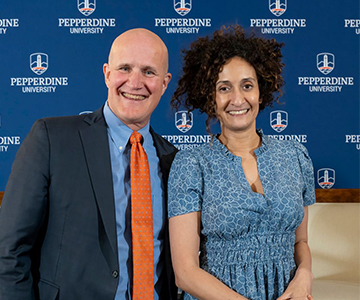 Birbalsingh and Gash
Following Birbalsingh and Gash’s conversation, he presented her with a token of his regard, a ceremonial coin detailing this year’s annual presidential theme of Courage. “If I had to take one word to describe you, Katharine, it's courage,” he said.
The event welcomed a full audience of the Pepperdine community including educators from other institutions. Many attested to being moved by Birbalsingh’s bold vision for educational reform, which instills dignity into children through high standards.
Bob Bowne II (JD ’95), a Pepperdine alumnus and parent, expressed appreciation for Birbalsingh’s lived mission. “Katharine is empowering kids that have been told by everyone that they don’t have a fair shake in life. She tells them, however, that they are completely able to excel and far surpass those that have more of the advantages existing educational frameworks say matter,” Bowne said following the event. “The same individual values that teach your children for their success are the same values that she’s teaching at her school.”
Likewise, Myron McClure, director of intercultural affairs at the University, who has previously taught as an adjunct professor at local junior colleges said, “What was meaningful for me was the conviction that love and discipline should not be separated,” says McClure. “Often to learn what is right requires correction. The teacher should have the ability, with love, to instill high standards upon their students to help shape the next generation.”
Find a full broadcast of Birbalsingh’s conversation here.
Photo Credit:
All images courtesy of Ron Hall, University photographer
Subscribe to Wavelength
Pepperdine Newsroom's official newsletter for campus updates and top news.
Subscribe