AI’s Biggest Healthcare Challenge Is Leadership, Not Technology, Experts Say at Pepperdine Graziadio Business School’s Future of Healthcare Symposium
Speakers discuss how artificial intelligence could transform healthcare delivery while raising new leadership, governance, and equity challenges
MALIBU, California – Leaders from across healthcare, technology, and business gathered at Pepperdine Graziadio Business School on March 12 for the 2026 Future of Healthcare Symposium to examine how artificial intelligence is reshaping healthcare delivery, workforce dynamics, and patient access — and why leadership, oversight, and trust will determine whether that transformation succeeds.
Media assets are available here.
Pepperdine University President Jim Gash and Graziadio Dean Deborah Crown opened the symposium, while John Figueroa (MBA ’97), senior advisor to the U.S. Secretary of Veterans Affairs and founding benefactor of the symposium, shared remarks on the event’s growth and the accelerating role of artificial intelligence in healthcare.
The symposium featured a virtual keynote address from AI and technology strategist Shelly Palmer, CEO of The Palmer Group, who urged healthcare leaders to focus less on the novelty of AI tools and more on how organizations adapt to using them responsibly.
“These tools give us an opportunity to have better patient outcomes everywhere, better take care of patients, better monitor their health, and turn data into action,” Palmer said.
Palmer also cautioned attendees against assuming AI systems can operate without accountability, particularly as organizations begin adopting more autonomous tools and agentic workflows.
“Agents are people. They are employees – synthetic employees – and they will need human oversight,” Palmer said. “There’s no time in the near future when they won't need human oversight."
Following the keynote, a panel of healthcare and business leaders examined how AI
is already affecting clinical workflows, supply chains, investment strategy, and patient
care. Moderated by Amy Towner (MBA '18, PKE 139), CEO of the Health Care Foundation for Ventura County and a Graziadio Board member,
the discussion focused on what it will take to translate innovation into meaningful
outcomes across healthcare systems.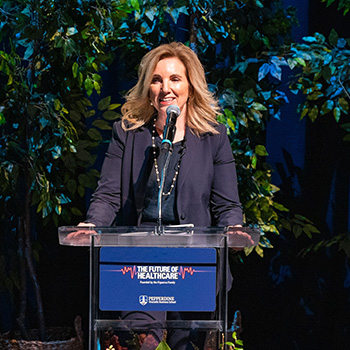
“We are here to look at the last mile of AI implementation,” Towner said. “Technology must optimize the business of care, not as a replacement for human leadership, but as a catalyst for operational excellence.”
Shawn Lin, medical director at UCLA Health–Calabasas Stein Eye Center and associate program director for the UCLA Health Ophthalmology Residency Division of Cataract and Refractive Surgery, said AI’s greatest promise in healthcare is not simply improving efficiency but restoring clinicians’ ability to solve problems and lead change.
“The thing that AI needs to do is that it needs to give doctors back agency,” Lin said.
Lin also argued that burnout in medicine stems from more than long hours or administrative burden.
“I believe the core burnout is the identity collapse of taking somebody who’s a builder and making them a button pusher,” he said.
Billie Jo Nutter, operating partner at HCAP Partners and advisory board member at
Neurosteer, emphasized that healthcare leaders must evaluate AI not only by its sophistication,
but by whether it expands access and improves outcomes across the communities it is
meant to serve.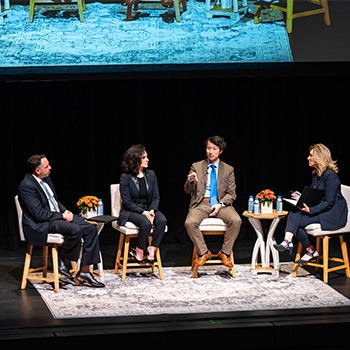
“I don’t think we’re going to judge healthcare by how advanced the technology is,” Nutter said. “I think we should judge it by how broadly we can spread those advancements across the population.”
She warned that poorly implemented AI could deepen inequities rather than reduce them.
“If we do it poorly, we’re going to unintentionally create a two-tier system,” Nutter said.
The panel also featured Peter Eskander, director of supply chain end-to-end digital transformation at Amgen, who discussed how AI is influencing operational decision-making and creating new demands for oversight, data integrity, and cross-functional leadership.
The annual Future of Healthcare Symposium brings together executives, clinicians, investors, students, and alumni to examine the forces shaping the future of healthcare. This year’s program focused on the intersection of artificial intelligence, leadership, and healthcare delivery, with discussions ranging from governance and workforce impact to equity, trust, and patient-centered innovation.
###
About Pepperdine University Graziadio Business School
For more than 50 years, the Pepperdine Graziadio Business School has challenged individuals to think boldly and drive meaningful change within their industries and communities. Offering a comprehensive range of BSM, MBA, MS, executive, and doctoral degree programs grounded in integrity, innovation, and entrepreneurship, the Graziadio School advances experiential learning through small classes with distinguished faculty that stimulate critical thinking and meaningful connection. Students and working professionals are inspired to realize their greatest potential as values-centered leaders. Follow Pepperdine Graziadio on Facebook, X, Instagram, and LinkedIn.
Media Contact
Public Relations Office
pr@pepperdine.edu
818.702.1401