Alumnus Dan Wright Brings Life-Saving AI Technology to the Edge

Far away from big cities and suburban life there exists “the edge”—the remote or high-risk places where reliable communication can be scarce.
At the edge, sleet-gray waves of the North Sea toss boats about like toys, avalanches on Alaska’s frontier plummet into mountain valleys, and military forces work in locations where every second matters. Today, sensors and drones can gather vital information about potential hazards. But in these remote places, processing that data can take too long, leaving responders without the needed information to make split-second decisions when lives are at stake.
Why has nobody solved this problem? Dan Wright (’06) had wondered before launching Armada, a technology company that transports AI-powered computing “in a box” to these remote environments.
Twenty years after graduating from Seaver College, Wright recently returned to Pepperdine for the President’s Speaker Series and his conversation with President Jim Gash (JD ’93) revealed how studying the humanities, and a transformative study abroad experience, prepared him to lead Armada.
Though a tech trailblazer, Wright is distinctly committed to designing technology with an intentional greater good in mind, and in Armada’s case, toward a greater good of saving lives.
“Pepperdine was formative as a student, but has continued to be formative and has stuck with me throughout my life and career,” says Wright “We are all about saving lives or preventing people from harm, and to me, that is what is so compelling about Armada. My other companies were really amazing to build, but I'd never before been part of a company where you have such an impact in the real world.”
From Great Books
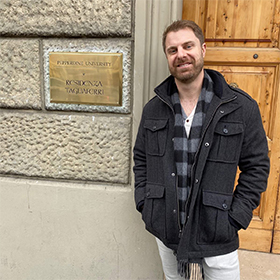 Wright revisiting Residenza Tagliaferri residence hall
While walking the cobblestone paths of Florence, Italy, as a Pepperdine student studying abroad, Wright realized how deeply literature, art, and events of the past continue to influence the human experience.
With this understanding, Wright developed a particular fascination with the Great Books and the centuries-old wisdom they possessed, which have shaped generations of profound thinkers. While majoring in international business, Wright also minored in Italian, diving into Dante’s Divine Comedy in its original language.
During his international studies, Wright also met and fell in love with his Pepperdine sweetheart, Betsy Wright (’06). The couple married shortly after graduation and now happily have three children. Recently, Wright returned to Florence with Betsy and members of their extended family, retracing the paths he once walked as a student, while reflecting anew on the lasting value of his undergraduate education.
"The Great Books taught me to think at a deep level and then be able to precisely communicate those thoughts," says Wright. "I got immersed in history from my travels. My liberal arts education allowed me to think beyond the contemporary and really anchor myself in history to understand how the past shapes what’s going on today."
As a student, Wright found one common trait among his literary and historical heroes: “They had a purpose bigger than themselves,” says Wright, “and they were bold enough to go after it to try to make a dent in history.”
 Dan (middle right) and Betsy Wright (middle) with their family in Florence
The lessons Wright learned from the worn pages of Great Books would shape the biggest decision of his career.
To Great Innovation
Following the success of two businesses—DataRobot and AppDynamics—Wright could have easily rested on his laurels and left the problem of “the edge” for someone else to solve. But lives being lost to preventable emergencies was a concern he could not abandon.
“I felt it was a moral responsibility to build this company,” Wright adds.
He began exploring statistics, spending late nights poring over research, asking, How many people around the world were affected by preventable emergencies? How many people are facing natural disasters without proper warning? How many people were losing their lives on battlefields where detection data was left unprocessed?
Wright found that 70 percent of the world lacked access to technology capable of processing the enormous amounts of information gathered by sensors and monitors. In remote locations, latency was the most pressing challenge, as those most in need of immediate data processing had to wait hours or even days following a crisis.
Wright’s solution? Send these modular data centers, called Galleons, designed to deliver computing power directly to remote locations. Among the organizations Armada has helped is the Alaska Department of Transport and Public Facilities, to process drone imagery across the Last Frontier for potential landslides, avalanches, flooding, and other high-risk events. Prior to Armada, the state would face delays of more than 24 hours in processing information. Now first responders can make informed decisions within minutes.
“The only way to do anything about this data that was not reaching the edge was to bring the actual physical infrastructure,” says Wright. “And, to me, that was a really compelling problem to solve.”
 Armada’s Galleons on the road
Pioneering the Edge
Armada's namesake and technology pays homage to centuries-worth of nautical innovations. The Galleon, Armada’s family of modular data centers, finds its name from the 16th-century ship, while the company's name references a fleet of ships or aircraft with its “A” logo representing a double sail.
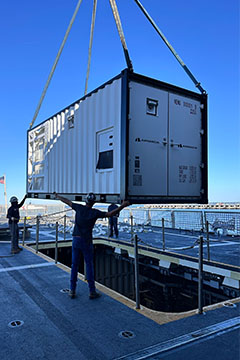 Armada’s contribution to UNITAS
This spirit of exploration is continually represented in Armada's work. The company was the first to deploy data centers in extreme environments, from the frigid Arctic to the Saudi Arabian desert, where temperatures can reach 130 degrees. In addition, Armada has an ongoing partnership with the United States Navy to service previously communication-denied environments.
“We are just scratching the surface of what we can be,” Wright says. “The company is about bridging the digital divide, and I think you’re going to see many more of us involved in increasing the velocity of that mission.”
Advice Wright would offer to any Pepperdine student with an entrepreneurial spark is to “take advantage of all that is around you.”
True to that entrepreneurial spirit, Armada has recently partnered with Pepperdine to cofound the Waves Innovation Accelerator, which will help students develop their own companies through mentorship, venture-building support, and connections with key investors and industry leaders. In addition to Wright’s engagement with his alma mater, Betsy, also remains connected to the University by serving as a trusted member of the Seaver Board of Advisors.
With Armada, Wright hopes to show students that technological innovation should not be distant from real-life issues, rather, that it can “solve really important problems in the world.” Likewise, he encourages all to never distance the humanities from science, as cultivated ethics are necessary to steward these brand-new technologies.
“Pepperdine has continued to be formative and has stuck with me throughout my life and career,” says Wright. “I will always take what I learned in Great Books to my current work, especially spending enough time with a book to add something brand new to the discussion. We are now doing that at Armada. We’re writing our own story, and that’s pretty epic.”
Subscribe to Wavelength
Pepperdine Newsroom's official newsletter for campus updates and top news.
Subscribe