Armada CEO Dan Wright ('06) Discusses "Bringing AI to the Edge" at the President's Speakers Series
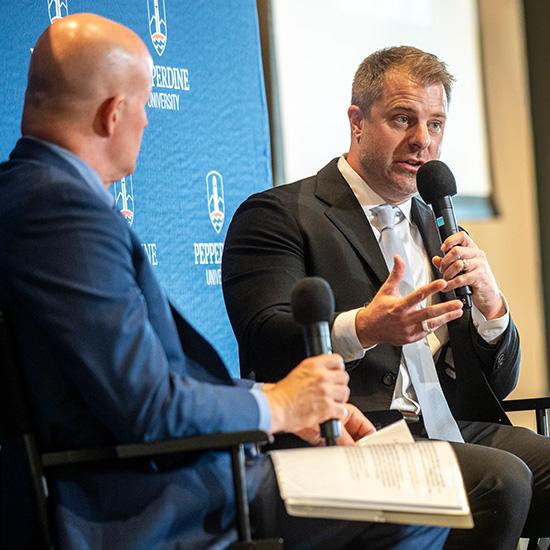
As the use of AI for the sake of human flourishing remains a topic of pressing importance, Dan Wright (’06) cofounder and CEO of Armada—a company bringing AI infrastructure to remote and industrial sites across the world—joined Jim Gash (JD ‘93), president and CEO of Pepperdine University, for the first installment of the 2026-27 President’s Speaker Series.
Held Tuesday, September 1, 2026, in Payson Library’s Surfboard Room, “AI at the Edge: Building the Infrastructure of the Future,” delved into Armada’s work of bringing transportable AI data centers to “the true edge,” including remote and crisis zones, natural disaster-stricken areas, industrial sites, offshore oil fields, and key national-security environments.
Wright also addressed the broader ethics surrounding AI use and how his Pepperdine education, especially time immersed in centuries-old wisdom of the Great Books, informs his vision for the future of AI technologies.
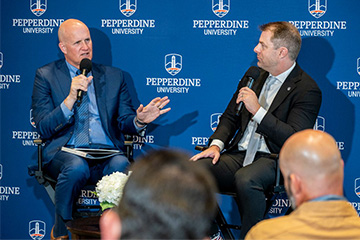 Gash and Wright in discussion
“Few subjects at the present will shape our shared future more profoundly than artificial intelligence,” said Gash. “Most public conversations about AI focus on what happens on our screens or inside enormous data centers. Today's conversation takes us somewhere else . . . to places where the data is actually generated and the decisions made can carry immense human consequences.”
Asked by Gash what motivated him to launch Armada, Wright explained that only 30 percent of the world’s population has access to the data center clouds that house data for AI use. However, the other 70 percent of the world’s population, including remote zones and places of crisis, are the areas that could benefit from AI infrastructure. Transportable data centers on wheels called galleons, a name inspired by 16th-century cargo ships, were Armada’s solution to expanding AI accessibility.
Following the success of his two technology companies—DataRobot and AppDynamics—Wright encouraged entrepreneurs to follow his path of using their resources and experience to tackle hard questions. For Wright, the hard question was how to bring AI to crisis zones.
“People in big cities think AI is everywhere,” Wright said. “It’s not. About 70 percent of the world still operates essentially as it did decades ago in terms of computing and connectivity.”
The conversation turned to Alaska, where natural disasters are frequent and sometimes lethal, as a real-life example. Using sensors to monitor avalanches, floods, and other hazards, Alaskan authorities once had to send their data to a major cloud provider for processing, resulting in a 28-hour delay that offered minimal help when a fatal occurrence could unfold in seconds.
Yet by installing an Armada modular data center inside the state, the data processing could occur in real time, enabling authorities to detect threats and respond quickly enough to save lives during an emergency. Wright explained that the technology has broad applications, including dam and levee monitoring, glacier movement, and geospatial intelligence for fires and floods.
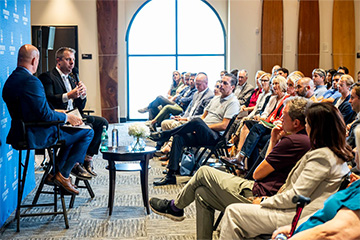 Gash and Wright's conversation welcomed a full crowd
“The highest purpose of AI, in my mind, is saving lives,” Wright said. “You can’t prevent bad things from happening in the world, but what we can do is try to be proactive to avoid as many of them as possible and, when they do happen, mitigate the damage.”
Wright credited the humanities with informing his stewardship of such unprecedented technologies. Pepperdine’s Great Books program and professors such as Paul Contino contributed to his formation into a person of purpose and integrity, he added. The depth of thought and careful writing demanded in those courses still shapes how he leads and makes important business decisions.
“Studying the Great Books taught me to go very deep on a topic, think carefully, and write persuasively, Wright said. “In business, you’re constantly telling your story to investors, to recruiters, to customers. The ability to think and communicate clearly is critical.”
Preserving human dignity should always be at the forefront of efforts to steward these powerful technologies, Wright continued. He points to his Christian faith as being his true North regarding the responsible use of AI. Wright also underscored the importance of the United States and organizations maintaining ownership and control over their AI infrastructure, a concept known as AI sovereignty.
“There’s a very real concern about ownership and control,” he said. “People don’t want their AI controlled by a hyper-scaler, by a single foundation model company, or by a rival nation‑state. They want to preserve their own sovereignty.”
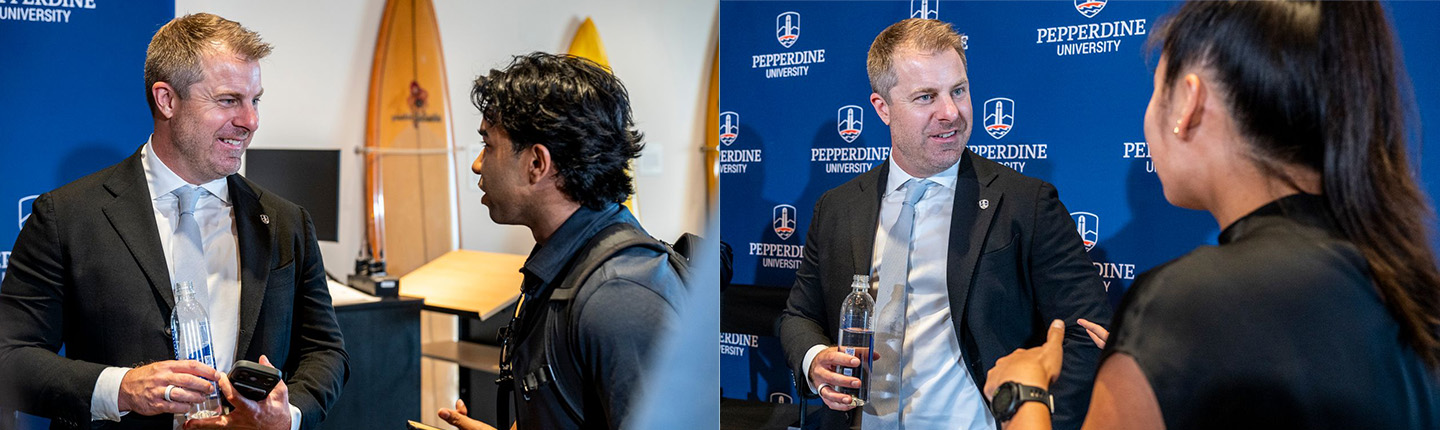 Many students discussed business ideas and the future of AI with Wright following
the event
Many students discussed business ideas and the future of AI with Wright following
the event
In closing recognition of Wright’s efforts, Gash presented the Armada founder with a Courage coin inspired by the 2026-27 presidential theme, honoring Wright’s resolve to be an ethical leader in the AI sphere. Wright then expressed gratitude for the Pepperdine community, which remains a source support in his life and the special place where he met his wife, Betsy, while he was a student.
“Pepperdine is a uniquely important place right now,” Wright said, “to help shape people of character who will go out and build the next great company that changes the world—and do it from a place of faith, from a place of mission, and from a place of trying to give to the world.”
“AI at the Edge: Building the Infrastructure of the Future” welcomed a crowd full of Pepperdine students, faculty, staff, and alumni interested in learning more about Wright’s cutting-edge use of AI, as the technology remains top of mind across the nation.
For Seaver College senior Austin Bishop, cofounder of the Waves Innovation Summit who is developing his own agentic AI company, Wright’s emphasis on using emerging technology to serve others resonated.
“Dan Wright’s conversation with President Gash showed how AI can bring value to people’s lives and even save lives,” Bishop remarked. “I love how he described the necessity of having a good mission behind your work and am glad to be at a place like Pepperdine where I am encouraged to find my purpose and bring that to life.”
The conversation concluded with Wright reflecting on his greater purpose: “I think I'm doing exactly what I was put on earth to do,” Wright said, “which is to try to build something that has a positive impact on the world and in the process, inspire some other mission-driven, faith-driven entrepreneurs to do the same thing.”
For a full broadcast of Wright’s conversation and previous events in the President’s Speaker series, please visit PeppLearn.
Subscribe to Wavelength
Pepperdine Newsroom's official newsletter for campus updates and top news.
Subscribe