Celebrating 40 Years of Great Books: A Conversation with Michael Gose
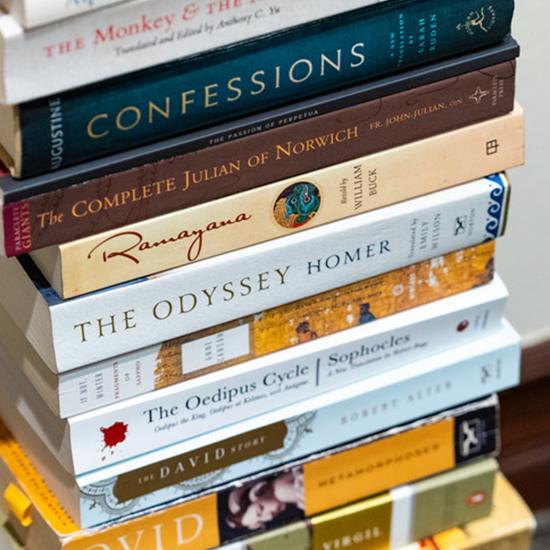
As Pepperdine's Great Books program celebrates its 40th anniversary, the University continues to breathe new life into an academic offering that has invited countless students to partake in the 3,000-year conversation among the most influential minds of the classical tradition. Today student opportunities are expanding through a variety of initiatives led by Jessica Hooten Wilson (’04), Fletcher Jones Chair of Great Books, and Paul Begin (’99), senior associate dean of Seaver College.
Yet in 1986, the Great Books program was still an idea of Michael Gose (MA ’75), current professor of teacher education at Pepperdine. As a field of study, Great Books was popularized by Mortimer J. Adler, American philosopher and educator based in Chicago, who visited Pepperdine in December of 1984 during former president Howard A. White’s tenure. Gose was so inspired by Adler’s talk that he galvanized the launch of a Great Books program at Seaver College.
Now Gose reflects on how the program continues to form the minds and hearts of students, inviting all to read and discuss seminal works of ancient Greek philosophy all the way to 20th-century fiction.
Q: In the 1980s Great Books programs were few and far between, with formally established programs at only a handful of universities nationwide. What made you so passionate about bringing a Great Books program to Pepperdine and its student body?
Gose: The Great Books are everybody’s inheritance. When I was hired in 1980—at the time Seaver College had only been around for eight years, founded in 1972—I realized we were getting brighter and brighter students, and we needed something to enhance the intellectual climate on campus for those students who were serious academics. At a place like Pepperdine, we wanted to encourage students’ educational and career aspirations and help determine what can lift them up. I knew encouraging the study of the Great Books would do that. It would lift them up to be even more competitive for their graduate school applications and their first jobs as well as forming them into the people they need to be.
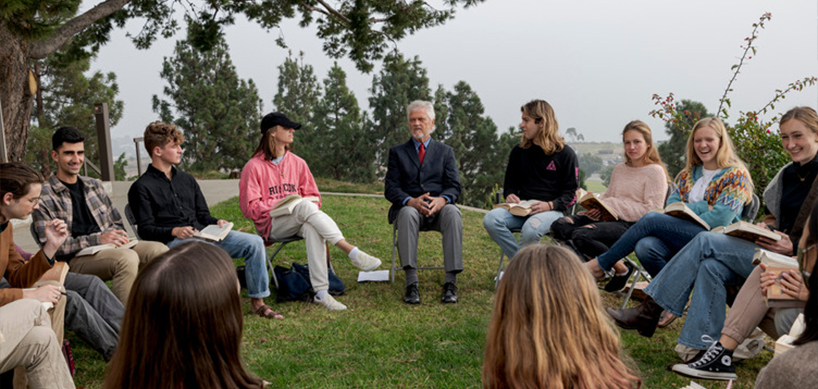 Gose (middle) teaching the Great Books at Pepperdine's Beaman Patio
Q: With an impressive 46-year tenure of teaching at Pepperdine, you have the unique perspective of witnessing your students walk through major life milestones beyond college. What were the very first cohort of Pepperdine Great Books students like and how have you seen the program grow?
Gose: I believe we had 60 students. I am still in contact with a lot of the students from my first class. All in all, one of the things that I am most pleased about is that I’ve had a student become a professor here at Pepperdine in every division except the Fine Arts.
The program has grown in number but our values remain. As Johann Wolfgang von Goethe, the German poet says, “He who cannot draw on 3,000 years of history is living from hand to mouth.” This emphasis of the program remains because the 3,000-year-old Great Conversation remains, and the works within have influenced one another.
I see an example of this Great Conversation in art with the statue of David in Florence. That statue is based upon Hebrew subject matter, sculpted in the Greek form, yet it was paid for by the Roman Catholic Church. So you have those traditions coming together to make one of the most astounding works of Western civilization.
Q: Pepperdine celebrates many successful alumni who have gone on to pursue an array of different careers, from tech company founder Dan Wright (‘06) to Catherine Illingworth (‘08), who is seeking cures for rare pediatric diseases. Both credit studying the Great Books with forming them into the purpose-driven individuals they are today. Why do you see the study of the Great Books as beneficial to any student, regardless of major?
Gose: What Great Books do is it puts students from all the divisions and all the majors in association with each other and allows them to feed off one another. I am absolutely positive that my most ambitious future lawyers developed that way because they were taking classes with the natural science, pre-med students.
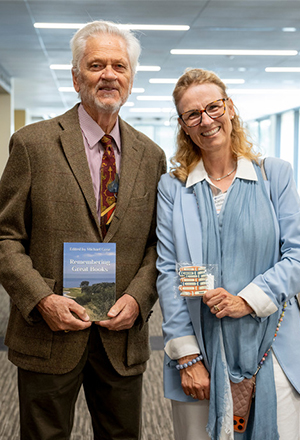 Gose (left) with his students' book, Remembering Great Books
Q: As a professor of teacher education, what is your approach to teaching a Great Books class? How does it differ from a lecture-based course?
Gose: I’ve studied Socrates a great deal in terms of his pedagogy. He’s interacting with those he’s talking with to seek truth, what one would call the dialectic. But Socrates was not always trying to use the dialectical approach—sometimes he was just trying to get students to look at things from a different perspective. So I really like that gadfly role of Socrates.
But I would take it one step further, to be in a different three-part kind of conversation. One of the key persons in the conversation is the actual text we are talking about. Thus, the conversation has three parts: the text, the teacher, the students. For instance, I just finished teaching Kant. We want to understand Kant on his own terms, and he’s a part of that conversation. So instead of specifically being in dialectical engagement, trying to understand the form of truth, we are also trying to understand Kant’s approach to seeking truth.
Q: What's one Great Book or classic text you'd want every incoming student to read?
Gose: The two books that are my favorite to teach are Martin Buber's I And Thou and Kierkegaard's Fear and Trembling.
Buber talks about God as being like the air you breathe. He says that you don't find God; God finds you, and where God finds you is in that “I Thou,” that special relationship between two individuals that transcends all other things.
According to Kierkegaard, because the individual is in absolute relationship with absolute [God], the individual is higher than the universal. The Great Books student is given the opportunity to figure out what all that would mean. But there's a big history for this belief, both biblically and with Calvin, with Bonhoeffer, with Kierkegaard, in terms of the sanctity of the individual, that I think is really worth considering.
Q: What does it feel like to have former Great Books students such as Jessica Hooten Wilson (’04) come back and carry the program forward into the next 40 years?
Gose: Like I said, it is incredible to look back and see that I’ve had a student become a professor here at Pepperdine in almost every division. And now this new student scholarship is an immense honor, as is my students' recent book publication. I've thought a lot about what emotion captures it—gratitude. Overall I am blessed.
Learn more about Pepperdine's Great Books program.
Subscribe to Wavelength
Pepperdine Newsroom's official newsletter for campus updates and top news.
Subscribe