Pepperdine and Prison Fellowship International Advance Landmark Global Study on Prison Program Efficacy

In 2023 Pepperdine University and Prison Fellowship International (PFI), in partnership with Colombia’s National Penitentiary and Prison Institute and Prison Fellowship Colombia, announced an unprecedented five-year study of prison programming in Colombia. Led by Pepperdine’s Center for Faith and the Common Good under the leadership of Byron Johnson, visiting professor in the School of Public Policy, the study was designed to evaluate the effectiveness of faith-based international prison programs in supporting rehabilitation, reducing recidivism, strengthening family relationships, and informing broader correctional reform.
More than three years into the study, Johnson and criminologist Sung Joon Jang, research fellow in the Center for Faith and the Common Good, have completed three initial rounds of research. By tracking thousands of incarcerated individuals and their families across multiple prisons and programs, the researchers are building an evidence base to identify effective approaches to rehabilitation and prison reform.
Three Research Efforts and Their Findings
The first research effort examined four major faith-based rehabilitation programs across 10 Colombian prisons, following 2,085 incarcerated individuals between November 2023 and September 2025. Findings showed that participation in one of these programs was associated with stronger religious engagement, more positive identity transformation, greater happiness and life satisfaction, and improvements in hope, empathy, forgiveness, and accountability. Researchers also found that lower negative emotions and greater resilience were associated with a reduced risk of interpersonal aggression, suggesting potential pathways through which these programs may support rehabilitation.
The second effort expanded beyond prison walls to examine three community-based programs supporting children and adolescents affected by parental incarceration: The Child’s Journey, Angel Tree, and Green Side. Among 902 young people across 10 research sites, findings showed that participation in these programs was associated with stronger religious beliefs and behaviors, improved emotional well-being, stronger family relationships and support, and a greater sense of meaning and purpose. The findings also suggest that these programs may diminish some of the challenges experienced by children of incarcerated parents, although results varied by program.
The third effort focused on two of Prison Fellowship Colombia’s restorative justice programs, Restorative Communities and Juvenile Restorative Justice, examining outcomes for offenders and victims. Researchers found that participation was associated with improvements in forgiveness, accountability, self-forgiveness, and social relationships among offenders. Victims also experienced gains in forgiveness, empathy, and accountability, alongside reductions in revenge motivations, avoidance, and negative emotional responses.
Together, the three research endeavors offer insights into how prison-based rehabilitation, community support and restorative justice programs may contribute to individual well-being, stronger family and social relationships, and more holistic approaches to correctional reform.
Institutional Impact on Pepperdine
By establishing an integrated database that connects correctional data with Individual-level outcomes, this landmark initiative enables Pepperdine scholars to generate actionable empirical data to inform national policy and correctional training globally. As Pepperdine president Jim Gash (JD ’93) noted at the Human Flourishing and Justice: Offender Rehabilitation and Restorative Prisons symposium, which discussed the research and partnership, the study serves as a leading example of how Christian higher education can collaborate with public and international leaders to address complex global challenges.
As the five-year evaluation continues, PFI's Centre of Excellence serves as the bridge between research and practice, transforming the study's findings into tools, training, and standards that can be implemented by prison ministries around the world. This process ensures that emerging evidence does not remain confined to academic literature but informs real-world prison reform efforts across more than 120 countries.
According to Andy Corley, PFI’s president and CEO, understanding how rehabilitation, safer prison environments, and stronger family relationships can help break cycles of incarceration is critical for practitioners, policymakers, correctional leaders, and faith communities around the world.
"Through our partnership with Pepperdine University, we are combining rigorous research with five decades of experience serving people in prison, families, and victims to better understand what contributes to lasting change,” said Corley. “Together, we are building a knowledge base that can strengthen restorative approaches to justice and help bring transformation to more lives and communities around the world."
Additional Prison Studies
In parallel with the global evaluations, Johnson’s research has extended to prisons in the US, particularly at Mississippi State Penitentiary (Parchman), and examines how moral rehabilitation and spiritual practices transform internal prison environments. Over the past four years, Johnson and co-investigator Andrew Johnson (no relation) have conducted extensive survey work, prisoner-led congregation observations, and hundreds of in-depth interviews across the seminary and facility.
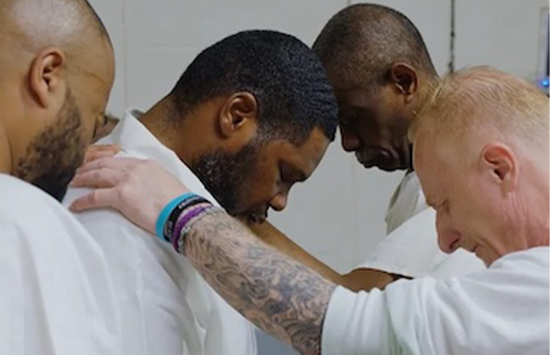 Incarcerated individuals participating in prison seminary program
As Byron Johnson reflects in a recent blog post, observing these dramatic personal transformations has deeply shaped the research team: "When you watch a man serving a life sentence lovingly take care of the physical and spiritual needs of dying men in the hospice unit, it is impossible not to be inspired . . . The men we get the honor to study minister to us in many profound ways."
The initiative centers around a prison seminary program that trains incarcerated individuals to become ordained field ministers and peer leaders. Through daily spiritual practices—including Bible study, prayer, group worship, and peer-to-peer counseling—participants experience identity transformation, more sociable behavior, and a renewed sense of purpose.
These qualitative and quantitative findings demonstrate a notable reduction in negative prison culture, such as gang activity and violence, while promoting human flourishing in high-security settings. To complement the peer-reviewed empirical findings, the team is also capturing the transformation on film to showcase how structured faith-based programming directly informs evidence-based standards for global correctional reform.
Learn more about the research and findings by visiting the Center for Faith and Common Good website.
Subscribe to Wavelength
Pepperdine Newsroom's official newsletter for campus updates and top news.
Subscribe