Pepperdine University Cohosts Global Dialogue in Geneva on Artificial Intelligence, Faith, and the Future of Peace
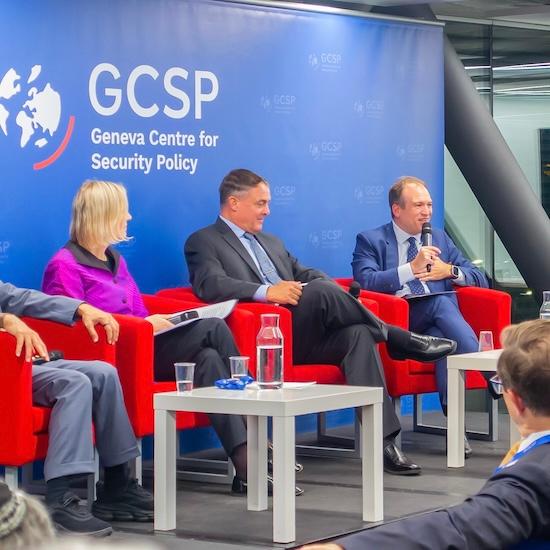
As artificial intelligence rapidly transforms societies, economies, and the global security landscape, questions about its responsible development and use have become increasingly urgent. Beyond its technological possibilities, AI presents profound questions about human responsibility, ethical leadership, and the future of international cooperation.
These questions were at the center of an international gathering held on Tuesday, November 10, 2026, cohosted by Pepperdine University, the Geneva Centre for Security Policy (GCSP), and the US Embassy in Bern, Switzerland, that brought together leaders and experts to consider the relationship between artificial intelligence, faith, and global peace.
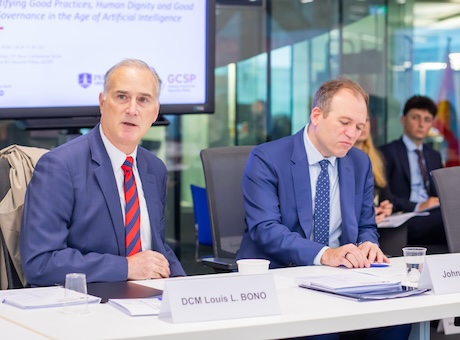 Led by Johnnie Moore, vice chancellor of Pepperdine’s Washington, DC, campus and managing director of
the Master of Middle East Policy Studies (MMEPS) program at Pepperdine’s School of Public Policy, the convening, held at the GCSP in Geneva,
explored AI through three interconnected lenses: AI for Good, AI for Bad, and AI for
Peace. Together these themes offered a framework for examining both the extraordinary
opportunities presented by emerging technologies and the risks they introduce to an
increasingly interconnected world.
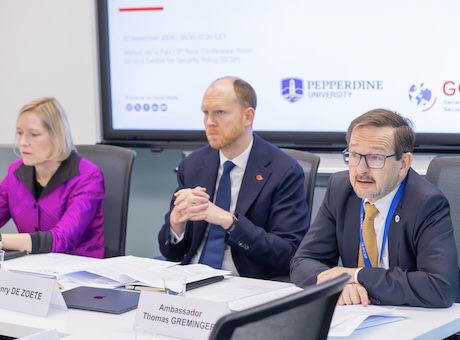
The gathering drew participation from across the international diplomatic, academic, corporate, and religious communities, including representatives of the Swiss Foreign Ministry, diplomatic missions from across Europe, the United Nations, Microsoft, and international religious leaders. Pepperdine faculty, including Caruso School of Law Professor of Law Chris Goodman, and students also took part, alongside Henry de Zoete, who led the United Kingdom's work on its inaugural AI summit and is now director of the UK's AI Security Institute.
Moderated by Christina Schori Liang, head of counterterrorism and preventing violent extremism at GCSP, the event opened with introductory remarks by Thomas Greminger, executive director of GCSP, and featured a panel comprising Moore; H.E. Ali Rashid Al Nuaimi, chair of the Defence, Interior, and Foreign Affairs Committee of the United Arab Emirates; and Mike Groen, senior advisor on defense policy at the American Security Fund, former director of the Joint Artificial Intelligence Center at the US Department of Defense, and founder and president of GroenTech LLC.
In his remarks Moore emphasized that technological advancement must be accompanied by wisdom and a clear understanding of human responsibility. “Intelligence may be easier to come by, but wisdom is more valuable than ever,” he said, underscoring the importance of bringing together perspectives from science, faith, and international affairs.
That conviction is reflected in Pepperdine's recent launch of the Institute for Wisdom and AI. Established in September, the institute brings scientists and religious leaders into conversation to explore the ethical, philosophical, and human questions raised by artificial intelligence. The initiative reflects the University's commitment to ensuring that the pursuit of technological innovation is accompanied by thoughtful consideration of its broader implications.
Drawing on the history of technological advancement, Moore recalled how Geneva helped the world respond to the humanitarian consequences of new weapons through the work of Henri Dunant and the first Geneva Convention. Moore also invoked Benjamin Franklin’s invention of the lightning rod as an example of how innovation can be guided by a sense of responsibility. Drawing a parallel to the challenges of artificial intelligence, Moore observed, “AI is our lightning, and the world is still deciding where to put the rods.” The connection was especially meaningful for Pepperdine as two lightning rods at the University's Château d’Hauteville campus in Switzerland were donated by Franklin himself generations ago.
The discussion began with the promise of AI for Good, considering how emerging technologies can serve humanity and contribute to meaningful progress. Moore urged participants to recognize the urgency of these opportunities, noting that delays in innovation can carry profound human costs. “Every day we are slow is a day a disease goes uncured, a humanitarian crisis goes unpredicted, and a child somewhere goes without a teacher,” he said.
From there, participants examined AI for Bad, addressing the potential for misuse, the implications for international security, and the ethical challenges that accompany increasingly powerful technologies. Moore cautioned that the risks extend beyond the technology itself: “The most dangerous target of AI may not be our machines at all. It may be our trust in one another.”
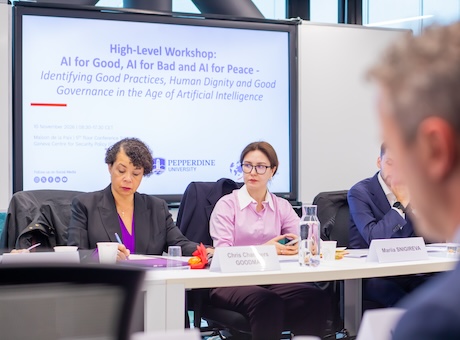
The conversation then turned to AI for Peace, considering how artificial intelligence might be leveraged to advance human dignity, strengthen diplomacy, and prevent conflict. Moore challenged participants to consider how AI could help match peacemakers with conflicts, equip mediators with the knowledge of past negotiations, and counter disinformation that threatens fragile agreements. He emphasized that these possibilities require urgency and human judgment in equal measure. “AI will be extraordinarily good at solving problems, but only people can decide what is worth doing and what must never be done,” he said. Peace, he reminded participants, is ultimately a human decision, shaped by the moral convictions and faith traditions of people around the world.
A distinctive dimension of the gathering was its emphasis on the role of faith and religious leadership in shaping conversations about technological advancement and global security. Moore observed that while religious convictions inform the moral decisions of much of the world’s population, religious leaders have largely been absent from formal international AI negotiations. He called for their inclusion alongside diplomats, military leaders, entrepreneurs, and engineers and argued that the questions raised by artificial intelligence demand both scientific inquiry and moral reflection. He noted, “You don't have to be religious to appreciate religious ideas as wisdom compounding through the centuries.”
For Pepperdine, whose educational mission is grounded in Christian values and a commitment to preparing students for lives of purpose, the conversation reflects the University's broader interest in engaging consequential global challenges through thoughtful dialogue and principled leadership.
Moore closed by recalling the final question attributed to Henri Dunant: “Where has humanity gone?” In an age of rapidly advancing artificial intelligence, he suggested, the question remains as urgent as ever—and the responsibility to provide a meaningful answer rests with the generations shaping the technology today.
Subscribe to Wavelength
Pepperdine Newsroom's official newsletter for campus updates and top news.
Subscribe