Pepperdine University Launches Institute for Wisdom and AI at Sixth Annual Human-Centered AI Conference
Pepperdine University today announced the launch of the Institute for Wisdom and AI, a new interdisciplinary initiative that will bring Christian thought and the University’s academic expertise to some of the most consequential questions surrounding artificial intelligence and its impact on human life.
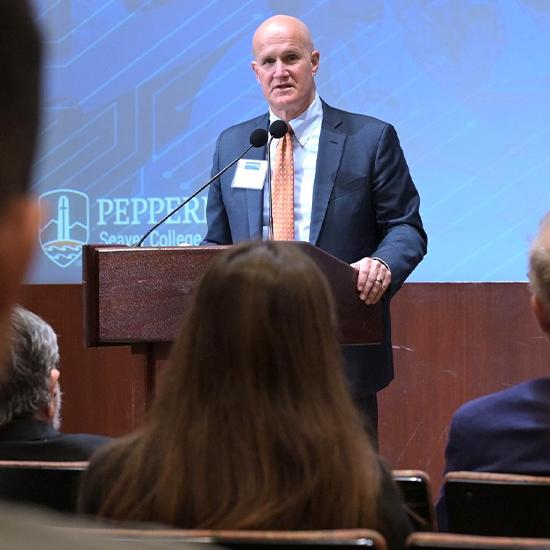
 President Jim Gash
Rooted in Pepperdine’s Christian mission, the institute will convene researchers, technology leaders, policymakers, and faith leaders to examine not only what artificial intelligence can do, but what it should do—and how its development can advance human flourishing.
Pepperdine University president Jim Gash (JD'93) announced the institute in his opening remarks at the University’s sixth annual Human-Centered AI Conference, held alongside the inaugural Global Summit on Faith in AI on the University's Malibu campus. The two-day gathering, co-chaired by Fabien Scalzo, director of Pepperdine's Keck Data Science Institute, and Johnnie Moore, vice chancellor of Pepperdine's Washington, DC, campus, convened Turing Award laureate Judea Pearl, Caltech's Katie Bouman, UK AI Security Institute director Henry de Zoete, and leading researchers from UCLA, USC, MIT, and Berkeley, together with Christian leaders from the Orthodox, Coptic, and evangelical communities and religious leaders representing the Jewish, Hindu, and Muslim communities.
"‘The next great division of humanity, Wendell Berry warned a quarter-century ago, will be between those who live as creatures and those who wish to live as machines," said Gash. "To be a creature is to be made by God, in His image, for relationship with Him and with one another. That is something artificial intelligence may attempt to imitate, but can never replicate. The question before us is how to keep living as creatures while our machines grow more powerful, and how to build this technology so that it deepens our humanity rather than diminishes it. Pepperdine has never been afraid of hard questions. Our Affirmation Statement says that ‘truth, having nothing to fear from investigation, should be pursued relentlessly in every discipline.’ The Institute for Wisdom and AI is that conviction applied to the defining question of our age."
The institute will be housed in Seaver College, Pepperdine’s residential undergraduate liberal arts college, with significant participation from the School of Public Policy, joining Pepperdine's scientific and technical strength in Malibu with its policy presence in Washington, DC, but its program will extend across the University's schools as its work grows. Its research agenda is also deliberately practical, taking up the questions Gash and others posed in their remarks, including how:
- AI can create economic opportunity rather than strip citizens of the dignity of work, and what a labor market looks like when entry-level white-collar jobs are automated;
- this technology is shaped by fundamental principles of democracy and human liberty, while limiting the influence and security risks posed by those who would restrict individual freedoms;
- AI can deliver breakthroughs in medicine and mental health while maintaining patient-centered care; and
- a university can put unprecedented computational power in the hands of students without hollowing out the critical thinking, deep reading, and moral formation that produce people of wisdom and virtue.
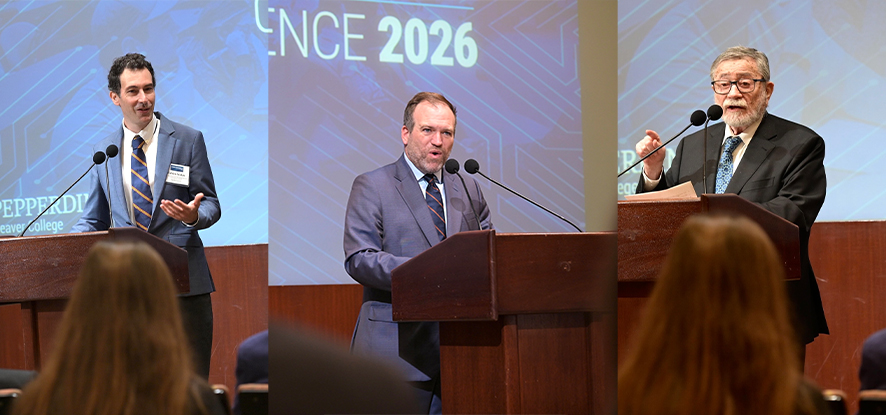 Conference Chairs Fabien Scalzo (left) and Johnnie Moore (center) and event speaker
Judea Pearl (right).
Conference Chairs Fabien Scalzo (left) and Johnnie Moore (center) and event speaker
Judea Pearl (right).
That work will proceed simultaneously on multiple fronts as contributions allow the institute to scale. The institute will convene the AI laboratories, policymakers, military and intelligence leaders, business executives, and religious leaders, and will bring the perspective of faith into rooms in Washington and Silicon Valley where decisions about this technology are made. When fully funded, it will support faculty and research fellows across business, law, public policy, psychology, and the sciences, producing applied research on AI's effects on employment, family life, education, and national security, alongside the deeper questions of alignment, agency, and human flourishing. And it will form students who graduate from Pepperdine fluent in the technology and equipped to lead with it in the marketplace, the classroom, the clinic, and the halls of government. The institute begins its work immediately, gathering each fall in Malibu and each year at one of Pepperdine's campuses elsewhere, in Washington, DC, Switzerland, Italy, Germany, the United Kingdom, Argentina, and Japan, with the first international convening planned for Geneva later this year.
"A Christian university offers a distinctive approach to the study of artificial intelligence," said Jay Brewster, provost of Pepperdine University. "The temptation is to treat AI purely as an engineering problem. However, this technology is already reaching deeply into all facets of society. To navigate the change that is coming requires an evaluation of important questions regarding personhood, human agency, and societal values as AI becomes more fully integrated into our lives. These are topics our universities have been exploring for centuries and our faculty scholars examine every day. The Institute for Wisdom and AI at Pepperdine will provide structured opportunities for bringing critical leaders together, for funding scholarly efforts around human-centered AI, and for adding a Christian university to this important conversation."
The launch builds on years of leadership by Scalzo, who established the Human-Centered AI Conference as one of the first academic gatherings in the country to put humanity, rather than technology alone, at the center of the AI conversation. Under his direction, the Keck Data Science Institute has produced a generation of Pepperdine graduates now working at the frontier of the field, including the University's first Rhodes Scholar, Sean Wu, who returned to campus this week as a panelist.
The institute launches with founding seed gifts and with relationships already in place at the frontier of the field. This year alone, Pepperdine leaders have met with executives at Anthropic and OpenAI on the development of artificial intelligence. The institute will grow through partnerships with AI laboratories, foundations, philanthropists, and religious institutions who share its conviction that the most consequential technology of our time must be built to serve humanity.
"We believe the development of AI can and must be oriented toward the true north of human flourishing,” said Gash. “That will take wisdom, and it will take courage, and Pepperdine intends to bring both."
Learn more about Pepperdine's approach to the future of technology and AI on the AI at Pepperdine website.
SUBSCRIBE TO THE WAVELENGTH
Pepperdine Newsroom's official newsletter for campus updates and top news.
Subscribe