Pepperdine University Hosts Sixth Annual Human-Centered AI Conference
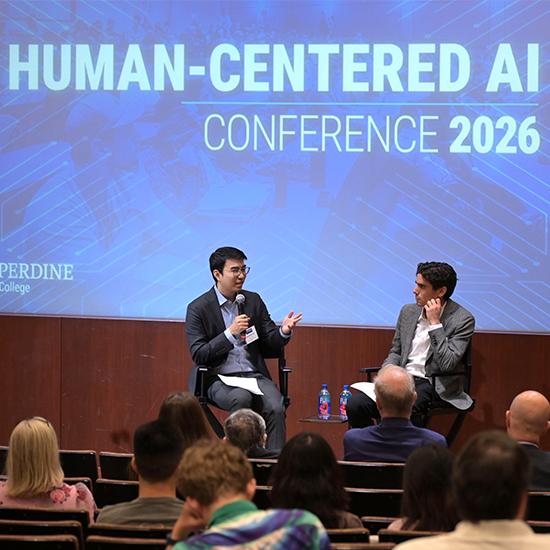
Pepperdine University hosted the sixth annual Human-Centered AI Conference from September 25–26 on its Malibu campus. Faculty, students, alumni, global faith leaders, and industry professionals convened to examine the ever-evolving impact of artificial intelligence and how to best steward this technology for the common good of humanity.
Led by conference chairs Fabien Scalzo, Pepperdine associate professor of computer science and director of the Keck Data Science Institute, and Johnnie Moore, Vice Chancellor Pepperdine's Washington, DC, campus and Managing Director of Middle East Studies, the two-day event featured keynote addresses, expert panels, and structured lectures examining AI through the lenses of robotics, neuroscience, ethics, creativity, and various traditions of world religions.
“This is a human-centered AI conference,” said Jim Gash (JD ’93), Pepperdine’s President and CEO, to open the event. “Those of us gathered here, though we may disagree on many things, share a fundamental conviction that artificial intelligence must serve humanity and not the other way around. We're not pursuing progress for its own sake. Computing for the sake of computing, power for the sake of power. We believe that our development of AI can and must always be oriented toward the true North of human flourishing.”
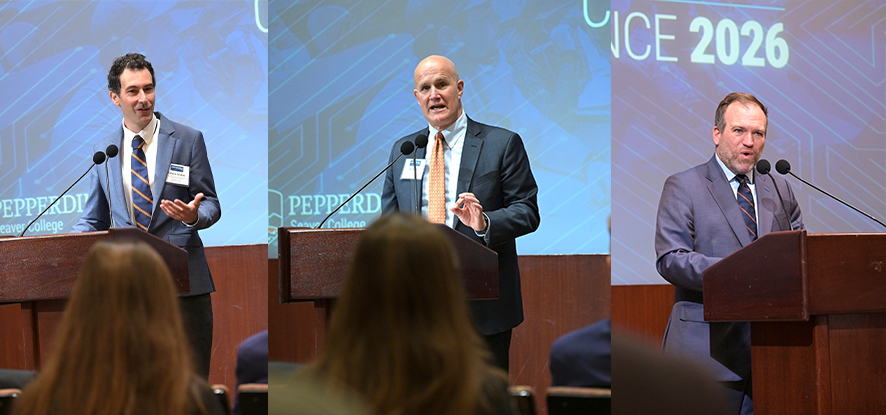 Conference Chairs Fabien Scalzo (left) and Johnnie Moore (right) and president Jim
Gash (JD ’93) (center).
Conference Chairs Fabien Scalzo (left) and Johnnie Moore (right) and president Jim
Gash (JD ’93) (center).
During the event’s proceedings Gash also announced the launch of the Institute for Wisdom and AI, a new interdisciplinary initiative that will bring Christian thought and the University’s academic expertise to some of the most consequential questions surrounding artificial intelligence and its impact on human life.
Scalzo reinforced Gash’s conviction that the technology of AI must be stewarded with wisdom and forethought. “AI is being created in our image,” Scalzo followed during his remarks. “It is the reflection of who we are. It is a multiplier; it is an amplifier; yes, it is a superpower that amplifies who you are. . . In my view, AI itself is neither good nor bad. Instead, it is a reflection of us. And that's why I believe it needs to be human-centric, because it starts with each of us.”
Within the broader conference was the inaugural Global Summit on Faith in AI, which brought together religious leaders and scholars from Christian, Jewish, Muslim, Hindu, and other faiths. Held that Friday morning and early afternoon, the summit delved into how centuries of human wisdom, tradition, theology, and religious practice can provide the moral compass for our approach to artificial intelligence.
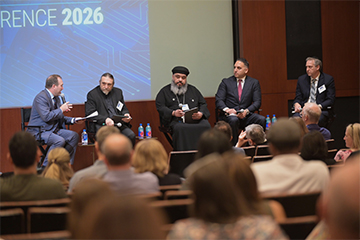 Global Summit on Faith and AI
Speakers included His Eminence Metropolitan Gerasimos of San Francisco, Rabbi Erez Sherman of Sinai Temple, Reverend Gregory-Telemachos Stamkopoulos representing His Eminence Archbishop Elpidophoros of America, Father George Kaldas representing the Coptic Orthodox Church, and Omar Qudrat of the Muslim Coalition for America.
“The danger of artificial intelligence is not that machines will become human; the danger is that we would slowly agree to become less than human,” said Gerasimos of San Francisco, speaking as a cohort member of the Inaugural Global Summit on Faith in AI. “[The danger is that] we will let a screen do our thinking, our remembering, our praying, our befriending. [The danger is ] that we will trade community for convenience, and no one will have forced us to do so. We will have chosen it. One small surrender at a time. The orthodox Christian answer to that danger is an old one. It is called Asisis, discipline.”
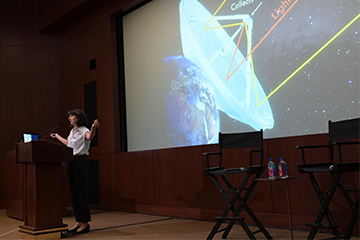 Bouman speaking about using machine learning in physics
Following the Global Summit on Faith in AI, the conversation shifted to the ways AI has already impacted medicine and broader scientific discovery. For instance, Jonathan Kao, associate professor of electrical and computer engineering at UCLA, examined how artificial intelligence is advancing neuroscience, including technologies designed to restore communication and movement for people with paralysis.
Following Kao’s address, in a session titled "Images of the Hidden Universe" Katie Bouman, professor of computing and mathematical sciences at the California Institute of Technology, discussed how physics and machine learning can help scientists reconstruct cosmic phenomena that cannot be observed directly. As an example, she referenced the Event Horizon Telescope’s work in producing the first direct image of a black hole.
Throughout the conference, faculty from universities across the country continued presentations on related research ranging from science to preserving creativity. A number of discussion panels also were held, including a Pepperdine Alumni Panel moderated by Dana Dudley, associate dean of special academic programs, which involved a pertinent discussion on AI and technology among Seaver College alumni Sean Wu, Sean Wu (’25), Pepperdine’s first Rhodes Scholar, Ulysse Saltiel (’25), who now works at Armada, a company bringing AI infrastructure to remote and industrial sites across the world, Sherry Guo (’15), a data scientist at Salesforce, and Katelin Gono (’23) who is now earning a master’s degree in global risk from John Hopkins University.
“Since graduating in 2023, the AI landscape has changed dramatically and continues to evolve at a pace that’s hard to keep up with,” remarked Gono. “I love that Pepperdine is creating a multidisciplinary space to wrestle with what these technological breakthroughs mean for our faith and ethics. I’m grateful to be an alum of such a thoughtful and forward thinking community.”
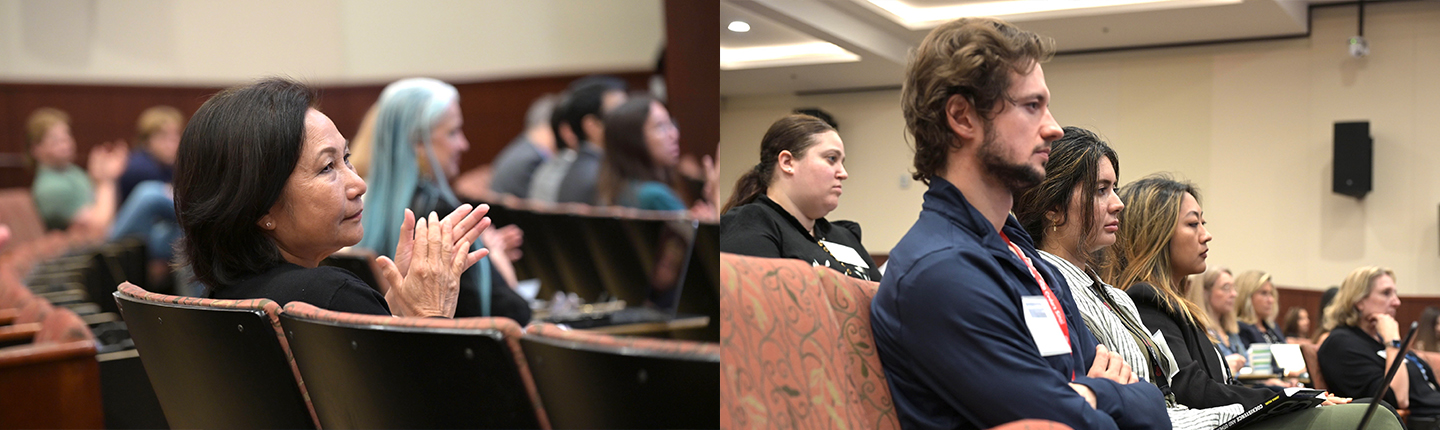 Summit attendees
On Saturday afternoon, the University announced the Waves Innovation Accelerator, a program created in partnership with Armada to give Pepperdine student entrepreneurs access to mentorship, industry connections, and investment.
For Pepperdine students and alumni, the conference provided a concerted opportunity to connect emerging technology with questions of vocation and ethics. For students like Rex Fisk, a junior majoring in finance at Seaver College, the conference offered a chance to learn directly from a broad scope of established researchers, entrepreneurs, and alumni spanning disciplines.
“Having attended the Human-Centered AI Conference, as well as previous technology and finance conferences at Pepperdine, I can say that each event has been integral to expanding my understanding of important topics,” said Fisk. “This emphasis on learning is especially apparent through alumni and professional speakers who have a passion for educating the younger generation about innovation. Hearing about the ways AI can promote a common good is not only intriguing but also useful in work and academic development.”
“I’m really excited that Pepperdine is continuing the tradition of the Human Centered AI conference,” added Wu following the event. “I think the University plays an interesting role regarding artificial intelligence. With these new tools, Pepperdine’s mission doesn’t change; it’s now our job to find a specific application of AI to serve the world.”
Photo Credit:
All images courtesy of Ron Hall, University photographer
SUBSCRIBE TO THE WAVELENGTH
Pepperdine Newsroom's official newsletter for campus updates and top news.
Subscribe