Pepperdine's 11th Annual Future of Healthcare Symposium Explores How AI is Transforming Healthcare Landscape
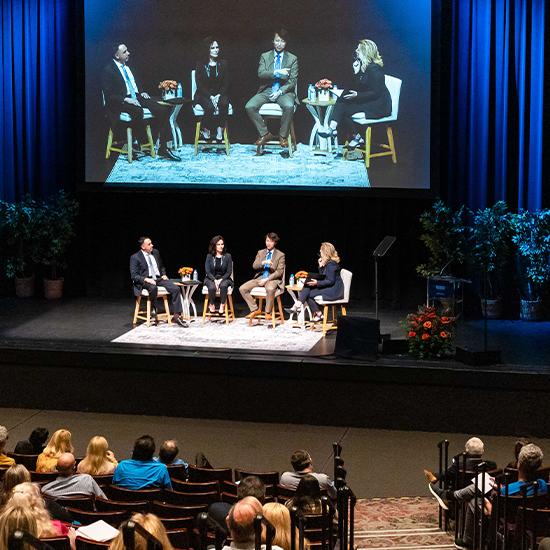
Pepperdine University’s 11th annual Future of Healthcare Symposium, themed “Advances in Technology and Healthcare: The Age of AI,” highlighted the transformative impact of AI on the healthcare industry. Showcasing Pepperdine’s commitment to shaping the future of healthcare through education, industry partnerships, real-world case work, and entrepreneurship, the event featured leading experts and thought leaders in both technology and healthcare. The symposium's vision, mission, and tone were set by President Jim Gash (JD '93) as he welcomed attendees to Smothers Theatre on Thursday, March 12. Gash expressed deep pride in the platform Pepperdine is providing to advance the event’s important and meaningful conversations.
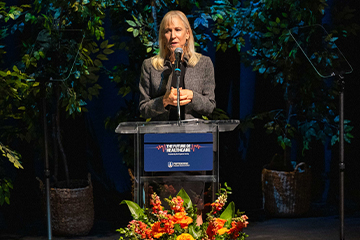 Dean Deborah Crown
“Few topics carry more weight and more promise than the one that's bringing us together today, advances in technology and healthcare," said Gash. "The Age of AI—we are living through a genuine inflection point, a moment in which artificial intelligence, data analytics, robotics, and digital health tools are not only simply improving healthcare, but redefining what we think healthcare can be.”
Following Gash’s remarks, Deborah Crown, dean of Pepperdine Graziadio Business School, emphasized how the graduate school is positioning itself at the intersection of healthcare, business, and AI-driven leadership. By fostering such conversations, she noted, the school furthers awareness of the tools and innovations emerging from the integration of healthcare and AI and how they are impacting relationships, care, and purpose.
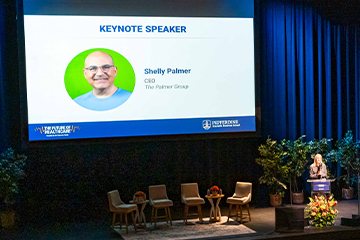 Shelly Palmer's virtual keynote address
“We are at a pivotal moment in history. We aren't just witnessing a change in technology. We are witnessing a change in the fabric of how we interact and care for one another, how we live our lives with greater purpose,” said Crown.
John Figueroa (MBA ’97), the founding benefactor of the Future of Healthcare Symposium, prerecorded a special message for attendees. He commemorated 11 years of the gathering and observed how AI has rapidly moved from concept to concrete impact in healthcare, underscoring that ethical, visionary leadership is what will ultimately determine how this powerful technology shapes the future of this field.
"When we started this symposium, we wanted to make sure that the Pepperdine Graziadio School had speakers and dialogue on where healthcare was going,” said Figueroa. “And I'm proud to say that after 11 years, we've accomplished that task, and we have remarkable speakers, remarkable policy change, and remarkable things that we have done in our school impacting healthcare.”
Shelly Palmer, chief executive officer of the Palmer Group, a technological strategy and solutions firm, then gave the keynote address, in which he provided a deep dive into the current and future state of AI. He examined its rapid trajectory, noting that while today’s large language models are powerful, they remain limited in their ability to transfer knowledge across domains. He described the accelerating push toward Artificial General Intelligence (AGI)—and eventually Artificial Superintelligence (ASI)—driven by unprecedented government and private investment, with capabilities advancing so quickly that breakthroughs from just months ago can already feel outdated. Palmer distinguished between models, which provide raw intelligence; systems, which integrate models with data, tools, and policies; and agents, which enable systems to autonomously execute complex tasks through coordinated workflows.
He emphasized that the primary challenge ahead is no longer technical, but cultural and organizational, as leaders must learn to manage human–AI partnerships and oversee AI agents functioning as “synthetic employees.” "Technical debt is not the issue, cultural debt is the issue. How do you lead in this environment?" asked Palmer. "This becomes completely a leadership challenge and in no way a technical challenge.”
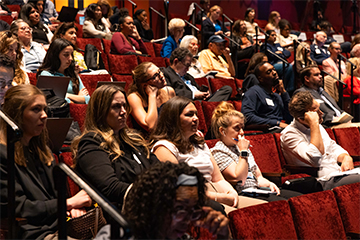 Audience at Healthcare Symposium
Regarding healthcare, he expressed optimism about AI’s potential to transform vast clinical and sensor data into actionable insights and expand personalized, continuous care, while stressing that ethics, governance, and human leadership will ultimately determine whether these tools improve patient outcomes. Palmer concluded by encouraging leaders to actively engage with emerging AI tools themselves and position themselves as architects of the future rather than passive consumers.
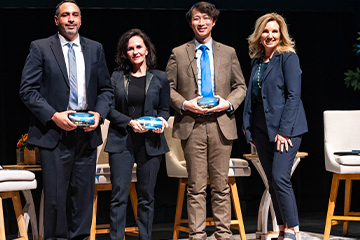 Healthcare panelists
"It's going to require leaders that have the vision," said Palmer. "It's going to require leaders that have integrity with an ethical standard that manages all of these changes.”
Moderated by Amy Towner (MBA '18, PKE 139), chief executive officer of the Health Care Foundation for Ventura County, the symposium concluded with a panel discussion featuring healthcare experts Peter Eskander, director of supply chain end-to-end digital transformation at Amgen; Shawn Lin, medical director at the University of California, Los Angeles Health-Calabasas Stein Eye Center and associate program director at UCLA Health-Ophthalmology Residency Division of Cataract and Refractive Surgery; and Billie Jo Nutter, operating partner at HCAP Partners and advisory board member of Neurosteer.
The panelists explored how AI can move from technological breakthroughs to meaningful improvements in patient care. They emphasized that AI’s true value lies in operational impact, from improving supply chains and clinical workflows to integrating fragmented healthcare data through interoperability standards. While investors and health system leaders remain optimistic, success depends on disciplined implementation, strong governance, and building trust among clinicians and patients. The discussion also stressed how AI can be used to restore physician agency rather than simply increasing efficiency. The panelists agreed with Palmer that the future of healthcare will depend on leaders who can thoughtfully integrate AI into systems of care while maintaining strong human judgment, ethical oversight, and patient-centered values.
For more on Pepperdine's annual healthcare symposium, visit the Future of Healthcare Symposium website.
SUBSCRIBE TO THE WAVELENGTH
Pepperdine Newsroom's official newsletter for campus updates and top news.
Subscribe